Is there life beyond Earth? For years, scientists have argued that it’s very likely that we are not alone in this vast Universe.
Pointing to the number of potentially habitable planets, the abundance of life’s elemental building blocks and the sheer age and size of the cosmos, it seems impossible that life couldn’t exist elsewhere.
Even so, we have yet to see any sign of life beyond our Blue Planet.
The search for extraterrestrial intelligence (SETI), however, is ongoing and has captured the imagination of the general public.
One non-profit organisation, the SETI Institute, is at its forefront, bringing together scientists from different disciplines to understand the origins and potential existence of life in our Universe.
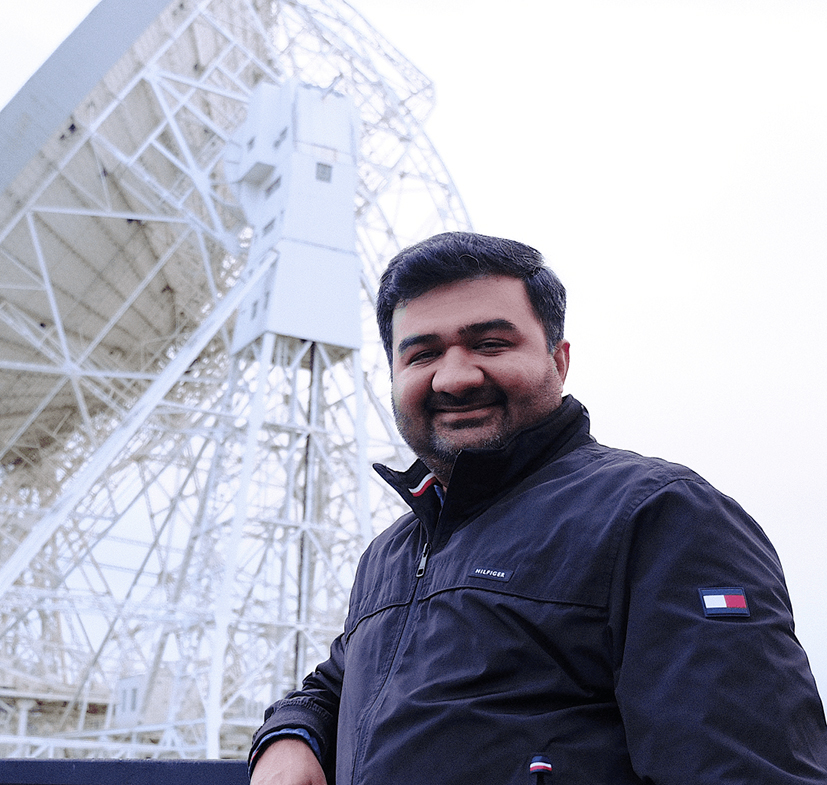
Some of those scientists, like Dr Vishal Gajjar, are actively searching for life, looking for its signals all across the Milky Way.
We sat down with him to talk about how he searches for signatures of technology from alien civilisations.
What kind of signatures are you searching for from aliens?
I am looking for evidence of technosignatures, the signs of a more technologically advanced lifeform.
We don’t consider ourselves separate from people looking for biological activity of any kind, but instead as a kind of extension to that process.
While the search for biological signatures can begin in the nearby Solar System, when you’re looking for more advanced life, that allows you to search a much bigger region of space.
What is a technosignature and how would you detect one?
Technosignatures are signals that, as far as we’re aware, don’t occur naturally. These include signals that have a really narrow frequency, like single tones.
We don’t know any natural processes that produce such signals.
If we detect something like this, we infer there’s a high chance it was produced by technologically advanced life.
There are other classes of technosignatures too. The SETI@Home project, for example, looked for radio signals that are pulsating with some sort of defined pattern, which could correspond to information transfer.
But we’re still limited in our imagination of what types of technosignature to search for, because we are bounded by human ingenuity and our current technological capabilities.
We expect that an extraterrestrial society producing these signals might be far more technologically advanced than we are.
Their communications might be completely different, or they might use a technology we don’t even know about yet.
All the same, if they are using radio waves, we can still search for a coherent signal.

What is the SETI Institute and what is it trying to do?
The SETI Institute is really a large umbrella under which scientists consider all aspects of the search for life.
There is a famous equation in science called the Drake equation, which multiplies together many factors to work out how likely it is that intelligent life exists elsewhere in the Universe.
They’re things like: How many stars are there in the Milky Way? How many of those stars have a planet around them? How many of those planets will be like Earth?
How many could have intelligent life? How many of them will we ever be able to detect a signal from?
Taken as a whole, the Drake equation is a very complex problem that touches on everything from astrobiology to fundamental physics.
The SETI Institute is where we dig down into every individual factor of that equation.
How do you search for technosignatures?
We use radio telescopes to scan the skies for radio signatures and target different kinds of sources.
We look at different stars and different parts of the Milky Way, and run searches for different types of signals.
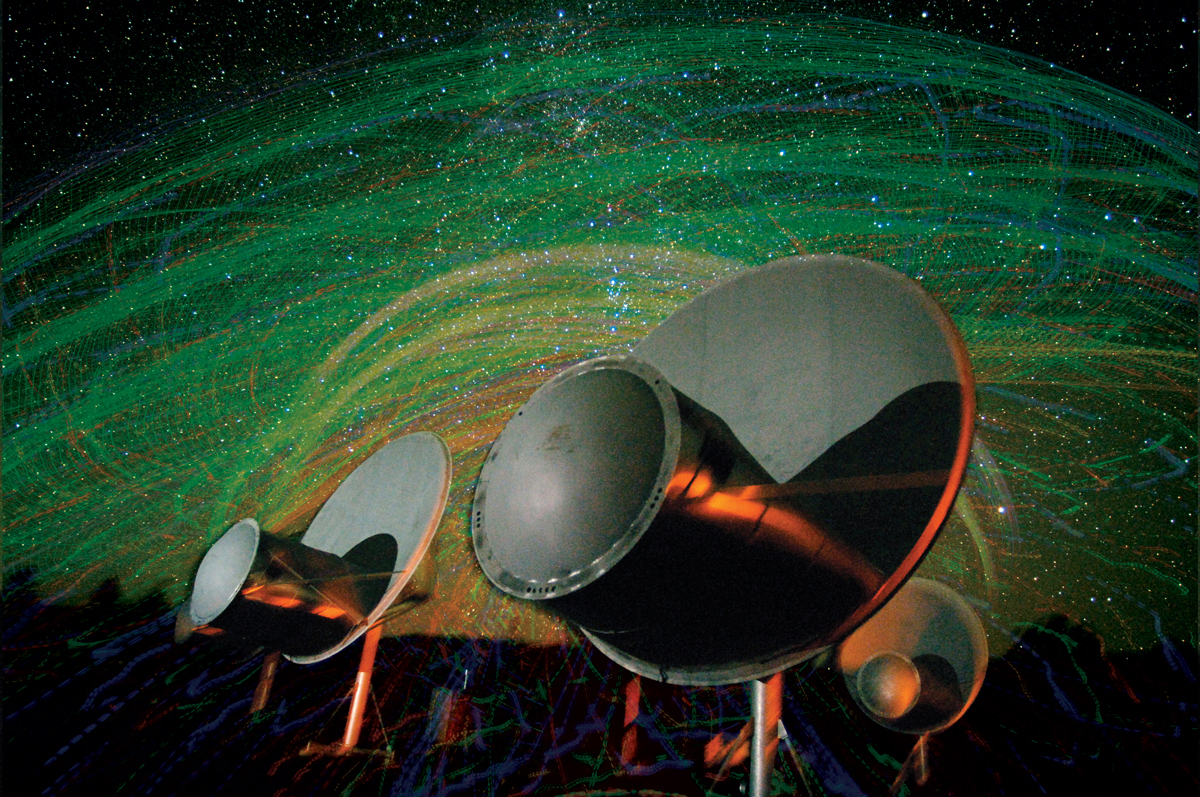
The SETI Institute also has its own radio telescope in California called the Allen Telescope Array.
It has 42, 6.1-metre (20ft) antennas spread over a 300-metre (1,000ft) area or thereabouts.
How likely is it that these advanced civilisations you’re looking for exist?
We’ve learned recently that the basic building blocks of life are everywhere throughout the Universe.
On the asteroid Bennu, we found the basic amino acids that make up DNA. That’s why I’m very optimistic that there has to be other life out there.
We don’t know exactly how life started, and so the question of whether life originated here or arrived from elsewhere is fundamental.
What we can say is this: if the building blocks of life are present everywhere and you imagine all the Earth-like planets that exist in the habitable zones around stars in the Universe, then you would expect that in some cases you end up with the same result as on Earth.
The chances that we are the first life to arise are quite low.

If life is likely to arise, why haven’t we detected it?
Partly, it is just a limitation of our technology. In the grand scheme of the Universe, humans are a very young species.
We started searching for alien life in earnest around 60 years ago, which is a blink of the eye in cosmic terms. Our current technology is still expanding.
We don’t yet know exactly what kind of signals to search for, and we haven’t really searched for signals that we can’t identify.
This is becoming possible now: with advanced computer processors that allow us to sift through high volumes of data, we can look for signals we couldn’t easily find before.
The idea of a ‘great silence’ so far doesn’t mean there’s no life out there: what it does mean is that the likelihood of us finding it isn’t as high as we initially anticipated.
I consider the ‘great silence’ a limitation of our search strategies, not a fundamental law that says the Universe is silent.
What was the SETI@Home project?
SETI@Home was a visionary citizen science programme that began in 1999 and wrapped up in 2020, though scientists are still working with its results.
When you’re searching for a wide variety of signals, you need to look through raw data.
For SETI, there was a huge volume of this raw data, and we didn’t have the computing power to process it easily, creating a huge bottleneck for the research.
The idea that the SETI Institute came up with was to use the public to help process the data.
Desktop computers were very widespread and people were running screensavers on them when they weren’t being used.
Instead, SETI@Home used that downtime of the public’s computers to process this raw data.
The data was broken up into chunks and distributed to people who’d signed up, and their desktops would automatically process it and send it back.
Overall, they had millions of participants. In India, when I was at college, I downloaded the software myself.
It gave people who weren’t scientists the idea that they could contribute to the search for alien life and they got really excited about it.
SETI@Home became one of the first times distributed computing was used successfully, and was the trigger for many important citizen science programmes, like the University of Oxford’s Zooniverse, which is still running today across many areas; for astronomy alone there are more than 20 live projects.

What has SETI discovered that’s interesting so far?
The SETI effort has been going for many decades and it’s not just been about the final outcome – finding extraterrestrial intelligence – but what we’ve changed on the path to that outcome.
There have been a number of scientific advances associated with SETI to date.
The high-speed digitisation that’s widely used at radio telescopes is all because of SETI.
This was the first technique used to take in high volumes of data for processing, and that finds important applications all across radio astronomy today.
As well as advancing the technology, we’ve also made scientific discoveries like finding a fast radio burst at the highest radio frequency, and an intriguing signal from Proxima Centauri, that we later ruled out [as coming from ET].
Recently, we found a pulsar candidate at the Galactic Centre as part of the Breakthrough Listen Survey.
Right now, we are implementing AI-based searches to isolate interesting signals faster.
How can people get involved in the search for extraterrestrial intelligence?
There’s a sense of hope that comes with the search. If you’re curious about questions like, “Are we alone in the Universe?” or, “Is there life out there?” there are places you can go and feed that curiosity.
SETI has active research programmes for younger students, undergraduates and citizen scientists, and I’d encourage people to get involved in the search.