
There are a few ways to look for signs of alien life beyond Earth.
Scientists can send robotic probes to the planets and moons of our Solar System searching for biological evidence that life exists – or could exist – within our own cosmic neighbourhood.
Beyond our Solar System, the study of distant exoplanets can reveal what sort of chemicals are in their atmosphere, including any biosignatures that might indicate biological activity.
More on alien life

Scientists can even search for technosignatures, signals from technology developed by any intelligent species that happen to be residing within our Galaxy.
The same, then, is true for us. Planet Earth could be giving out its own signals, which could in turn be detected by distant astronomers on an alien planet.

Flight to Earth now boarding
Research shows that the radar systems used by civilian and military airports on Earth could be revealing our existence to any advanced alien civilisations that happen to be looking.
A study looked at 'hidden electromagnetic leakage' and how that might be detected by an alien species up to 200 lightyears from Earth.
That is, provided they had radio telescopes of the kind we've built on our own planet.

The scientists behind the study say international airports like London's Heathrow and Gatwick, and New York’s JFK International Airport, could give alien astronomers an inkling that our bright blue planet hosts life.
They simulated how radar signals produced by airports spread out from Earth over time and space.
The study then looked at how visible such signals would be when seen from nearby stars like Barnard's Star and AU Microscopii.
And the idea is not completely out-there. Barnard's Star is known to have a rocky exoplanet, known as Barnard b, orbiting it.

How Earth gives off signals
The study reveals that airport radar systems send out a combined radio signal of 2x10¹⁵ watts.
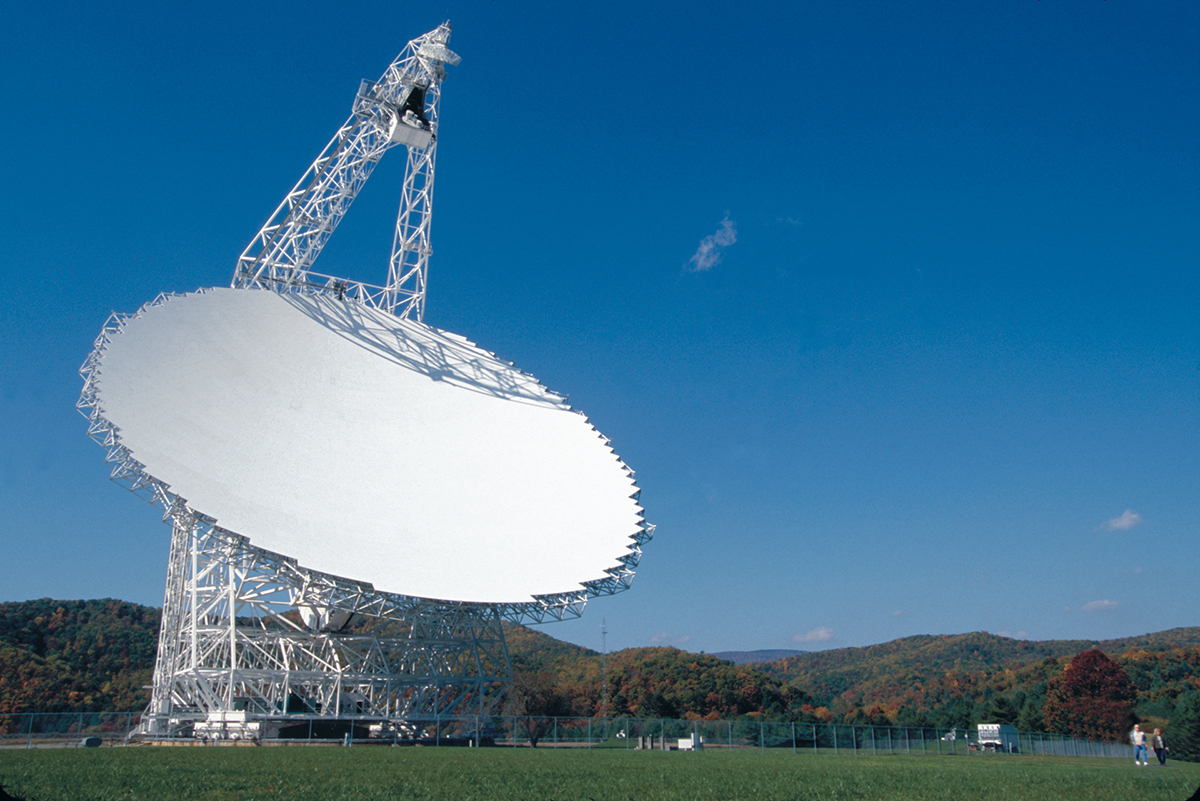
That's enough, the study authors say, to be detected up to 200 lightyears away by alien telescopes with an observing power equal to our own Green Bank Telescope in West Virginia, USA.
The nearest potentially habitable planet beyond our Solar System is Proxima Centauri b, just 4 lightyears away.
Military radar systems have an accumulated peak emission reaching about 1x10¹⁴ watts.
This would look "clearly artificial to anyone watching from interstellar distances with powerful radio telescopes," says lead researcher Ramiro Caisse Saide at the University of Manchester, UK.
"In fact, these military signals can appear up to a hundred times stronger from certain points in space, depending on where an observer is located."
"Our findings suggest that radar signals – produced unintentionally by any planet with advanced technology and complex aviation system – could act as a universal sign of intelligent life."
Looking outwards
The study can tell us a lot about how Earth might appear to aliens scanning the sky for signs of life, but there are other implications, too.
Ramiro Caisse Saide says the study helps us understanding of how human technology may be seen from space.
"By learning how our signals travel through space, we gain valuable insights into how to protect the radio spectrum for communications and design future radar systems," says co-researcher Professor Michael Garrett, also of the University of Manchester in the UK.
"The methods developed for modelling and detecting these weak signals can also be used in astronomy, planetary defence, and even in monitoring the impact of human technology on our space environment."
Caisse Saide adds: "In this way, our work supports both the scientific quest to answer the question 'Are we alone?' and practical efforts to manage the influence of technology on our world and beyond."

