
Astronomers using the Hubble Space Telescope have identified an entirely new kind of object in the Universe.
This strange object is a starless, gas-rich cloud that's dominated by dark matter, and is thought to be a remnant left over from the earliest days of galaxy formation, near the dawn of the cosmos.
It's called Cloud-9, and this is the first confirmed detection of a long-predicted but never-seen type of cosmic relic.
Scientists are saying the discovery is giving them a rare glimpse into how galaxies form – and how they sometimes fail to form – while opening a new window onto the elusive nature of dark matter.

A relic from the Universe’s earliest era
"This is a tale of a failed galaxy," says Alejandro Benitez-Llambay of the Milano-Bicocca University in Milan, Italy, and the programme’s principal investigator.
"In science, we usually learn more from the failures than from the successes. In this case, seeing no stars is what proves the theory right. It tells us that we have found in the local Universe a primordial building block of a galaxy that hasn’t formed."
The object belongs to a theoretical class known as Reionization-Limited H I Clouds, or RELHICs.
These are clouds whose cores are composed of neutral hydrogen and which formed early in the timeline of the cosmos, but which never accumulated enough material to ignite star formation.
Until now, they existed only in theory.

A view into the dark Universe
Cloud-9 appears to be heavily dominated by dark matter, offering scientists a rare opportunity to observe the effects of dark matter without the interfering glare of stars and galaxies.
Dark matter is an invisible, undetectable substance that acts like an unseen gravitational glue, holding galaxies together.
It cannot be directly detected, but it's thought to be the solution to the problem of why galaxies don't tear themselves apart as they rapidly rotate.
"This cloud is a window into the dark Universe," says team member Andrew Fox of AURA/STScI for the European Space Agency.
"We know from theory that most of the mass in the Universe is expected to be dark matter, but it’s difficult to detect this dark material because it doesn’t emit light. Cloud-9 gives us a rare look at a dark-matter-dominated cloud."
How Hubble caught the cloud
Before the discovery, astronomers say they couldn't rule out the possibility that Cloud-9 was simply a very faint dwarf galaxy.
"Before we used Hubble, you could argue that this is a faint dwarf galaxy that we could not see with ground-based telescopes. They just didn’t go deep enough in sensitivity to uncover stars," says lead author Gagandeep Anand of STScI.
"But with Hubble’s Advanced Camera for Surveys, we’re able to nail down that there’s nothing there."
In short, Hubble’s deep sensitivity confirmed that Cloud-9 contains no stars at all, making this odd curiosity a huge discovery.
More Hubble science
Why Cloud-9 is so strange
Astronomers have studied hydrogen clouds near the Milky Way for decades, but Cloud-9 is of particular interest.
It's smaller and more compact than typical hydrogen clouds. It's also highly spherical, unlike the irregular shapes usually observed.
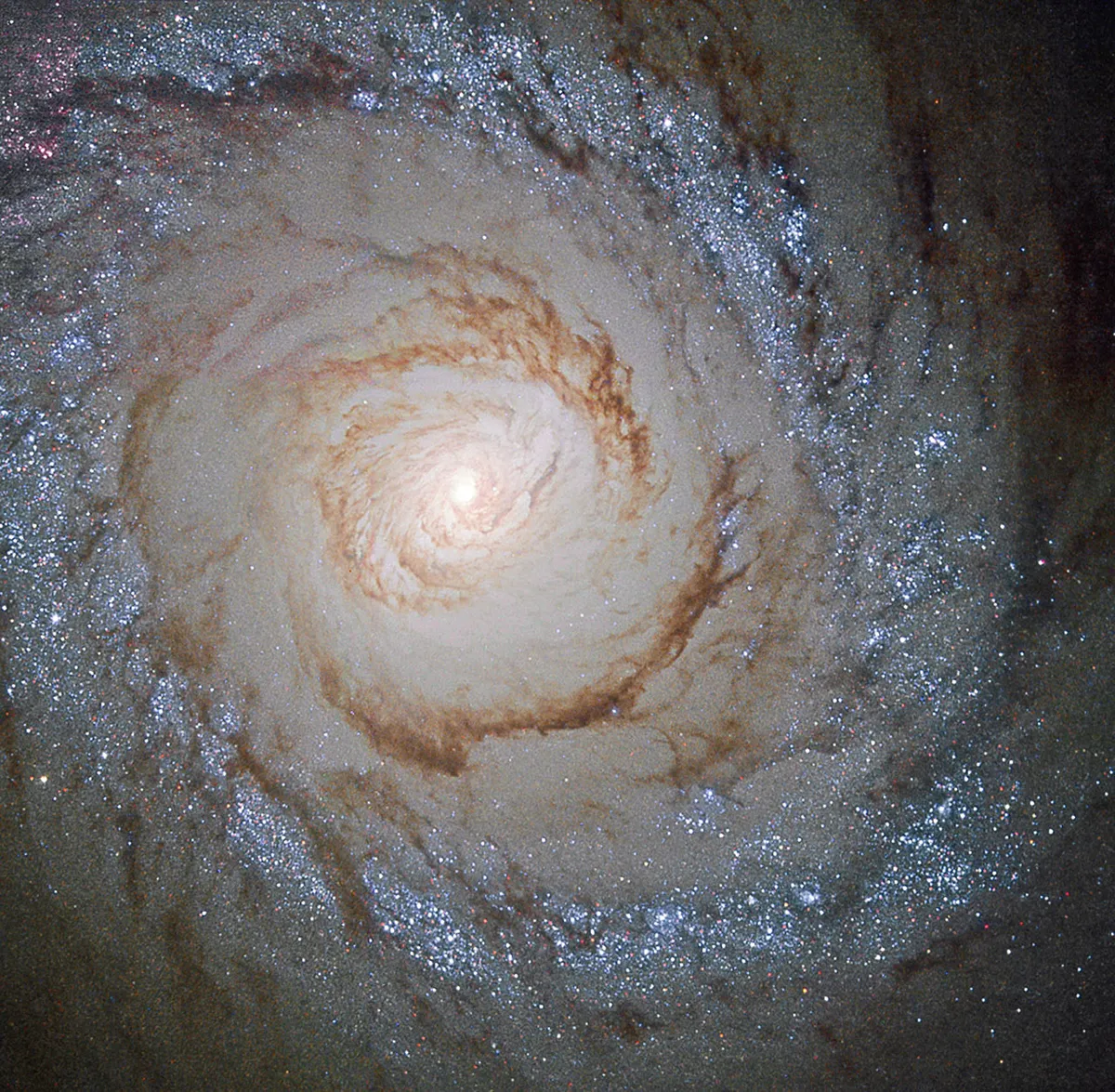
The object is named Cloud-9 because it's the ninth gas cloud discovered on the outskirts of a nearby spiral galaxy known as Messier 94.
The team say the cloud is close to M94 and seems to have a physical association with the galaxy.
For example, high-resolution radio data is showing distortions in gas that could mean Cloud-9 is interacting with the galaxy.
The cloud’s core spans about 4,900 lightyears and contains hydrogen gas to the tune of about one million times the mass of our Sun.
The total mass of the cloud is thought to be about 5 billion times the mass of the Sun, meaning it's overwhelmingly dominated by dark matter.
A galaxy that almost was?
The team say RELHICs like Cloud 9 represent a 'sweet spot' in cosmic evolution.
If Cloud-9 were more massive, it would have collapsed and formed stars, becoming a regular galaxy. But if it were smaller, its gas would have dispersed long ago.
The cloud may still form a galaxy someday, however, if it gains more mass.
How Cloud-9 was found
Cloud-9 was first detected three years ago during a radio survey by China’s Five-hundred-meter Aperture Spherical Telescope (FAST).
Follow-up observations with the Green Bank Telescope and the Very Large Array observatories in the USA confirmed the presence of gas.
Hubble was key to showing that Cloud-9 contains no stars, cementing its status as a true failed galaxy.
A key problem im detecting these objects is because they appear so faint compared to nearby stars and galaxies.
And they're frail, vulnerable to destructive cosmic phenomena that can strip them of their gas as they travel through space.
The discovery of Cloud-9 suggests many more dark, starless relics may be waiting to be found, offering new opportunities to probe early galaxy formation and the physics of dark matter.

