Astronomers have peered back into the early Universe to a time shortly after the Big Bang and discovered an enormous, gargantuan cosmic structure taking shape.
Located in a region observed by the astronomers when the Universe was only 2.1 billion years old, the newly discovered object, known as COSMOS-z3.1-A, is the earliest and most distant proto-supercluster of galaxies ever detected.
The team behind the study are calling it the ancestor of a giant 'cluster of clusters' and it measures about 5,000 times the mass of our own Milky Way Galaxy.
What's more, the ancient cosmic behemoth is giving space scientists unique view of how the largest sturctures in our Universe were formed.
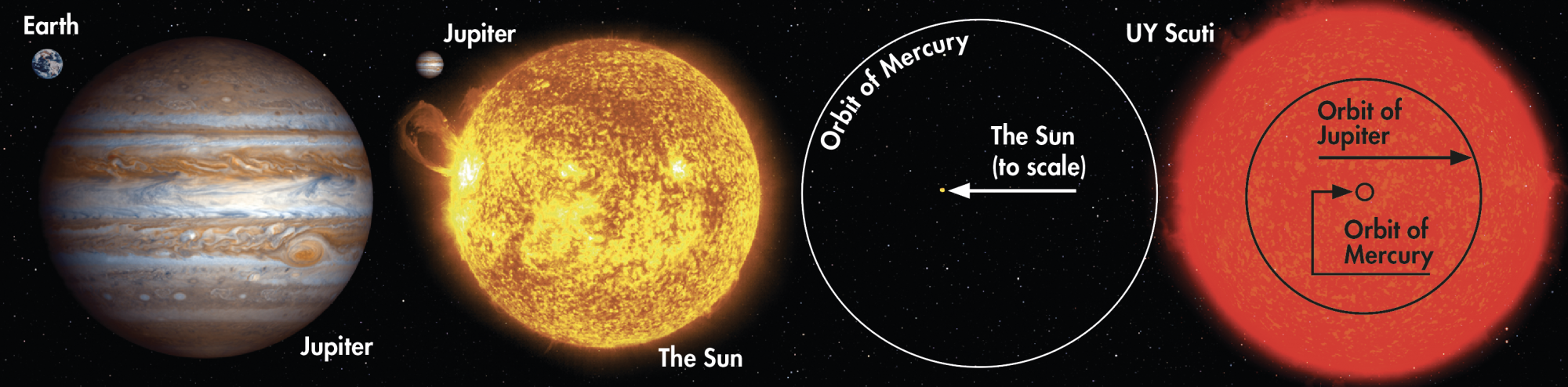
More cosmic enormities
Hunting for cosmic giants in the early Universe
Light from distant objects takes time to travel across the cosmos. The distances to some of the furthest objects are so enormous, even light itself takes billions of years to make its to our telescopes.
That's why astronomers measure distances in lightyears – i.e. the number of years it had taken light to get from a celestial object to our retinas.
And as that light travels across the Universe, it's stretched by the Universe's expansion towards the red end of the light spectrum.
Astronomers call this 'redshift' and the distance of extremely far-away objects is often described in redshift, denoted by the letter z.
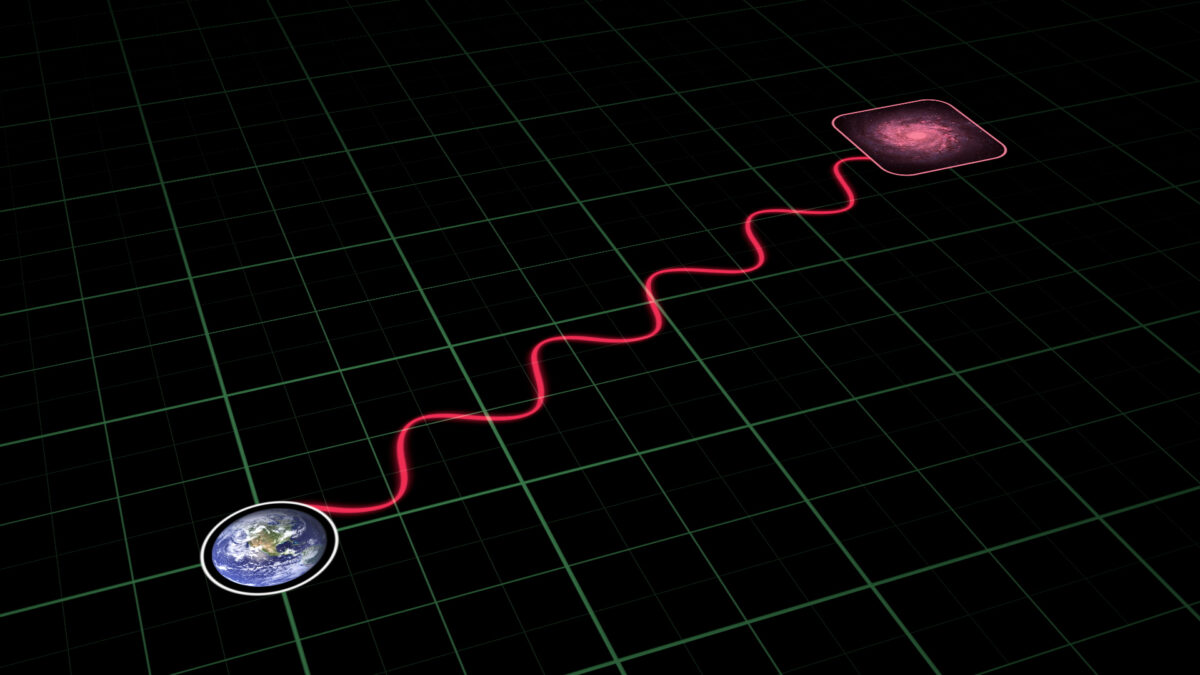
As a result of these enormous cosmic distances, when astronomers look at really far-away galaxies and galaxy clusters, they're seeing them as they existed when light from those objects began its journey billions of years ago.
In other words, they're looking back in time.
Galaxy clusters are the heavyweights of the cosmos. These massive, gravitationally-bound assemblies feature hundreds to thousands of galaxies held together by vast concentrations of invisible dark matter.
Nearby clusters we see today are mature and much more settled.
But looking back in time, astronomers see much younger galaxy clusters that existed when the Universe was between 1 and 3 billion years old.
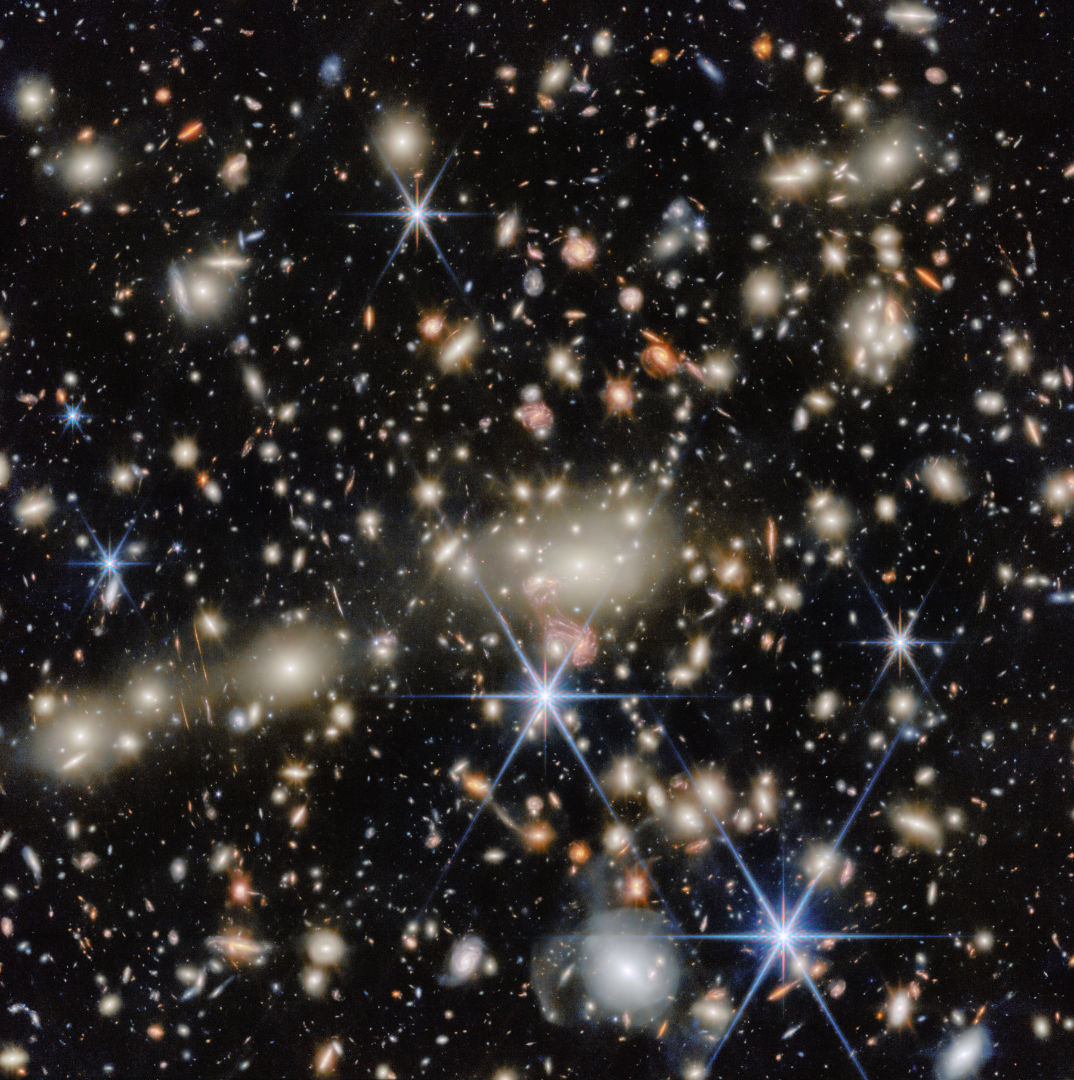
These are protoclusters: loose, chaotic groupings of galaxies still in the process of merging together.
To understand how these cosmic megastructures grew, a team led by Vandana Ramakrishnan, a doctoral researcher at Purdue University in Indiana, USA at the time of the study, began a deep-space survey.
"With this project, we’re hoping to understand the growth of massive structures in the Universe and how they influence the evolution of galaxies within them," says Ramakrishnan.
"We also hope to get a better sense of how these protoclusters are connected to the larger cosmic web."
From 2D images to a 3D deep-space map
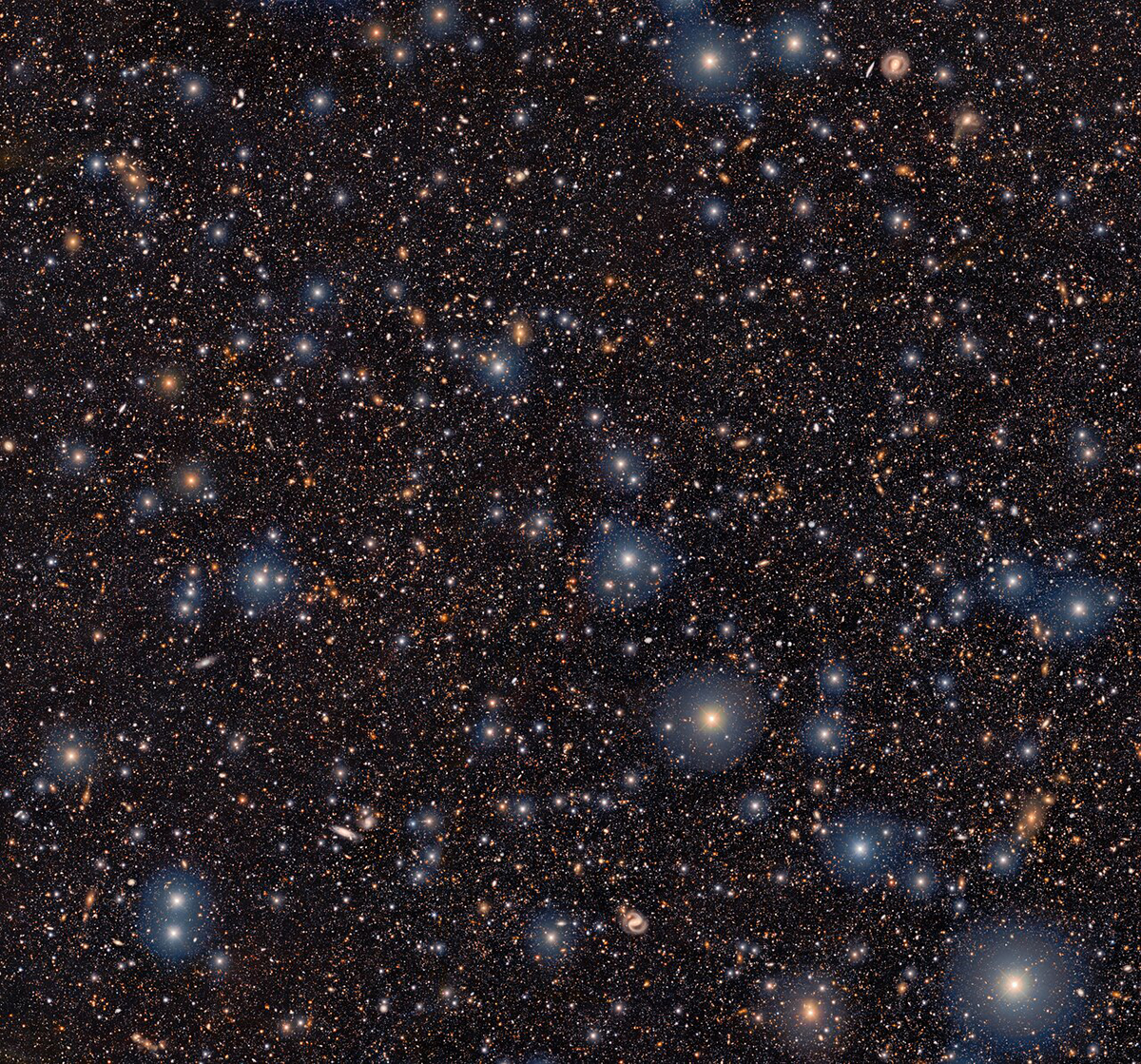
The search began with some of the most powerful and sophisticated observatories on Earth, such as data from the One-hundred-deg2 DECam Imaging in Narrowbands survey.
This survey uses the Dark Energy Camera on the Víctor M. Blanco 4-meter Telescope at Cerro Tololo Inter-American Observatory in Chile.
The Dark Energy Camera spent over 100 nights over three years capturing deep-sky images of a huge area of the Southern Hemisphere sky.
The team identified roughly 150 distant protoclusters that formed when the Universe was about 1–3 billion years old.
For context, the Universe today is 13.8 billion years old, so these distant protoclusters are being observed at a time when the Universe was in its infancy.
The team picked out two protoclusters that have a particularly high density of galaxies: COSMOS-z3.1-A and COSMOS-z3.1-C.
The survey, nicknamed 'ODIN', gave the team 2D coordinates of the clusters. The astronomers then turned to instruments called spectrographs – which analyse light from the objects – to measure their distances, thereby determining their positions in 3D.
That enabled the team to produce a 3D map showing where the young protoclusters are located in the distant Universe.
Monsters in the making
The resulting 3D maps enabled the team to calculate that COSMOS-z3.1-A and COSMOS-z3.1-C will both eventually evolve into structures more massive than the Coma Cluster.
That's the largest known galaxy cluster in our local Universe today.
COSMOS-z3.1-A is particularly impressive. The team say it's a proto-supercluster, containing multiple dense groups of galaxies that will eventually coalesce into a giant supercluster.
Observed when the Universe was only 2.1 billion years old, it's the earliest and most distant proto-supercluster ever identified.
"COSMOS-z3.1-A represents the most extreme, most overdense regions of the Universe," says Ramakrishnan.
"We think there should be fewer than one such object for every 10,000 galaxy clusters."
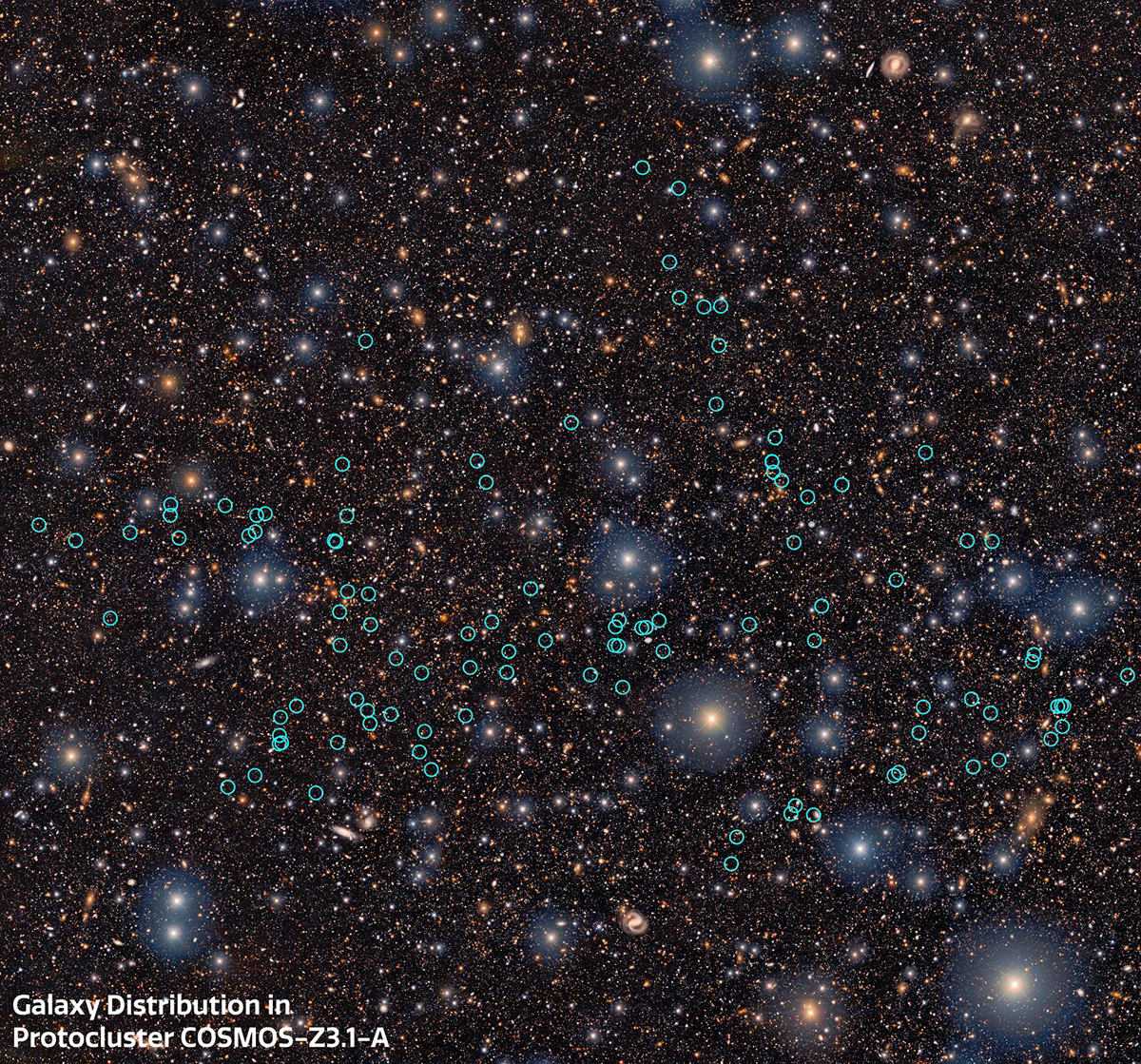
CTIO/NOIRLab/DOE/NSF/AURA. Image Processing: T.A. Rector (University of Alaska Anchorage/NSF NOIRLab), M. Zamani & D. de Martin (NSF NOIRLab)
A glimpse into the evolution of the Universe
This view back in time to the earliest still-forming galaxy clusters is giving the astronomers a front-row seat to the early evolution of the cosmos.
The 3D reconstructions reveal the early structures are clumpy, irregular and anchored directly at the intersections of massive cosmic web filaments.
This is the first time astronomers have directly observed such intricate cosmic web connections at such a extreme distance.
As part of the bigger picture, the clumpy shapes are providing evidence for how the Universe builds its largest structures.
According to standard cosmological models, structure formation occurs in a 'bottom-up' fashion, whereby small groups of matter form first, merging over time into increasingly huge structures.

The clumpy sub-regions mapped by the team show the individual building blocks of galaxies and galaxy clusters in the act of smashing together.
Over time, gravity pulls them into a single, smooth, rounder cluster like those seen in the nearby Universe today.
With the 3D mapping techniques showing great results, the hunt is now on to find more ancient cosmic super-structures.
The team say they're particularly looking forward to the results of the Legacy Survey of Space and Time being carried out by the Vera Rubin Observatory, which is the world's largest digital camera.
By imaging the entire Southern Hemisphere sky every few nights, Rubin is expected to give astronomers a dataset that will help them build a view of the nearby and distant Universe, giving them the chance to study the evolution of galaxy clusters across time and space.