In 2023, a new category of mysterious celestial bodies was identified.
These 14 objects are on orbits roughly between Venus and the asteroid belt – and they exhibit very strange behaviour.
They appear to experience ‘non-gravitational accelerations’ – their orbits are being affected by some other force.
This isn’t uncommon for a comet, where jets of escaping gas and dust exert a thrust to nudge its trajectory.
What’s weird is that their orbits are perturbed without any signs of outgassing – and so they’ve been dubbed ‘dark comets’.
More amazing science
The dark comet that warranted a closer look
One of these dark comets, 1998 KY26, was discovered in 1998 by the Kitt Peak National Observatory, when it passed very close to Earth.
It’s a small object, roughly 11 metres (36ft) across, with a fast spin of around once every five minutes and an unusually high albedo of around 0.5 (the Moon’s albedo, for comparison, is 0.12 – reflecting 12% of the sunlight that strikes it).
So, 1998 KY26 is very shiny. It’s a very curious object and in 2020 the Japanese space agency JAXA’s Hayabusa2 probe was redirected to rendezvous with it in 2031.
But there’s something else notable about 1998 KY26: its orbit around the Sun is uncannily close to that of a probe launched on a transfer trajectory from Earth to Mars.
Could Hyabusa2 be on its way to a probe?
This fact set a group of researchers thinking. Lead by Adam Hibberd at the Initiative for Interstellar Studies, London, and with Abraham Loeb of Harvard’s astronomy department as the senior author, the team have proposed that 1998 KY26 is in fact artificial: specifically, a failed Mars probe.
They identify it as the Soviet mission Phobos 1, which launched in 1988 before contact was lost after a mistyped command.
At 6.2 tonnes, Phobos 1 (and its twin Phobos 2, which did successfully explore Mars) is the heaviest interplanetary probe ever launched.
Hibberd points out that the 10-metre (32.8ft) span of its solar panels matches the estimated size of 1998 KY26 and that the craft would be expected to have a high albedo.
The non-gravitational acceleration of the object would be explained by solar radiation pressure as sunlight reflects off the probe’s shiny metallic surfaces.
For the interplanetary trajectory of Phobos 1 to fit the measured orbit of 1998 KY26, the probe would need to have subsequently fired its rocket twice, say the team: once on 2 September 1988 (shortly after contact was lost) and then again on 19 May 1996.
This isn’t impossible for a malfunctioning spacecraft and there is some evidence that Phobos 1 did indeed fire its rocket without being commanded.
The European Southern Observatory attempted to observe Phobos 1 three weeks after mission failure, but couldn’t find it at the predicted coordinates.
Hibberd’s team also calculate that Phobos 1 had enough fuel on board to shift from its launch trajectory onto the orbit observed for 1998 KY26.
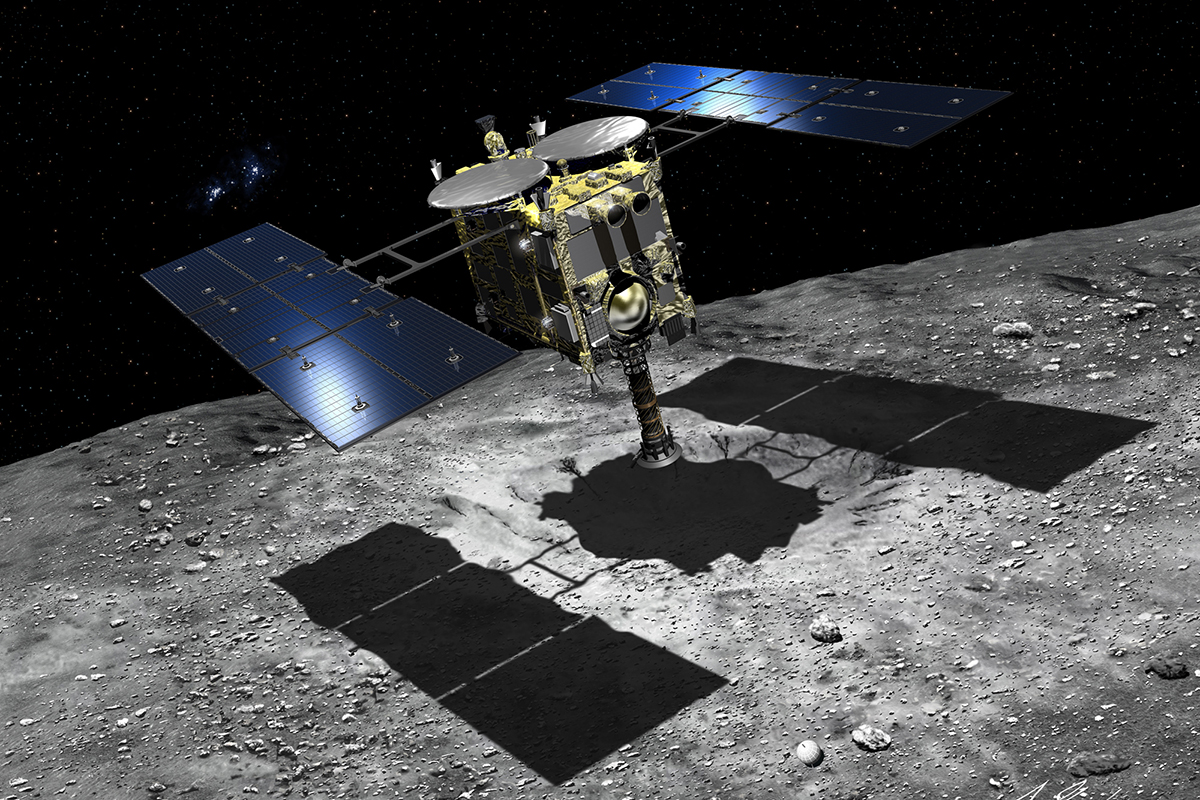
Could this be true?
So, while it may be at least plausible that 1998 KY26 is actually a human artefact, this certainly remains a controversial claim.
Most astronomers will tell you that 1998 KY26 is no more than a micro-asteroid: radar observations suggest a roughly spherical shape and a water-rich, possibly metallic composition.
But the exciting thing is that this hypothesis is testable – Hayabusa2 will arrive in five years and reveal the true nature of this curious dark comet.
And there’s at least an outside chance that it will discover one of its own robotic brethren, lost in space for four decades.
Lewis Dartnell was reading Is the Dark Comet 1998 KY26 the Spacecraft Phobos 1? by Adam Hibberd et al. Read it online at: arxiv.org/abs/2606.01288