There are very few telescopes with public recognition. When I was young, there were really only two.
The 200-inch telescope at Mount Palomar in California and the 250-foot radio dish at Jodrell Bank in Cheshire.
Now we learn that from April 2028 the UK’s Research and Innovation Agency (UKRI) has cut all funding for e-MERLIN, a network of seven radio telescopes including the Grade 1 listed Lovell dish at Jodrell Bank.
Hearing the news genuinely felt like a punch in the gut.
More amazing Chandra observations

I went to school in Manchester, often taking the train down past Goostrey to visit school friends, looking out every time for that iconic dish – still the third largest steerable radio telescope in the world.
Local families remembered when the telescope was first set up, back in 1957, and engineers would come calling from Jodrell Bank to put choke coils or ferrite rings on the power supplies of their household appliances to suppress radio interference.
I’ve lost count of the number times I’ve been to the visitor’s centre, a UNESCO World Heritage site.
Back when I first saw it in the 1970s, that huge dish, looming over the flat Cheshire plain, was a pure glimpse of the future – and even now it is a thrilling sight.
But it’s far more than a visitor attraction.
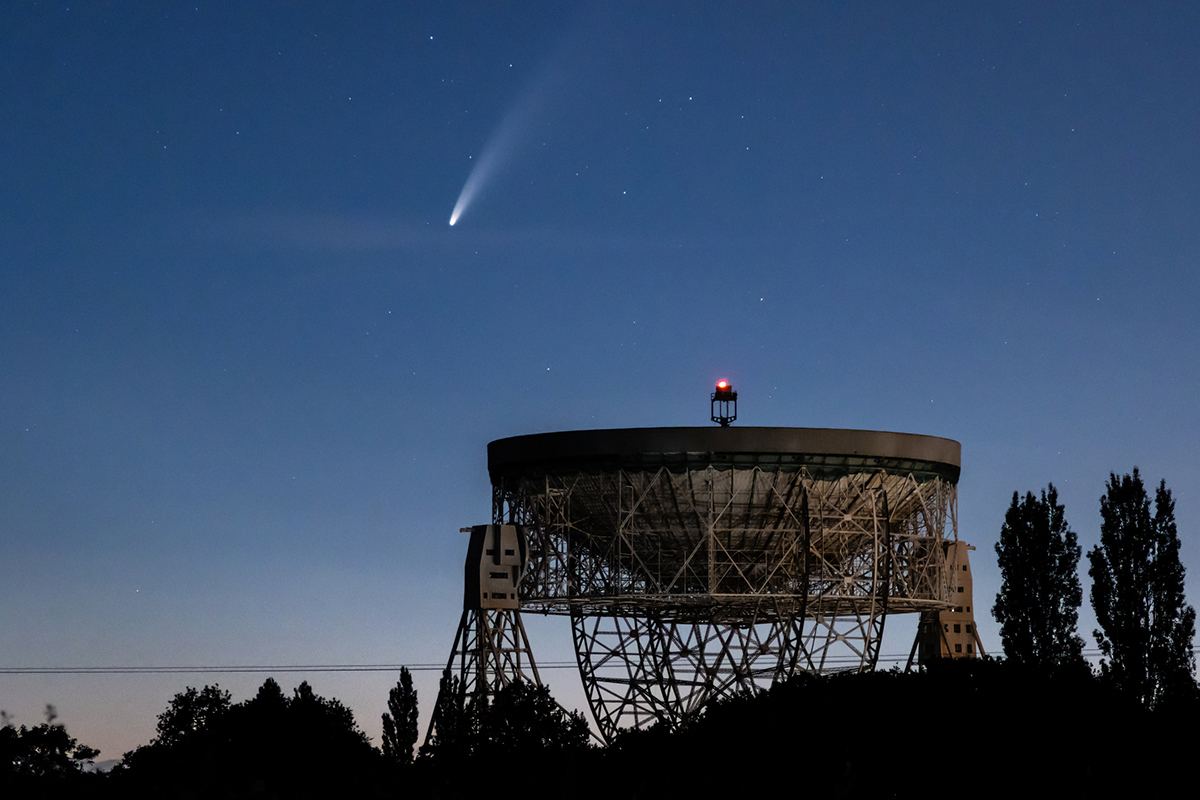
Jodrell Bank's role in the exploration of the Universe
Real science is being lost to save the £2.8 million a year going to e-MERLIN.
At Jodrell Bank this includes research into dark matter and dark energy, how planets and galaxies evolve, and the role of supermassive black holes.
Taking out e-MERLIN leaves a big gap in a Europe-wide radio telescope network.
Astronomy has been hit particularly hard in the cuts.
We are withdrawing from the Event Horizon telescope (a network primarily in the Americas), have removed funding from the James Clark Maxwell Telescope in Hawaii, removed future instrument funding from The Extremely Large Telescope in Chile, reduced our contribution to the Rubin Telescope in Chile, and more.

But important though all of these are, none has the same direct significance for the UK as Jodrell Bank.
Optical telescopes don’t thrive in the UK’s over-lit conditions, but our radio telescopes have continued to do great work.
The good news is that Manchester University, which owns the observatory, has made positive noises.
Professor Sarah Sharples, Dean of the Faculty of Science and Engineering, said that they “will continue to pursue routes with government, public agencies, industry and philanthropic funders to sustain the extraordinary science, engineering, training and public engagement enabled by Jodrell Bank.”
Let’s hope they succeed. There has been an outcry since the announcement, pleading with UKRI to reverse its decision.
This not just about the loss to science – it’s our heritage that is at stake.