When Yerkes Observatory opened in Wisconsin in 1897, it was a wonder.
Alongside the great one-metre (40-inch) telescope – the largest refractor ever built – the lavish facilities included the novelty of chemical and physical laboratories to support the new science of astrophysics.
All this scientific largesse was the gift of Charles Yerkes, a tycoon with a fortune derived in part from building bits of the London Underground.
More on space observing

Private support of even the grandest cutting-edge facilities was the norm, and only after the Second World War did telescopes – and, later, space missions like Hubble – become so expensive that government support was essential.
Today’s marvels, from JWST to the Vera Rubin Observatory, are funded mostly by taxes allocated to science agencies. That’s just the way it has to be.
Or does it?

The new private space telescope
A new space telescope has been announced, Lazuli, with a three-metre (10ft) mirror capable of observing in the optical and infrared.
This makes it larger than Hubble, and it will fly a sophisticated spectrograph and camera, plus a coronagraph for spotting planets around nearby stars.
What’s really notable is that the entire cost of Lazuli is being covered by Eric and Wendy Schmidt (Eric used to run Google), who are writing a cheque for what must easily be hundreds of millions of dollars.
The paper claims the team can move faster than a space agency by accepting more risk and using technologies – particularly in camera design – that haven’t yet been proven to work in space. Lazuli could be flying, they say, in three to five years.

What Lazuli could find
By then, astronomers will be swimming in alerts for transient events – supernovae, novae and other short-lived phenomena – from the Vera Rubin Observatory and gravitational-wave observatories.
While Hubble, say, needs at least a few days’ notice to swing to a new target, Lazuli will respond to new alerts in under four hours – perhaps even within 90 minutes.
If Lazuli can swing into action so quickly, it’ll play a big role in understanding the formation and evolution of black holes and other exotic objects.
It may even help with the Hubble Tension crisis in cosmology, where current methods for measuring the speed of expansion of the Universe disagree slightly, but significantly.

The onboard spectroscope is important. Rapidly capturing the spectra of transients like AT2018cow, a bright, fast-changing explosion caught a few years back, might explain why they remain surprisingly bright in the infrared so long after their initial explosion.
Spectroscopy of exoplanet atmospheres, making use of the three-metre mirror, will help us understand what these new worlds are like.
The coronagraph will allow the discovery of planets in Jupiter-like orbits around nearby stars, paving the way for the next really big taxpayer-funded space telescope, the Habitable Worlds Observatory, which will do the same for worlds in Earth-like orbits.
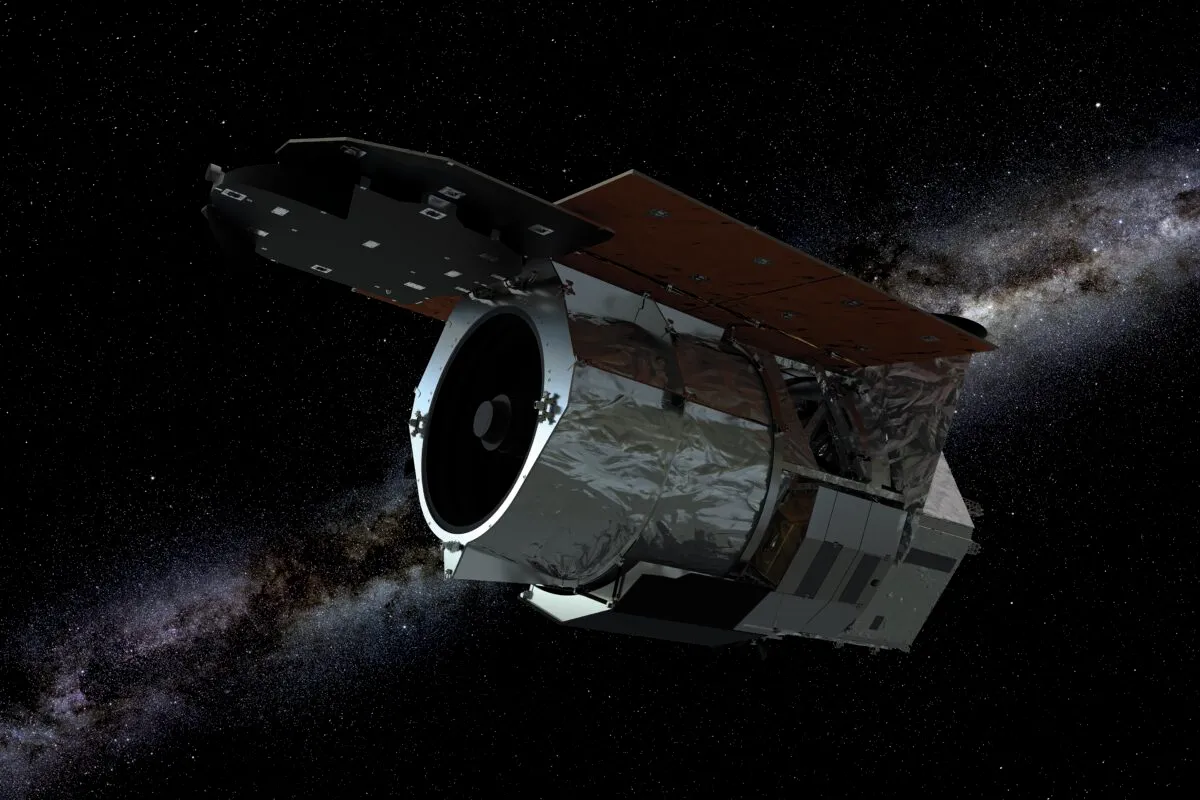
The Roman Space Telescope – due for launch this year – does have a similar instrument on board, but Lazuli’s slightly larger mirror, aided by a design that stops the secondary mirror from blocking the primary, has a slight advantage.
It’s very exciting. If the accelerated schedule is achieved and the risk-taking pays off, astronomers in almost every field will have cause to celebrate a remarkable act of generosity.
Chris Lintott was reading The Lazuli Space Observatory: Architecture & Capabilities by Arpita Roy et al. Read it online at: arxiv.org/abs/2601.02556