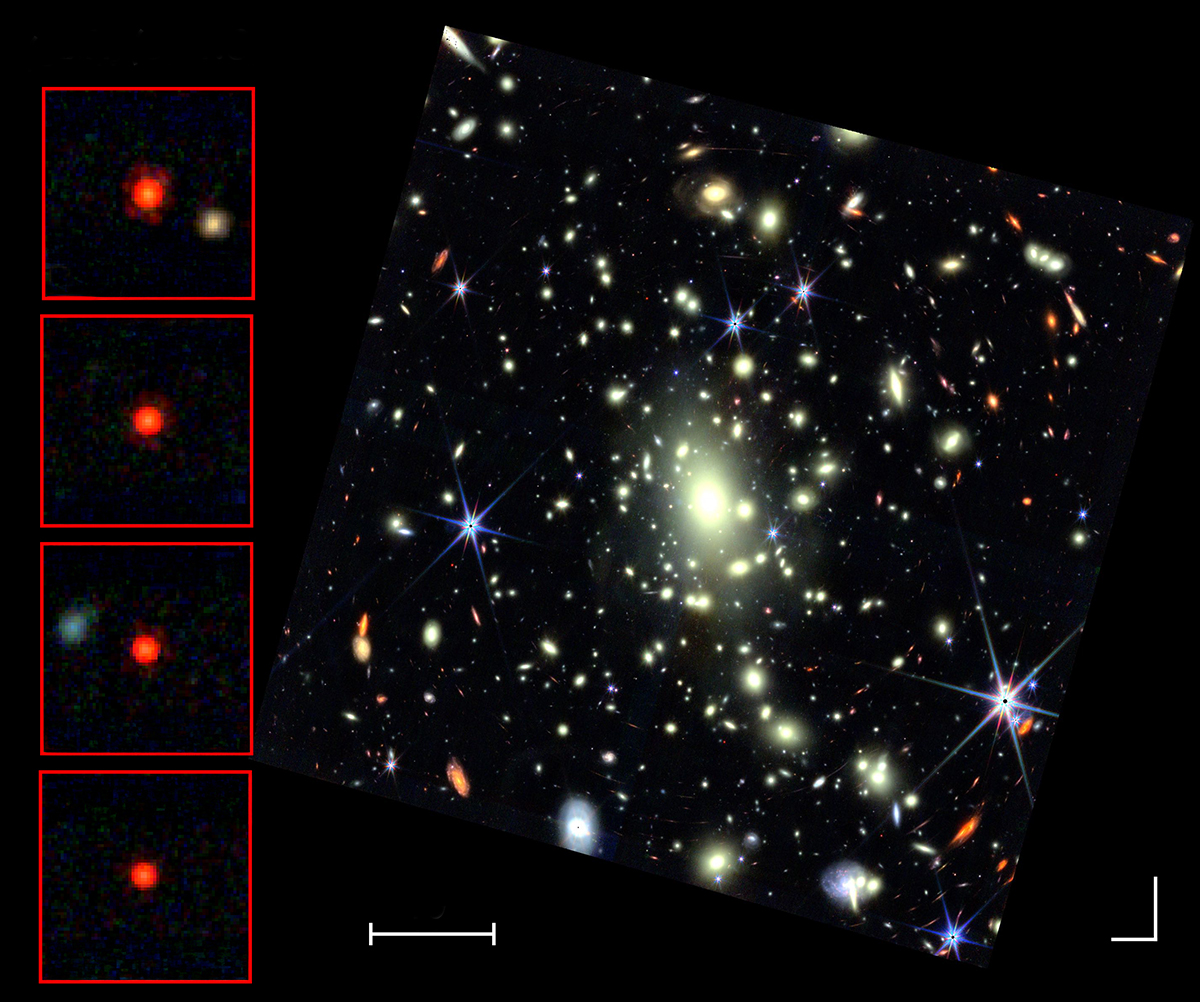
The discovery by the James Webb Space Telescope of little red dots – a previously unexpected population of compact red objects scattered across the early Universe – has caused debate and a decent amount of head-scratching as scientists scramble to work out what they are.
Though most would agree that the light from the little red dots must come either from an early burst of star formation or from material accreting onto a supermassive black hole, no simple model accounts for everything we see.
More complex, or exotic, ideas are thus gaining traction – such as a ‘quasi-star’ with a black hole lurking at its heart.
More amazing science
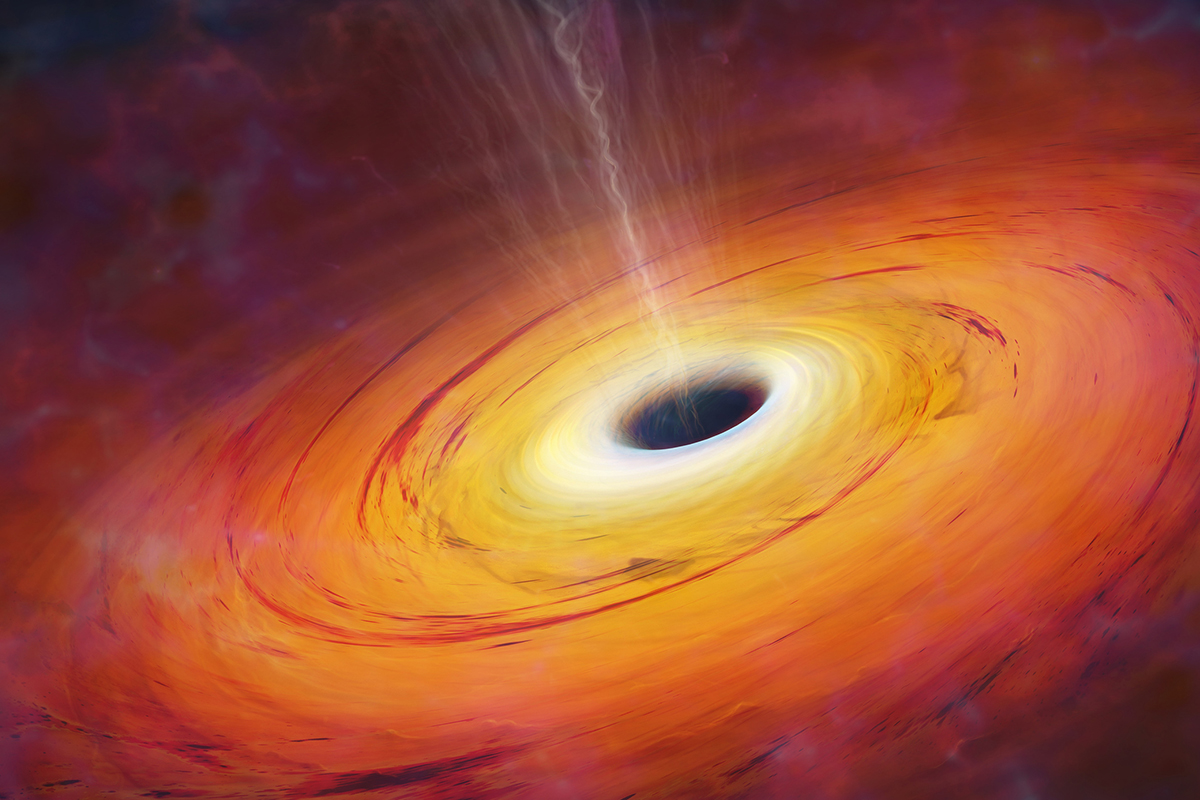
Black hole bomb
Normally, the creation of a black hole at the end of a star’s life creates a supernova, blowing the host to smithereens.
This inevitably stops the growth of the black hole in its tracks. To grow large black holes fast – as the little red dots seem to require – astronomers have suggested surrounding the new black hole with a dense atmosphere of gas.
This would come from an accretion disc in the protogalaxy. It’s even been suggested that in some circumstances a star could keep shining as a black hole grows within it.
Now new research has taken an important step in testing this idea, adapting a well-known code to predict what such objects might actually look like. The results are promising.
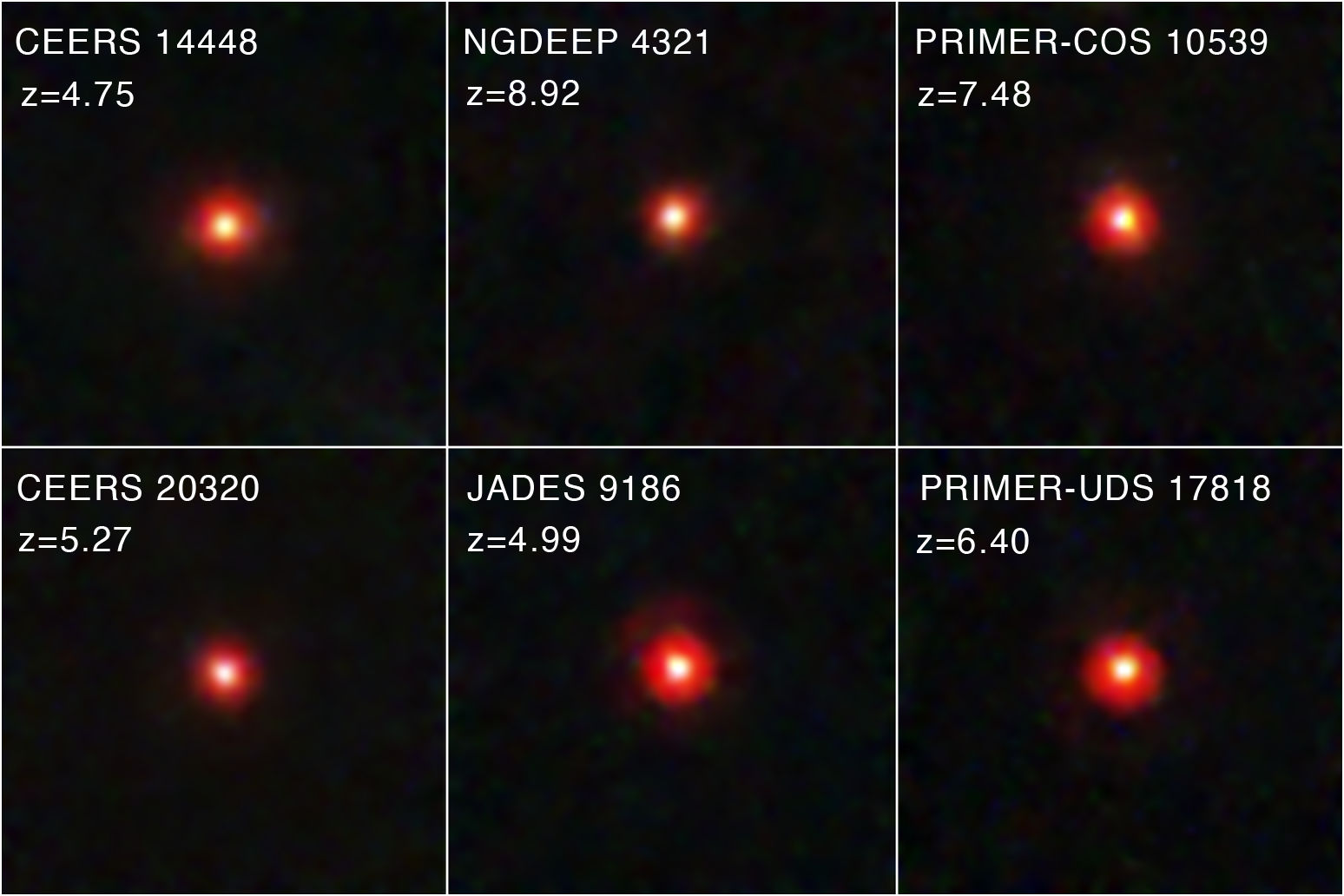
Using a model that places a light black hole weighing maybe 100,000 solar masses (compared to the few million for the Milky Way’s central black hole) in an envelope of dense gas a little bigger than the Solar System, they get results that match much of what we see in little red dots.
In particular, the dots in the model match the brightness of the real ones in visible and infrared light, as does the brightness of light emitted by the object’s hydrogen gas.
Assuming this explanation works, the black hole in each dot in this model accounts for up to about 1% of the mass of the galaxy in which it’s forming.
That’s high compared to what we see in the local Universe – though this could easily be because of the special circumstances driving the growth of these unusual objects.
They don’t produce the bright lines seen in dot spectra that seem to come from helium, nor does the model account for the hot dust seen in many dots.
The authors suggest that both might be coming from material surrounding the quasi-star itself or, in the case of the dust, floating in its atmosphere, neither of which is yet included in their calculations.
The problem with light
A more serious problem is that the model doesn’t yet correctly predict the brightness of many of the dots in the ultraviolet.
The given explanation is that surely such objects would be unlikely to form in isolation, and so we should expect ultraviolet light to be contributed by newly formed stars elsewhere in the protogalaxy.
This does seem a bit like cheating to me – but it’s plausible, until new observations give us a handle on the star-formation rates in these objects.
Such minor problems aside, this is a good score for the quasi-star model. With every twist in the little red dot story so far, though, new questions arrive alongside answers, and these intriguing objects will be puzzling us for a while yet.
Chris Lintott was reading The Quasi-star Model for Little Red Dots: Potential and Challenges by Fabrizio Gentile et al. Read it online at: arxiv.org/abs/2606.06575