
Deep beneath the Black Hills of South Dakota in the US, locked inside a cavern nearly a mile underground, an extraordinary experiment is hunting for dark matter.
And it may have just registered a tiny particle interaction that could unlock the secrets of the invisible universe.
More on dark matter

In a study presented at the 2026 TeV Particle Astrophysics conference in Japan, researchers have unveiled what they say is the most intriguing signal ever detected by the LUX-ZEPLIN (LZ) experiment.
It's a single particle interaction that seems to defy explanation by any known natural background process.
While scientists say it's too early to declare a discovery, they say it's LUX-ZEPLIN's most compelling glimpse yet into one of science's biggest unsolved mysteries.
Dark matter – we know it's there, but we can't find it
Everything we can see, touch, or interact with – from stars and planets to the screen you're reading this on – is made of ordinary matter.
Yet scientists say ordinary matter accounts for a mere 15% of all the stuff in the Universe. The remaining 85% is dark matter.
Although dark matter is invisible and can't be directly seen, its presence is inferred because of how we observe gravitational interactions across the Universe.
One key observation that led scientists to conclude dark matter's existence was the study of spinning galaxies.

Stars on the outer edges of spiral galaxies rotate far faster than they should based on the visible matter inside them.
Just like how we feel a spinning carousel wants to fling us outwards, stars on the edges of galaxies should be spinning out into space, tearing the galaxies apart.
That is, if we only account for the stuff we can see – the stars, dust and gas.
There must be extra mass providing gravitational glue to hold galaxies together. We can't see that extra mass, but it must be there, so scientists have called it 'dark matter'.
Another way of inferring the existence of dark matter is gravitational lensing.

This describes how the mass of nearby galaxy clusters warps and magnifies light from more distant galaxies, like a cosmic magnifying glass enabling scientists to see distant galaxies more clearly.
Astronomers can use these observations to calculate how much mass is in those foreground galaxy clusters.
Again, the maths tells them that there must be extra, invisible matter with an enormous gravitational influence. But we can't see it.
Dark matter must be there, but it doesn't seem to absorb, reflect or emit light.
How LUX-ZEPLIN works
One contender for dark matter is WIMPs, or Weakly Interacting Massive Particles.
WIMPs travel freely through planets, buildings and human bodies as if they weren't even there.
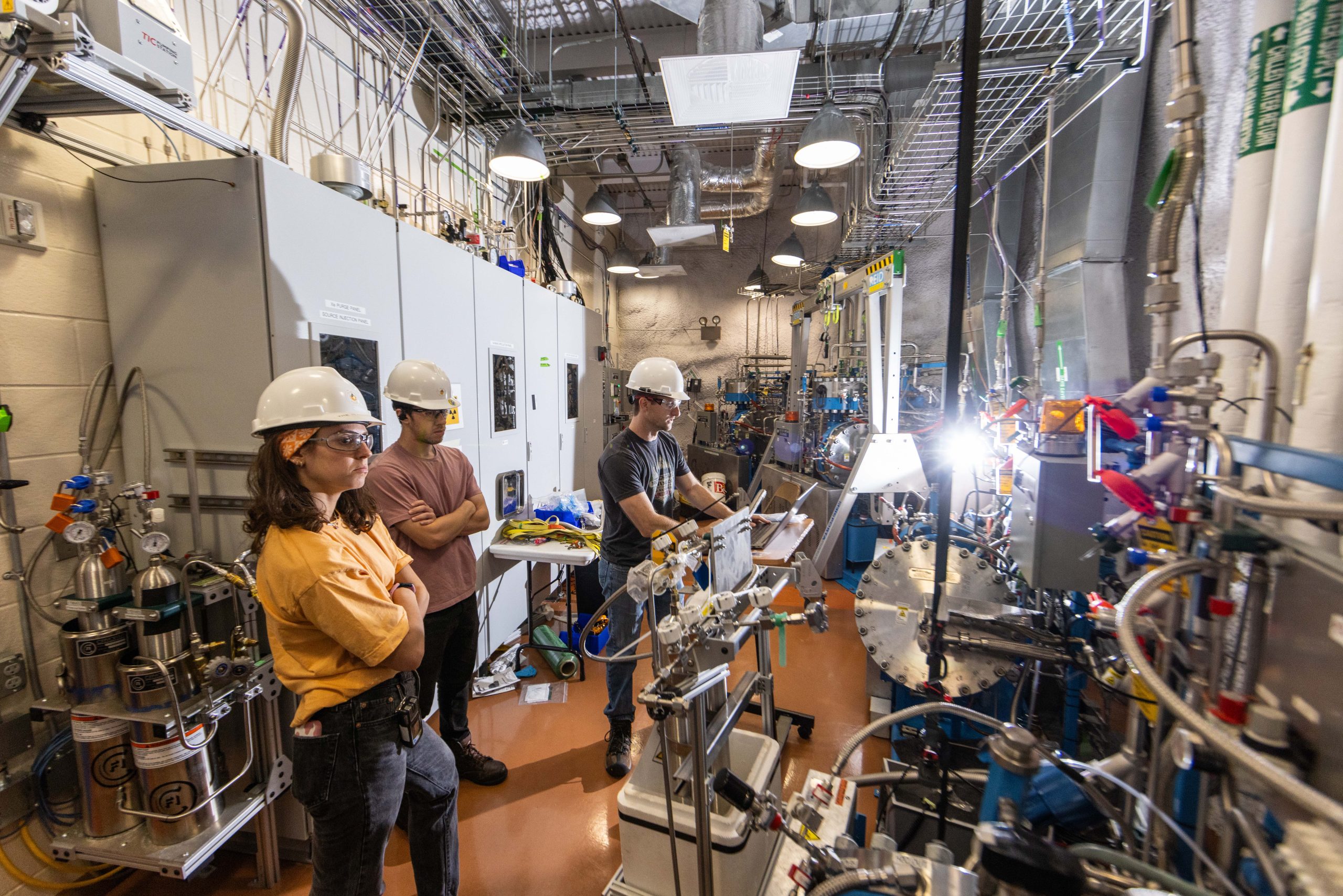
The LUX-ZEPLIN (LZ) experiment is managed by the U.S. Department of Energy’s Lawrence Berkeley National Laboratory and involves an international collaboration of around 250 scientists and engineers across 39 institutions, including a 50-strong UK team led by Imperial College London and STFC.
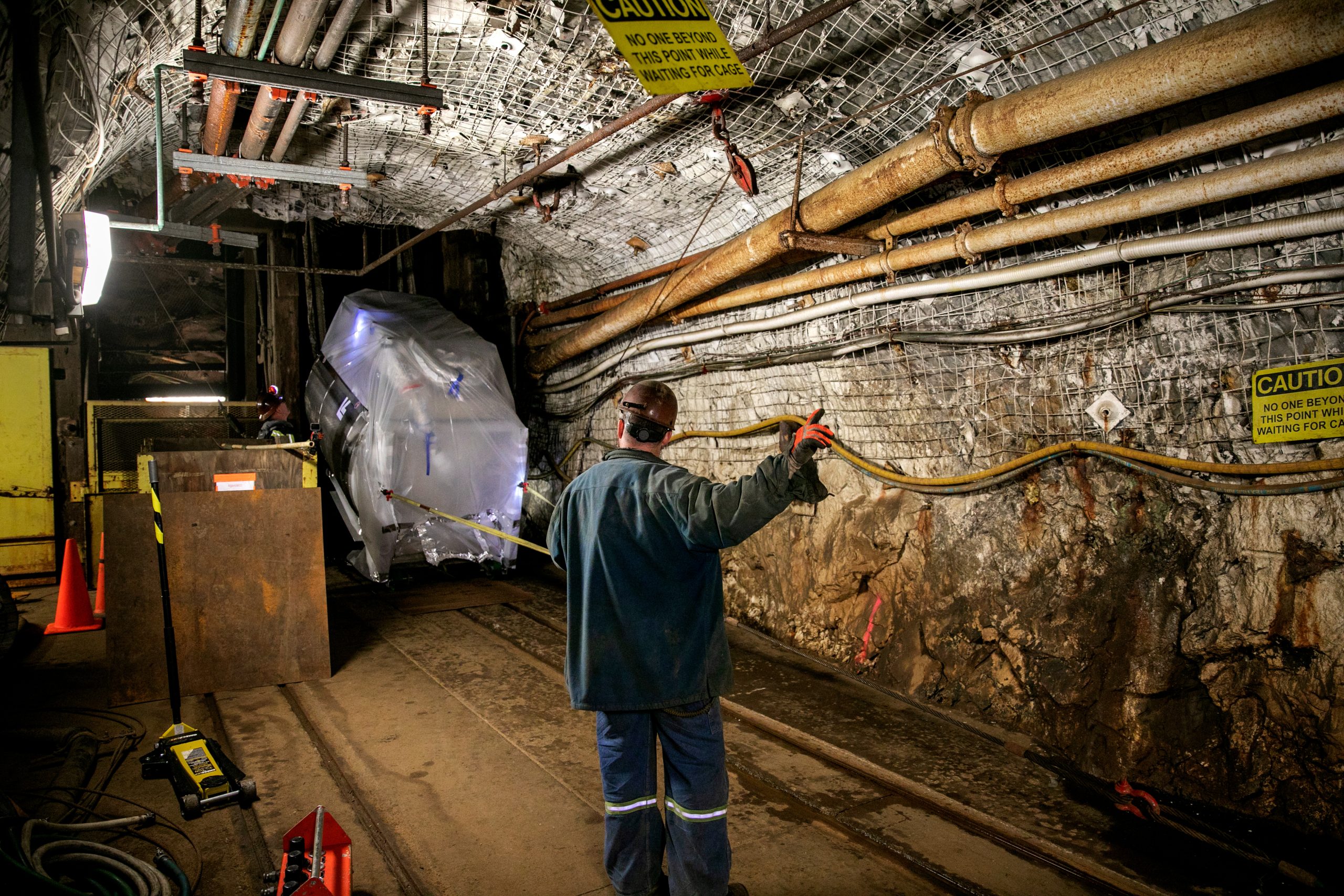
LZ is buried nearly a mile underground at the Sanford Underground Research Facility (SURF) in South Dakota, USA.
It's underground because it needs to be shielded from cosmic rays that constantly shower Earth's surface.
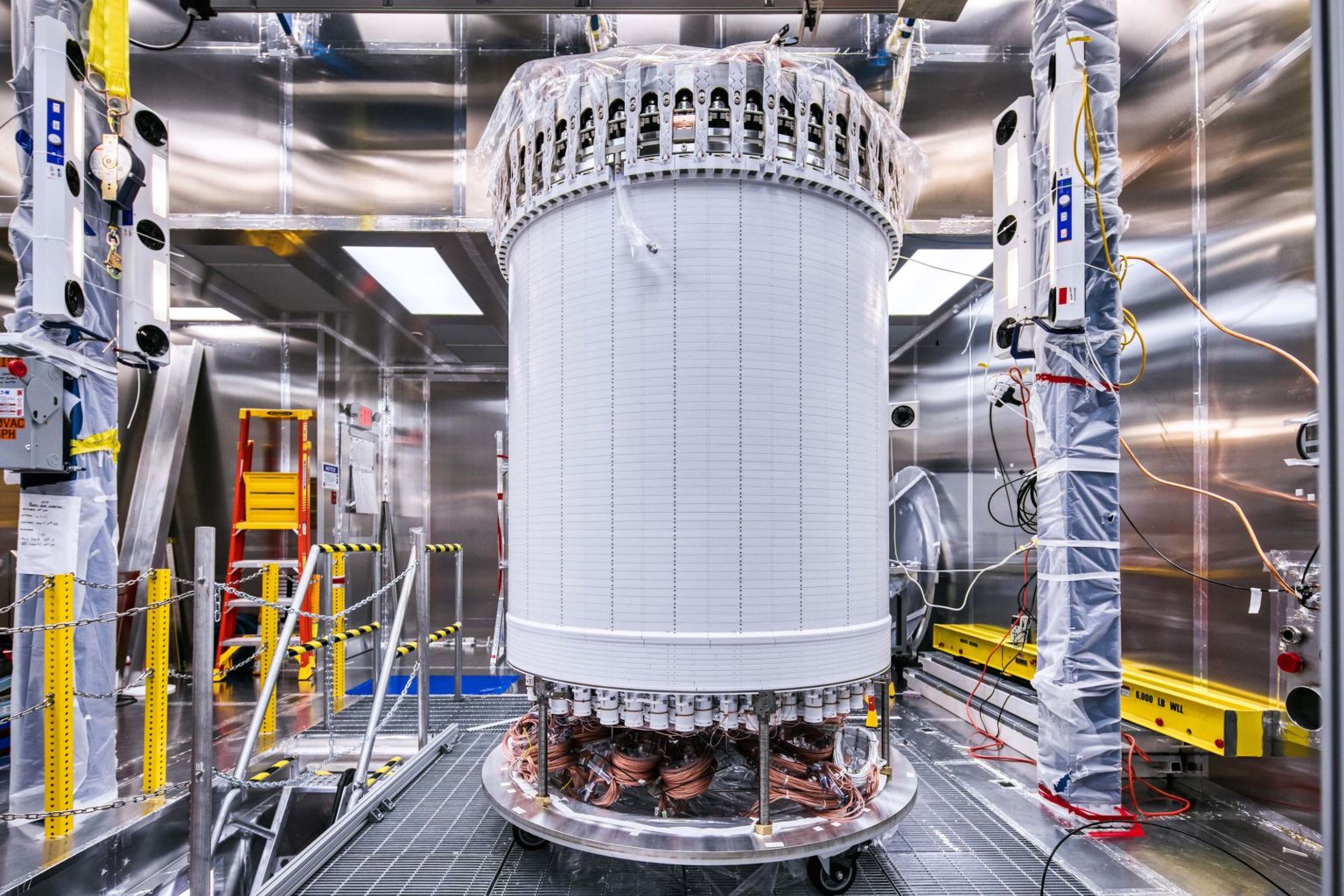
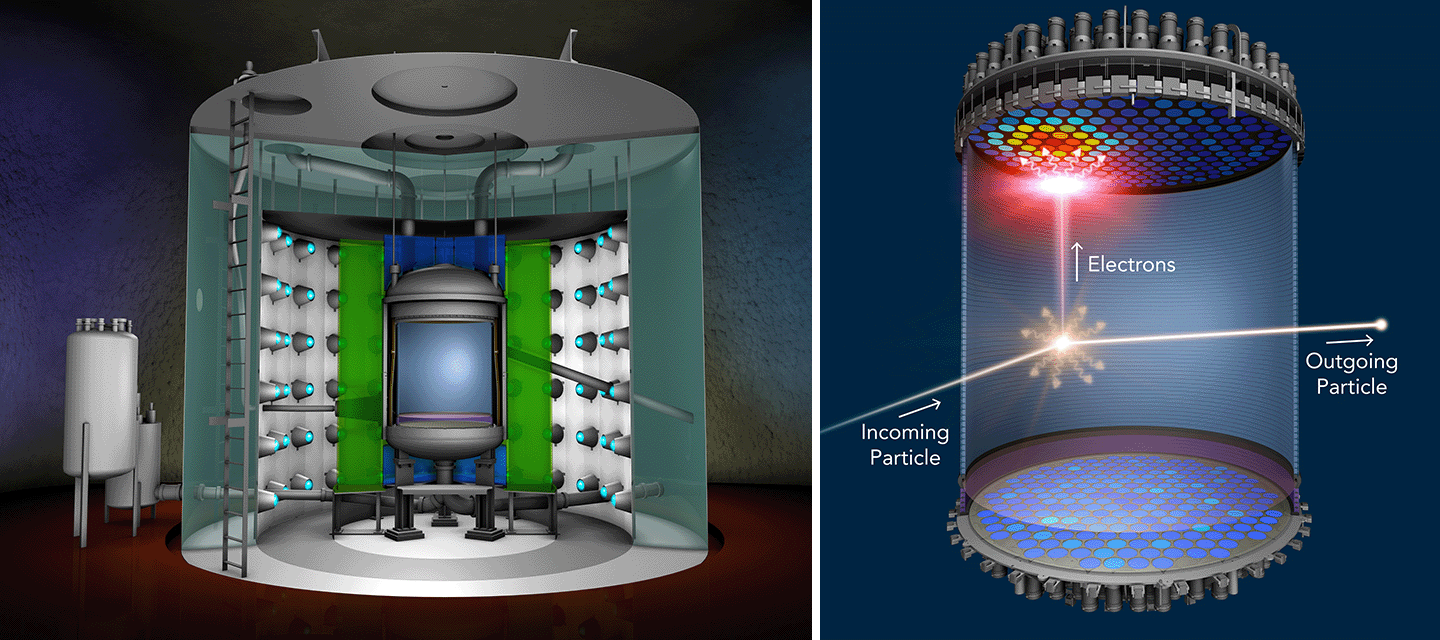
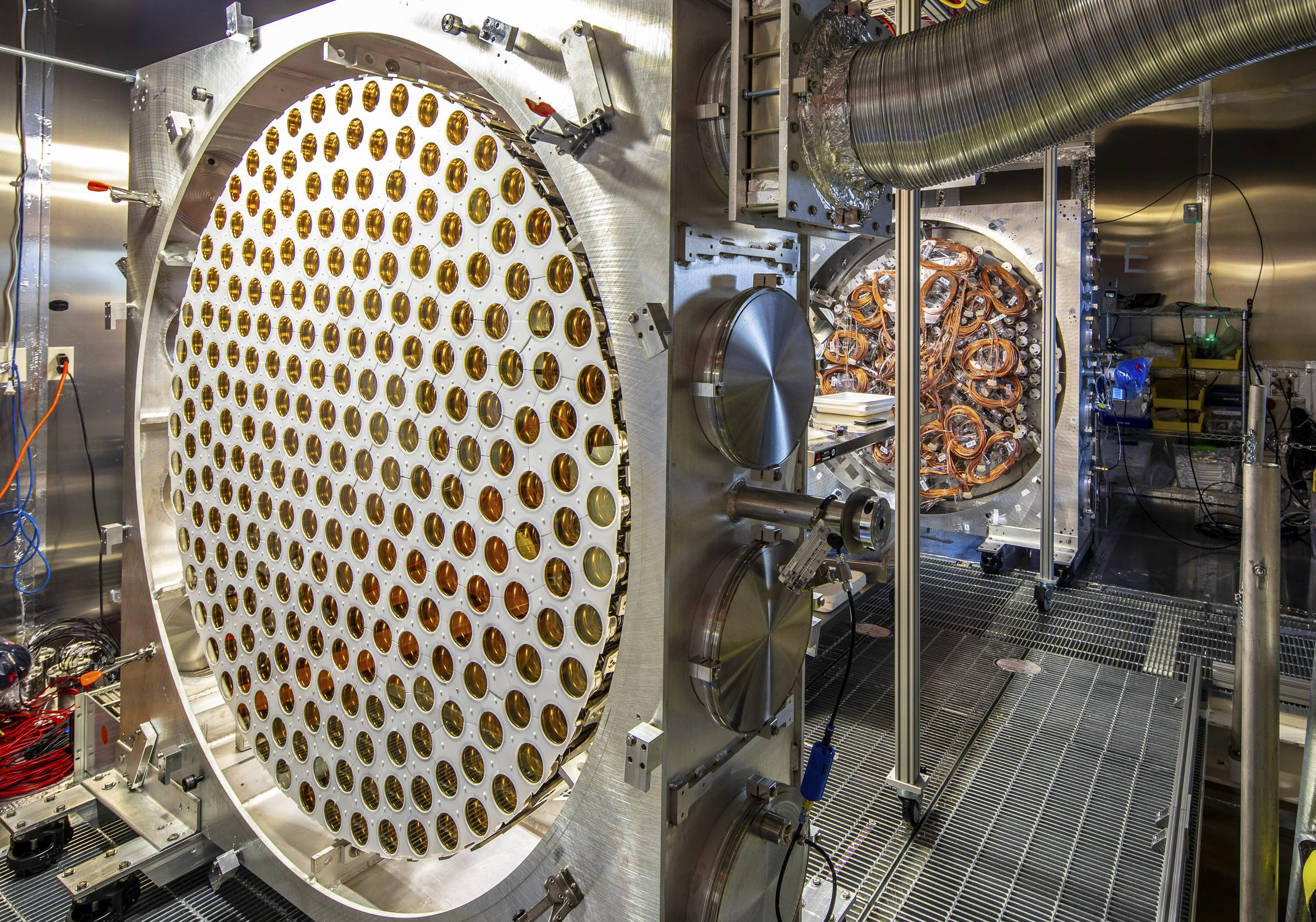
LZ contains 10 tonnes of ultrapure liquid xenon cooled to freezing temperatures.
When a particle hits a xenon atom, it causes a flash of light and a release of electrons.
By studying the timing and ratio of the light flashes, scientists can map the location of the event and determine what kind of particle caused it.
What the LZ experiment found
Scientists at the LZ experiment say they've uncovered a single particle interaction that could not be accounted for by known physics.
The team say they understand their backgrounds so thoroughly that even a single extra ping is noteworthy.
"This was a detailed study in a region we hadn’t explored within this dataset, and we spent months of additional effort to understand all the possible causes of background events," says Sam Eriksen, a senior research associate at the University of Bristol and lead author of the study.
"We understand our detector and the backgrounds so well that even a single outstanding event, like the one we found, is important.
"We expect dark matter events to be extremely rare, so only a handful could mark the first detection of WIMP dark matter."
However, the team do urge caution. They say the result stands at '2.6 sigma significance', meaning there's a 0.5% chance it could be explained by known backgrounds alone.
That, the team say, is short of the 5-sigma threshold required before a result could be called a discovery.
"This single event sits exactly where we would hope dark matter to appear, in a part of our search we had not fully explored before, and it has withstood months of scrutiny," says Professor Chamkaur Ghag of University College London.
"We are not claiming a discovery, but this is a genuinely exciting moment. We built LZ to be sensitive enough, and clean enough, to catch something like this if it were there.
"Whether this event turns out to be dark matter or an extraordinarily unlucky background, the coming years of data will tell us, and either way it's a strong test of everything the collaboration has built."
Now international partners are planning the ultimate successor, the XLZD (XENON-LUX-ZEPLIN-DARWIN), which could help scientists take the search for dark matter to the next level.
So whether or not this underground event proves to be our first look at the hidden 85% of the Universe, it feels scientists are getting closer to solving one of the cosmos's most intriguing mysteries.

