
Mars was once a ‘blue planet’, with a massive ocean covering approximately half of the Martian surface, a new study has concluded.
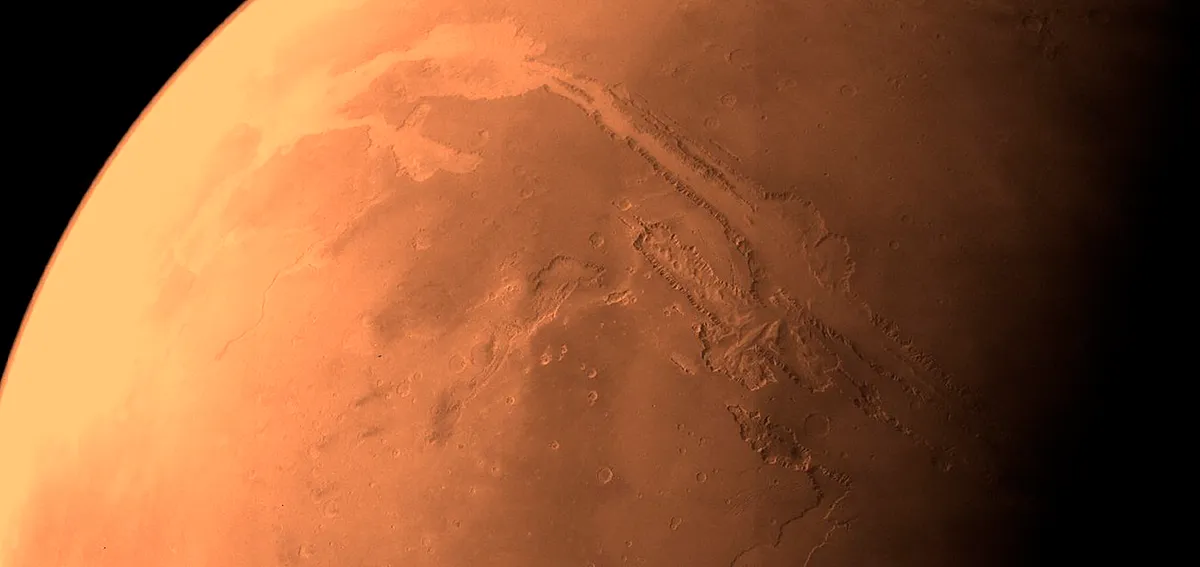
An international research team led by the University of Bern has identified unmistakable geological structures in the Valles Marineris canyon system that resemble river deltas on Earth, providing a ‘smoking gun’ for a Martian coastline.
The features were the canyon’s scarp-fronted deposits (SFDs), which indicate sedimentary material on an ocean bed where a river meets the ocean. They date to roughly three billion years ago.

Finding evidence of Mars's ancient ocean
"These structures are very similar to classic river deltas on Earth and represent the mouth of a river into an ocean," explains Fritz Schlunegger, professor of exogenous geology.
These delta remnants now lie beneath wind-sculpted dunes, but their shapes remain discernible in high-resolution images from Mars orbiters.
"The images allow us to reconstruct a former sea level and coastline."

All the SFDs were found at around the same elevation, between 3,750 and 3,650 metres (12,303–11,975ft) below Mars’s defined zero level.
From this, the researchers calculated what the water level would have been within the canyon, concluding that it was around 1km (3,280ft) deep at points.
This means the ancient ocean was at least as large as Earth’s Arctic Ocean, stretching across much of the northern hemisphere.
Further evidence of life on Mars?
Ignatius Argadestya, a geology PhD student and lead author of the study, emphasised the broader implications of the discovery.
"We know Mars as a dry, red planet. However, our results show that it was a blue planet in the past, similar to Earth.
"This finding also shows that water is precious on a planet and could possibly disappear at some point."
These extensive bodies of water raise fresh questions about Mars’s past climate and habitability.
As the researchers note, by comparing Martian depositional environments with those on Earth, we can better understand how water shaped the Red Planet and where future missions might search for traces of ancient life.

