The origins of Mars’s two moons, Phobos and Deimos, are still a matter of some debate.
Some planetary scientists argue that they’re asteroids that became captured by Mars’s gravity.
Others point out that’s unlikely, since both are in very circular, low-inclination orbits, and they instead formed from a disc of debris blasted into Martian orbit from a giant impact.
More on Mars

The future of Phobos
Phobos’s future is also uncertain. This is the larger, innermost of the two moons and so close to the Red Planet that its orbital period is shorter than Mars’s rotation.
This means that tidal effects are sapping it of orbital energy and it’s gradually circling nearer to the planet.
The traditional belief has been that as Phobos death-spirals closer to Mars, it will pass inside the ‘Roche limit’.
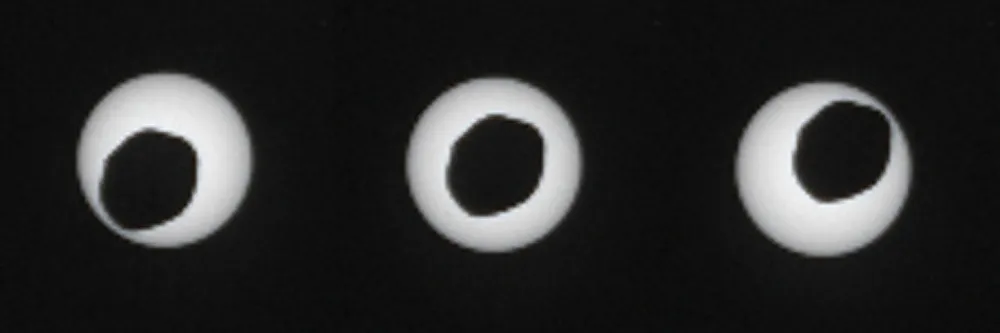
At that distance, the tidal forces will exceed the moon’s ability to hold itself together and Phobos will be torn apart into a rocky ring around Mars.
But this prediction is neglecting some crucial details, argue Harrison Agrusa and Patrick Michel, researchers at the Observatoire de la Côte d’Azur, France.
Phobos is too small to have ever formed into a perfect sphere; it’s elongated, like a potato pointing towards Mars.
More importantly, Phobos is thought to have weak internal strength and is more like a ‘rubble pile’ held together by its own gravity.
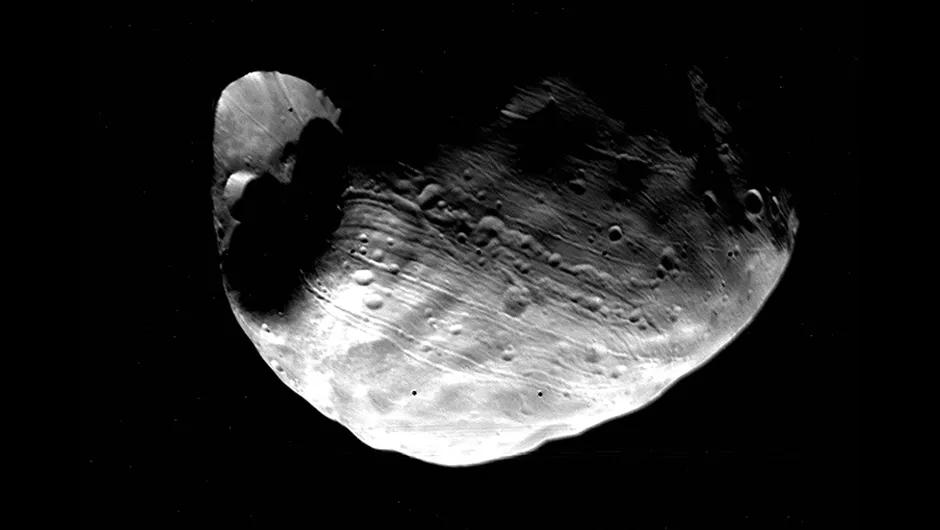
Credit: NASA
This means it may have a much more interesting fate before it dips inside the Roche limit.
The researchers took two different approaches to exploring the moon’s future.
The first is a simple mathematical analysis of factors such as the tidal strain at decreasing distance from Mars, and the shape and likely cohesive strength of Phobos.
The second is a more involved computer simulation of the moon as a rubble pile – like a large clump of marbles of all different sizes – that tracks each separate particle as the balance of forces on it changes during Phobos’s inward spiral.
And the two methods largely agree with each other.

Unravelling of a rubble moon
They found that if Phobos does indeed have a relatively low cohesion, its surface material will start being ripped away long before it approaches the Roche limit of around 1.6 times the radius of Mars (RM).
This mass shedding occurs from two opposite parts of Phobos: on the point facing Mars, where the planet’s gravitational tug is strongest; and on the far side, where the outwards-flinging centrifugal force is greatest.
They calculate that the first shedding event will occur when Phobos drops to an orbital distance of about 2.25RM.
Much larger shedding events then happen at around 2.15RM and 2.13RM, before finally – at around 2.09RM – two huge streams of material are wrenched from it.
At this point, the moon becomes destabilised and is rapidly destroyed by tidal disruption.

But Phobos may meet its end even before this. The large amounts of material torn from its surface would enter orbit around Mars and then later re-impact into the moon at high speeds, smashing off even more material.
This could trigger a ‘sesquinary catastrophe’, with the moon being obliterated by collisions with its own stripped material.
The Japanese Martian Moons eXploration (MMX) mission, due to launch in 2026, will give us a much better idea of Phobos’s internal structure, and thus its ultimate fate.
Lewis Dartnell was reading Tidal Disruptions of Rubble Piles: The Case of Phobos by Harrison Agrusa and Patrick Michel Read it online at: arxiv.org/abs/2602.21912