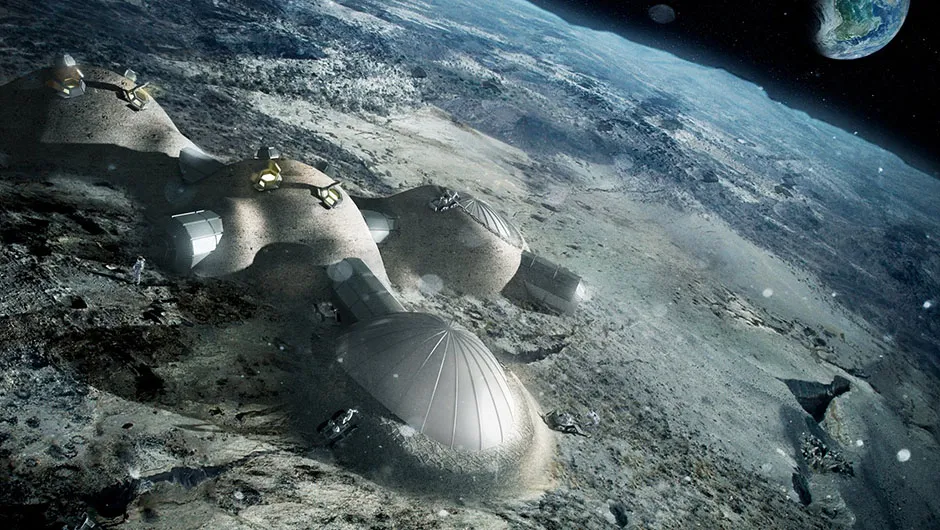
The Artemis programme is NASA’s renewed effort to not only return humans to the Moon for the first time since Apollo 17 in 1972, but ultimately to establish a permanent lunar base.
This sustained presence on the Moon is seen as a key stepping stone for human missions to Mars and beyond.
This base will likely be built near the lunar south pole, where certain locations offer critical advantages, including uninterrupted sunlight during the month, direct communications with Earth, and possible access to water-ice in permanently shadowed craters.
But there’s one major hazard to any future Moon base: the constant rain of micrometeoroids.

Micrometeroids and the dangers of lunar life
Micrometeoroids are fast-moving dust particles and fragments of rock that weigh up to 10g (0.35oz).
That’s far too small to create significant craters on the lunar surface, but nonetheless capable of punching straight through the metal shell of the Moon base and causing depressurisation.
Daniel Yahalomi, in Columbia University’s department of astronomy, led a team to investigate this risk.
NASA’s Meteoroid Engineering Model 3 (MEM 3) normally estimates micrometeoroid risks for satellites and interplanetary probes, but Yahalomi and his team adapted it to model the risk for a Moon base, treating the habitat like a spacecraft fixed on the lunar surface.

They assumed the Artemis base would be comparable in size to the International Space Station – roughly 100 x 100 x 10 metres (330 x 330 x 33ft) – and ran simulations for 1,000 virtual bases dotted evenly across the lunar surface.
The standard armour used on craft like the International Space Station is known as a Whipple shield.
More Moon missions

A thin, outer ‘bumper’ layer is designed to cause any impacting particles to fragment and then disperse as they cross the enclosed gap, so that their energy is spread out and better absorbed by the inner, main wall of the spacecraft.
The researchers calculated not only the rate of micrometeoroid impacts onto the Moon bases in different locations, but – crucially – how many strikes might be expected to breach such a Whipple shield.

Location, location, location
The team found that a lunar base located near the Moon’s equator and on the longitude directly opposite Earth would experience a maximum of around 23,000 micrometeoroid impacts per year.
At this position, their model revealed that the focusing effect of Earth’s gravity – bending trajectories and concentrating extra micrometeoroids towards the Moon – is more significant than the blocking effect from our planet.
For a base located at the lunar south pole, the impact rate is roughly 1.6 times lower – around 15,000 impacts per year – which bodes well for the planned location of the Artemis base.
They also calculated how big an incoming micrometeoroid would need to be to penetrate the base’s wall
if it had a state-of-the-art Whipple shield. They found this ‘critical mass’ to be 0.07g (0.002oz).
Luckily, 99.9997% of micrometeoroids are smaller than this danger threshold, demonstrating that current shielding technology will be adequate for protecting a Moon base.
Taking into account the impact rate at the lunar south pole, this would correspond to a penetrating strike only once every 42 years.
That’s reassuring news for future lunar crews who may call the Moon home in the 2030s.
Lewis Dartnell was reading Micrometeoroid Impact Rate Analysis for an Artemis-Era Lunar Base by Daniel A Yahalomi et al. Read it online at: arxiv.org/abs/2511.04740.
This article appeared in the February 2026 issue of BBC Sky at Night Magazine