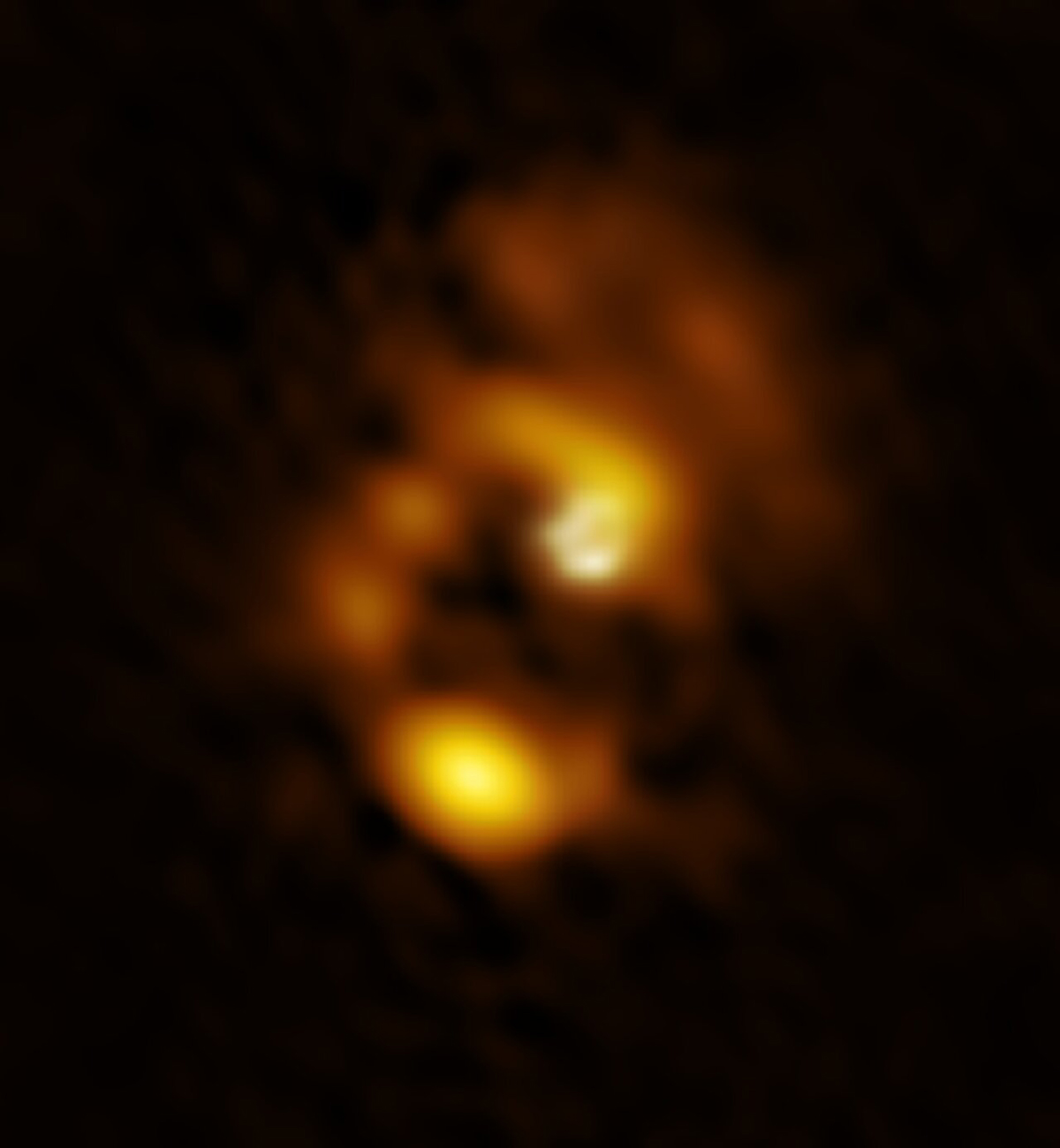
The image you see here of a lumpy, glowing object in centre of the frame is the surface of a star up-close, as seen by one of the most powerful telescopes on Earth.
It's called Mira A and it's a red giant star relatively close to Earth, just 330 lightyears away.
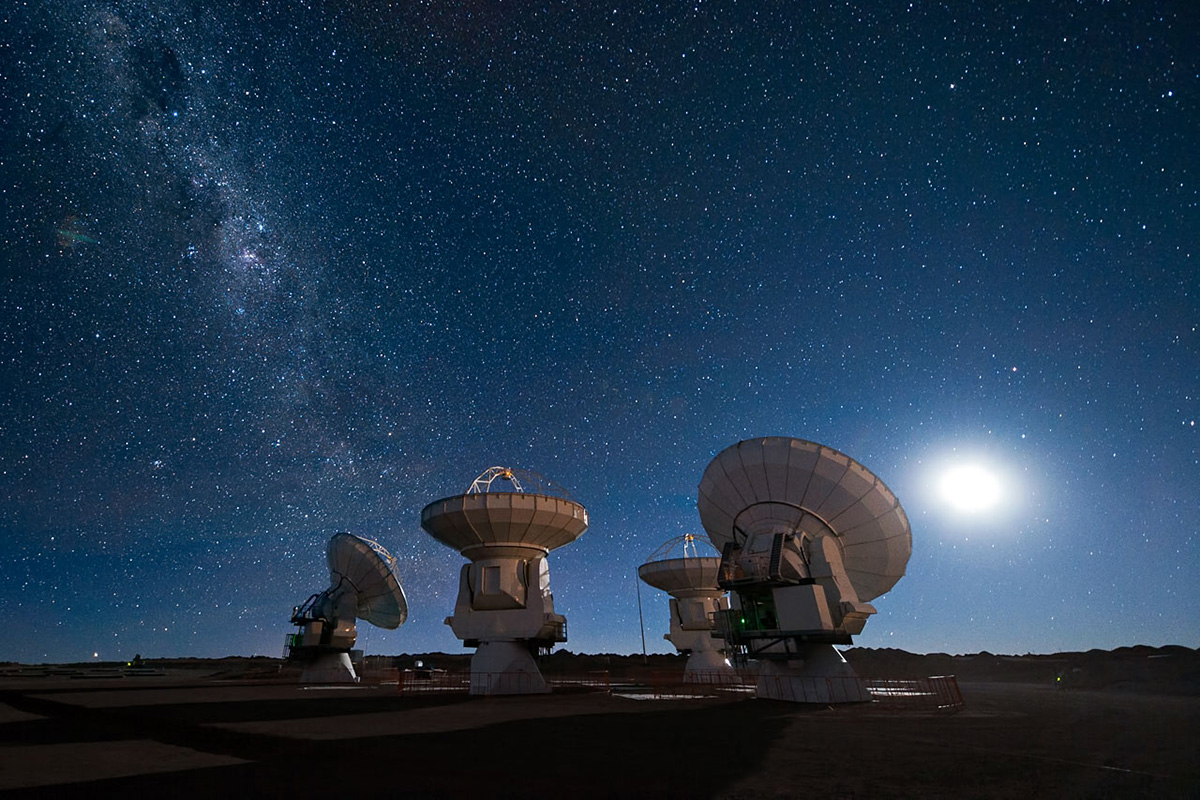
This image was captured under the dark skies of the Chilean Atacama Desert by the Atacama Large Millimeter/submillimeter Array, and shows a giant loop of material shooting outwards from the star.
What's causing it? Astronomers say they've been able to unlock the secrets of the powerful forces at play in this ageing star.
The chaos of a dying star
Mira A is approaching the end of its life. When this happens to stars like Mira A, they begin to shed their outer layers into space.
This happens because, as the star runs out of fuel, it can no longer resist the pull of its own gravity, causing it to heat up and push its outer layers outwards.
The ALMA view seen here shows a violent product of the dying process: a loop of material shooting outwards from the star stretching 10 astronomical units away.
One astronomical unit is the average distance between Earth and the Sun, so 10 astronomical units is about the distance from the Sun to Saturn!
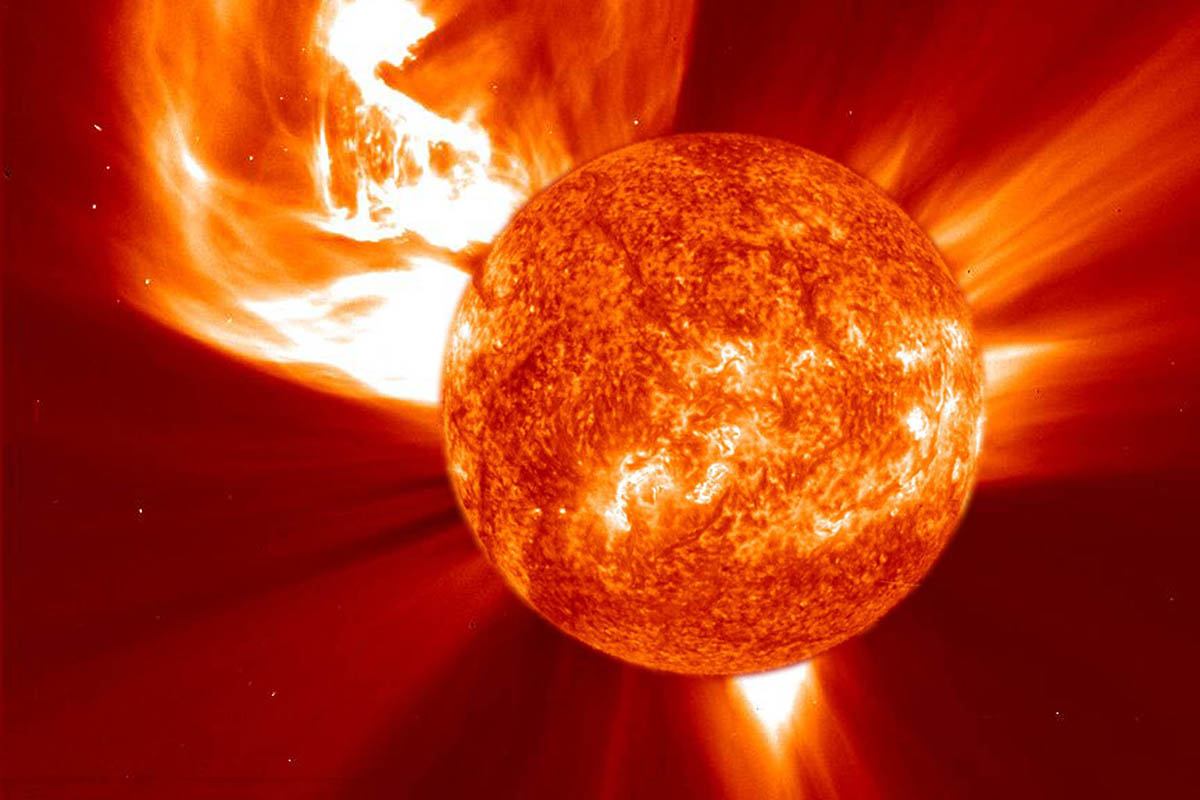
Astronomers say that, while it looks like a coronal mass ejection from our own Sun, it's much larger and carries more energy than the strongest flares ever measured.
It's thought other stars produce eruptions like this, but they're hard to see. Mira A's proximity makes it much easier to see and photograph.
Read more
Have we got stellar flares completely wrong?
“For decades, astronomers have believed that the winds from stars like this must be powered by starlight," says Wouter Vlemmings, Professor at the department of Physics and Astronomy, Chalmers University of Technology in Sweden and part of the study.
"Light from the star shines on grains of dust in the star’s outer atmosphere, and that gives them a push. But this star is showing us something different: that strong magnetic fields can also shape and power stellar winds.
"That changes a fundamental part of the origin story of the atoms we ourselves are made of."
The seeds for life
The team say that, without flares like this, life on Earth might not exist. That's because the elements of life like carbon, oxygen and nitrogen are made in stars like our Sun.
When stars grow old, they blow off their outer layers, spreading atoms across the Universe.
“In 2023, we saw one of these flares appear on the star’s surface, but it didn’t stop there," says Behzad Bojnordi Arbab, doctoral student at Chalmers and part of the research team.
"Over the next two years, this eruption on the surface created a vast, expanding loop of gas around the star, which we captured in an image in 2025. The loop was much bigger than the star, extending as far out as the distance of Saturn from the Sun. We hadn’t seen anything like that before."
“In the loop, there’s a strong magnetic field, which must also influence the star’s wind," says Vlemmings.
"That showed us a connection between the flare and the loop and reminded us also of phenomena we can see on our Sun."
"Now we see that magnetic storms on Mira’s surface are continually creating bright flares. Even more surprisingly, each of these is strong enough to lift parts of the star’s outer layers and launch them into interstellar space,” says Miora Andriantsaralaza, also from Chalmers.
"Our study has consequences for our understanding of the whole of the galaxy’s ecosystem," says Vlemmings.
"Perhaps, Earth wouldn’t be here if it wasn’t for magnetic storms on a red giant star, billions of years ago before the Sun was born."