
Have we been missing radio communication signals from intelligent alien civilisations because we've been listening in on the wrong frequency?
A group of astronomers say that could very well be the case and that we should widen the search to stand the best chance of making contact with intelligent extra-terrestrial species.
The team say we may have been missing alien signals that could have been sent in part of the radio spectrum that not recently explored.
Here's the science behind the claim – and what we can do about it.
More on alien life
Picking up radio alien
The Search for Extraterrestrial Intelligence (SETI) is a well-established, scientific approach to searching for signs of intelligent alien life beyond Earth.
Astronomers say most radio SETI surveys focus on frequencies between 1.42 and 1.66 GHz.
They call this range of requencies the 'water hole' because it lies between natural radio frequencies emitted by hydrogen and hydroxyl. These are two molecules whose combination forms water.
The logic behind this is the assumption that this quiet part of the radio spectrum would be a good place to communicate and that, if human beings have come to this conclusion, so might other intelligent species.
A technologically-advanced civilisation could recognise the significance of hydrogen and hydroxyl and transmit and listen there.
Widening the scope
A scientific study says higher radio frequencies could provide a new avenue in the search for technological signals from other civilisations.
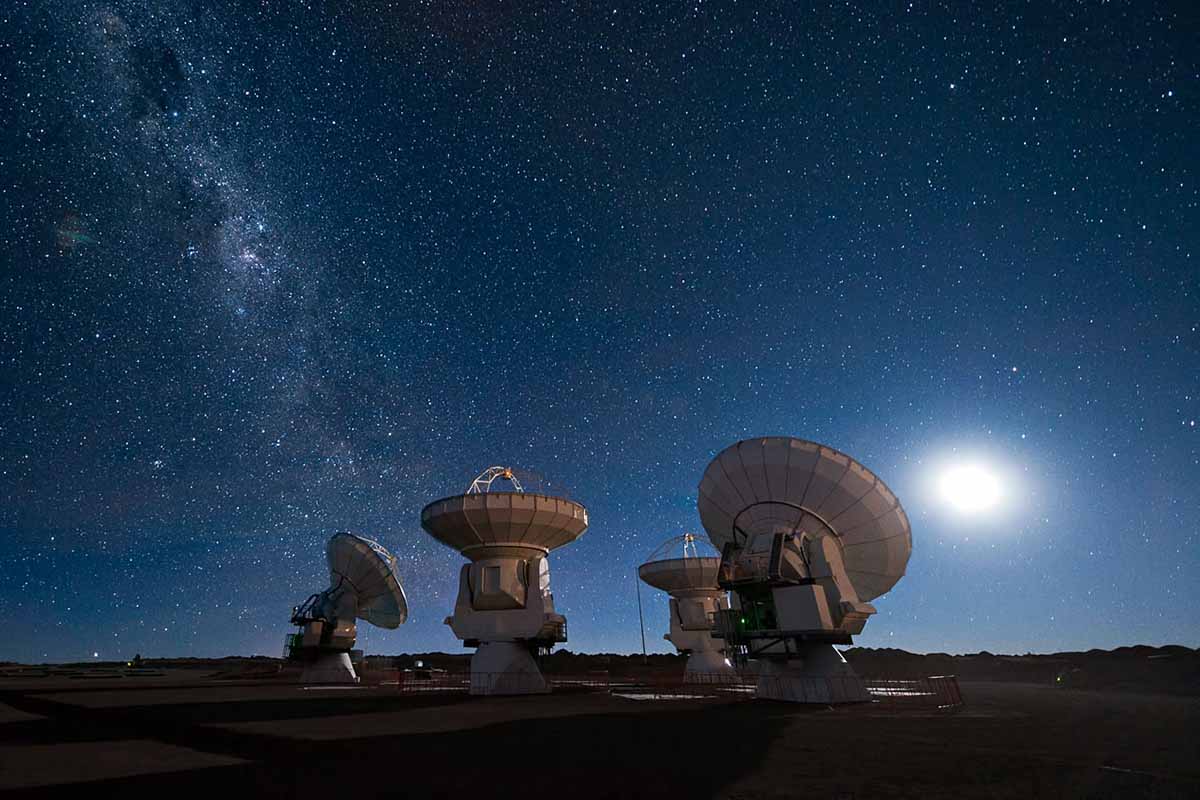
Astronomer Louisa Mason is a PhD researcher at the University of Manchester, UK who used archived observations from the Atacama Large Millimeter/submillimeter Array (ALMA) in Chile to conduct the first-ever SETI survey using the telescope.
But rather than carrying out new observations, Mason looked at existing data that was originally collected for other astronomical purposes.
She searched for narrowband radio signals that could be coming from alien technology – technosignatures – rather than natural processes.
"For decades, SETI searches have concentrated on a relatively small part of the radio spectrum. We wanted to ask what might happen if we looked somewhere very different," Mason says.
"The millimetre and submillimetre radio bands remain almost completely unexplored for SETI, so this is really about opening up a new area of parameter space to search."
Mason searched two small frequency windows in ALMA's Band 3 observations. She found no candidate alien signals above their thresholds.
But even thought the survey examined just four ALMA observations from the archives, Mason says her study shows high-frequency radio telescopes could play an important role in future SETI studies.
More stars to study
Mason also looked at whether there might be many more stars hiding within previous observations of the sky than thought.
When astronomers observe a celestial target with a telescope, they capture lots of extra stars within the telescope's view.
Mason used something called the Besançon Galactic Model to estimate the full population of stars contained in individual observations, including stars too distant or faint, or those too difficult to identify.
She applied the model to a SETI survey of 1,327 telescope observations and, she says, increased the estimated number of stars in the search from about 288,000 to over 6.1 million.

"One of the most exciting things about this work is realising that we've surveyed many more stars than initially thought," she says.
"Even a very small observation can contain a huge number and diversity of stars that we might never have intended to study. By combining high-frequency observations with galactic simulations, we can better understand exactly what we've searched and where we should look next."
While the absence of detected signals doesn't mean we can rule out the existence of intelligent life, Mason says it just means no candidate signal was found in the small frequency ranges examined in the study.
She hopes her work will mean future SETI surveys search more widely across the radio spectrum and fully capitalise on existing data.
Read the full science paper via the Monthly Notices of the Royal Astronomical Society

