
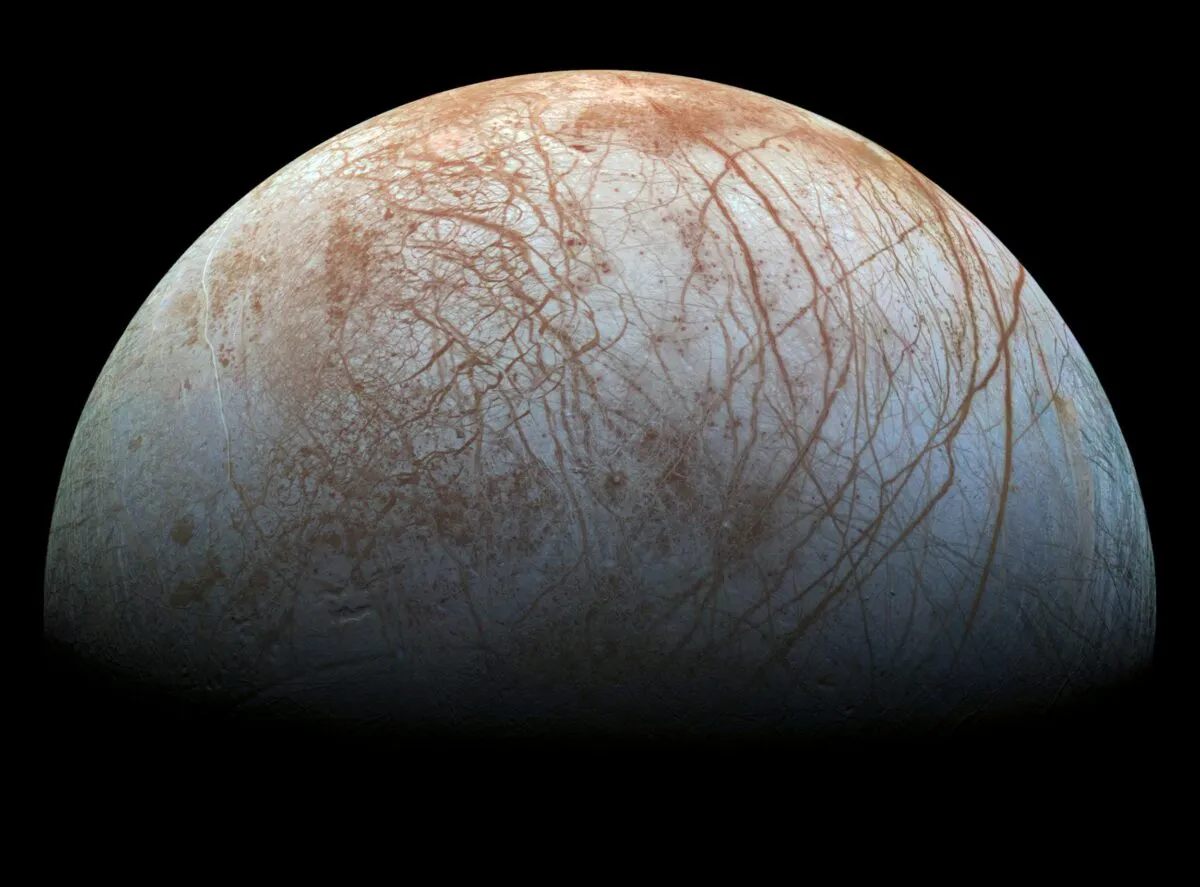
New data from a NASA spacecraft orbiting Jupiter has provided a measurement of the icy crust around one of the planet's largest moons.
Europa is a frozen moon that orbits Jupiter, but it has a liquid ocean beneath its surface.
More on NASA's Juno mission
Image processing by Kevin M. Gill, © CC BY
That makes it one of the best places beyond Earth to search for life in our Solar System.
Two spacecraft are currently on their way to explore Europa, and the new measurements could inform the science they do once they get there.

A new view of Europa's surface ice
Icy moons like Europa at Jupiter and Enceladus at Saturn are among the top places to search for signs of life in our Solar System.
That's because they have subsurface oceans of liquid water, which means they are potentially habitable worlds.
NASA's Juno mission is currently in orbit around Jupiter, and has used its Microwave Radiometer (MWR) instrument to give scientists a closer look at Europa's icy shell.
Juno scientists determined that Europa's shell is about 29km (18 miles) thick on average, following data collected during the spacecraft's flyby of the moon in 2022.
NASA says there's evidence the ingredients for life may exist in the salty ocean beneath its surface.

A flyby of Europa
Juno flew 360km (220 miles from Europa's surface on 29 September 2022.
Its Microwave Radiometer instrument gathered data on about half the moon's surface, and was able to measure its temperature at various depths.
"The 18-mile estimate relates to the cold, rigid, conductive outer-layer of a pure water ice shell," says Steve Levin, Juno project scientist and co-investigator from NASA’s Jet Propulsion Laboratory.
"If an inner, slightly warmer convective layer also exists, which is possible, the total ice shell thickness would be even greater.
"If the ice shell contains a modest amount of dissolved salt, as suggested by some models, then our estimate of the shell thickness would be reduced by about 3 miles."
A thick shell would imply oxygen and nutrients need to travel further from the surface to the subsurface ocean.
Understanding just how thick Europa's shell is could determine how habitable the moon really is.
Understanding Europa's cracks
Europa is known to have cracks and pores in its icy surface. Could these provide channels from the surface to the ocean?
NASA says the MWR data showed irregularities in the near-surface ice like cracks, pores and voids.
These features are thought to be just a few inches in diameter and could stretch hundreds of feet below Europa’s surface.
A study using the new Juno data shows the features are shallow, which could mean they're not likely deep enough to be a pathway for oxygen and nutrients to travel from Europa’s surface to its ocean.

The data could inform the science carried out by two upcoming missions: NASA's Europa Clipper and the European Space Agency's Juice mission.
These two missions will explore Jupiter's icy moons to find out more about their potential habitability.
"How thick the ice shell is and the existence of cracks or pores within the ice shell are part of the complex puzzle for understanding Europa’s potential habitability," says Scott Bolton, principal investigator of Juno from the Southwest Research Institute in San Antonio.
"They provide critical context for NASA’s Europa Clipper and the ESA Juice spacecraft — both of which are on their way to the Jovian system."

