NASA has paid tribute to the British actor Sir Patrick Stewart, who has died aged 86 following a "brief and poignant journey" with Alzheimer's and Lewy Body Dementia.
Stewart was known widely for his role as Captain Jean-Luc Picard in the sci-fi series Star Trek: The Next Generation, as well as for his role as Professor Charles Xavier in the X-Men movies.
In praise of his contributions to the sci-fi genre, tributes to the late actor have been flooding social media from space agencies, astronauts and astronomers.
NASA's Goddard Space Flight Center shared this image in tribute to Stewart – a Hubble Space Telescope capture of galaxies colliding and forming the shape the USS Enterprise, the fictional Federation ship in the Star Trek universe.
"History will never forget the name Captain Picard," NASA Goddard posted on its X feed. "Thank you for inspiring the Next Generation of explorers."
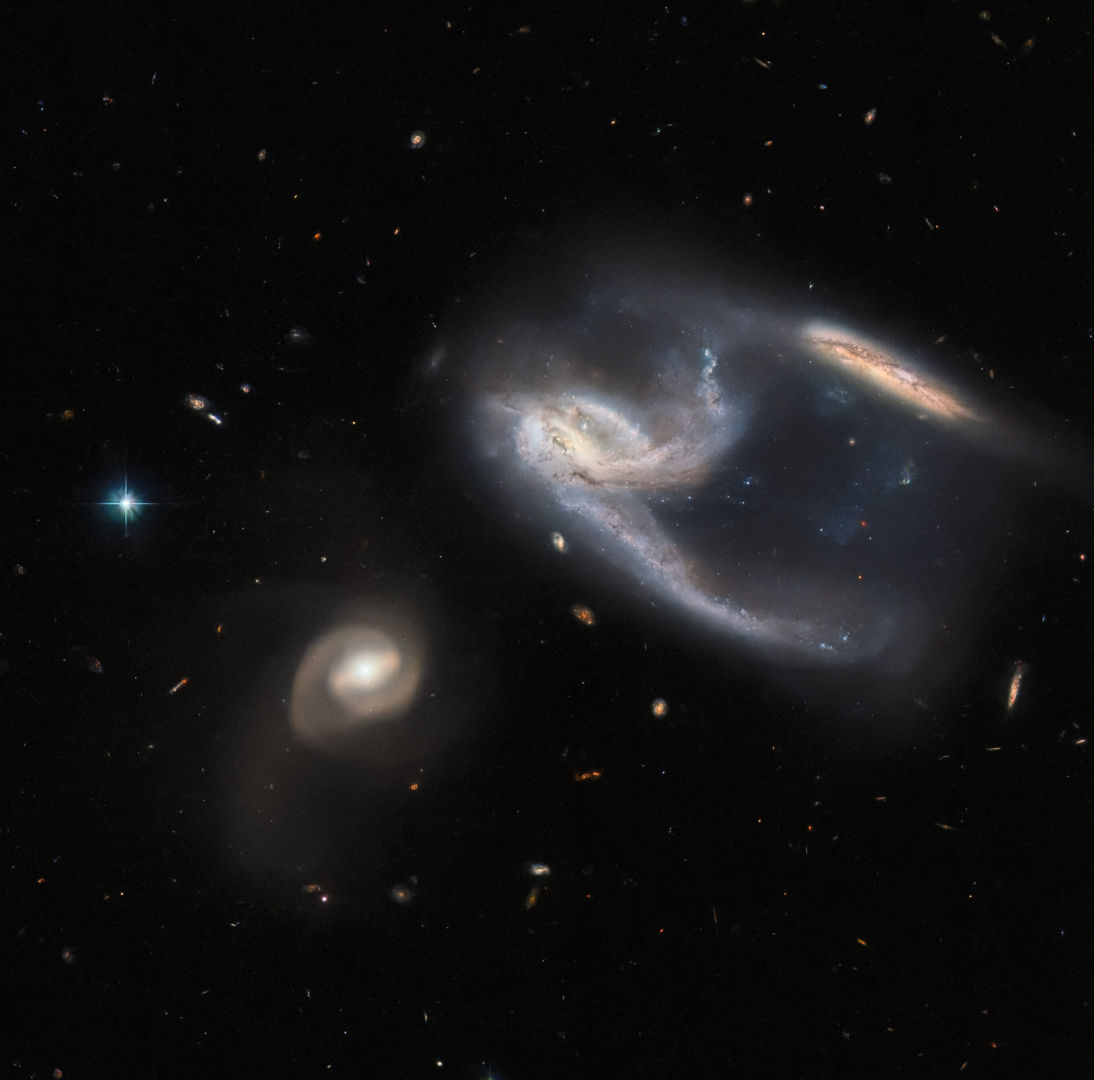
The image shows not one galaxy but three, collectively known as NGC 7764A, as seen by Hubble.
In space, nothing is static – not even galaxies. Galaxies collide and merge on enormous scales as they're pulled together by gravity.
And when galaxies do merge, the individual stars within each galaxy are so far apart, it's unlikely the stars would collide.
Instead, gravitational interactions churn up gas and dust and can even lead to new stars being born.
Even our own Galaxy is on a collision course. Astronomers say the Milky Way will eventually collide with its galactic neighbour in a future event dubbed the Andromeda-Milky Way collision.
In the case of this image of NGC 7764A, the two galaxies in the upper right are interacting with one another, forming the familiar shape of the USS Enterprise.
We can see long trails of stars and gas extending from the galaxy collision.
Interactions between galaxies happen over long periods of time, so the strange formation produced by the merger isn't going to change any time soon.
NASA says it's unclear whether the galaxy to the lower left is interacting with the other two, but they're so close to each other, it's possible this is in fact a triple galaxy collision.
Either way, this is NASA's fitting tribute to Sir Patrick Stewart, a name that will live long in the hearts and minds of sci-fi fans everywhere.