It's not easy measuring distances in the Universe, but astronomers have a few ways of getting around the problem.
One way is by observing exploding stars known as supernovae, and in particular a type of supernova known as a Type Ia supernova.
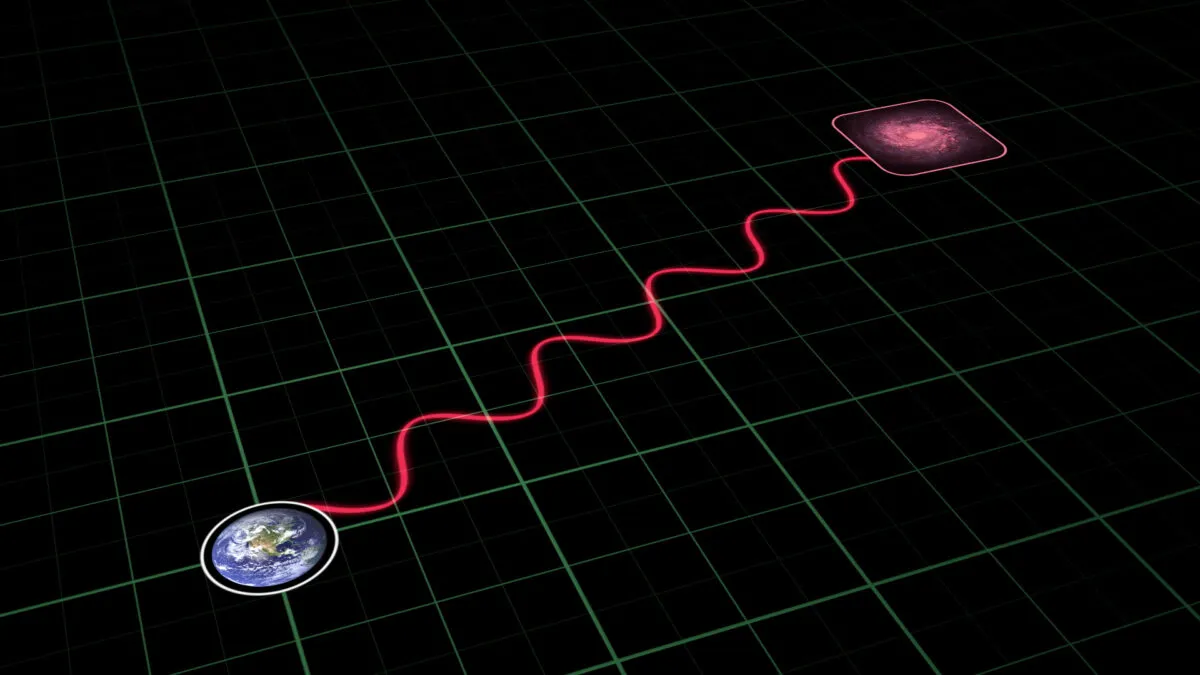
The idea is that these stellar explosions always glow with the same brightness, so astronomers can observe how bright they appear from Earth, compared with how bright they actually are, and thereby determine how far away they are.
But fresh evidence shows supernovae aren’t the trusty yardsticks we thought, putting the standard model of an accelerating, expanding Universe in doubt.
Dark energy is the name given to the fact that the expansion of the Universe seems to be accelerating, not slowing down, and it's one of the biggest mysteries in science.
But if we've been measuring the Universe wrong, does that mean the issue of dark energy finally has an explanation?
More on dark energy

Young-Wook Lee is the director of the Centre for Galaxy Evolution Research at Yonsei University, Seoul, South Korea.
We spoke to him about a study he carried out that shows the expansion of the Universe could be slowing down after all.

How do astronomers think the Universe is expanding?
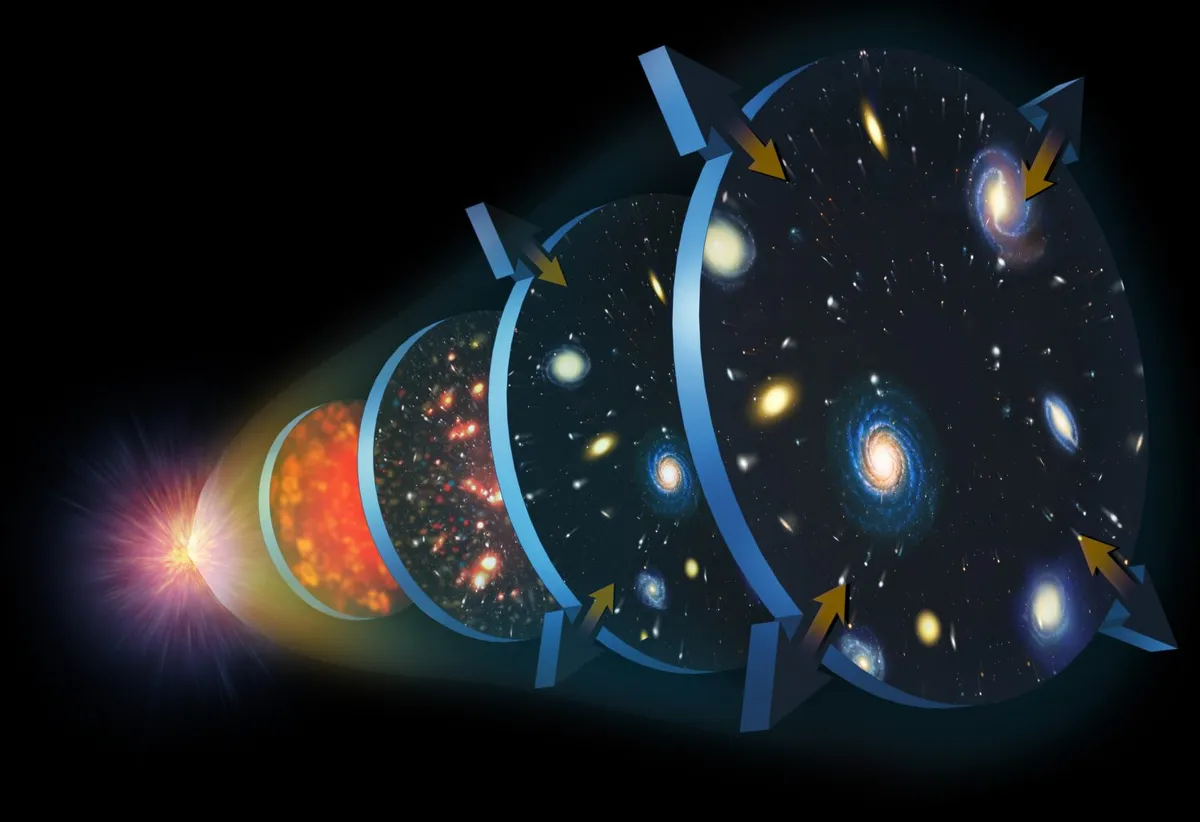
Astronomers have long believed the Universe is expanding at an accelerating rate, driven by what we call ‘dark energy’.
This led to a model known as Lambda cold dark matter (ΛCDM), in which the density of dark energy doesn’t vary with time.
Then, 27 years ago, a group of scientists observed distant supernovae – specifically Type Ia supernovae – and found they were dimmer than expected.
This fitted the predictions of ΛCDM very well, which is how we got the model of the Universe we have today.
What did your team discover?
Type Ia supernovae were used to test ΛCDM because they were thought to explode with an almost identical intrinsic brightness, making them good reference objects.
Instead, we found that the brightness of Type Ia supernovae is strongly affected by the age of the stars they come from.
After taking account of their age, supernovae from younger populations of stars appear fainter and those from older stars appear brighter.
We found an extremely high significance rate for our findings (over 99.9999999% confidence) in a sample of over 300 galaxies.
This means that the dimming of supernovae does not just arise from cosmological effects like the acceleration of the Universe, but also from stellar astrophysics.
As a result, the data we collected no longer matches the ΛCDM model.

What alternative model of the Universe does this point to?
Our data points to a model of the Universe based on ‘time-varying dark energy’, where instead of dark energy acting in a fixed, constant way, its impacts vary with time.
These models are also supported by data from other projects, like the Dark Energy Spectroscopic Instrument (DESI).
How did you make this discovery?
We started this project in 2010, when South Korea lacked its own telescope.
We sent two students to Chile and Arizona to collect extremely high-quality spectral data of 60 galaxies.
Our project has since been extended to 300 host galaxies by employing photometric age measurements.
This data is like a fingerprint, giving astronomers an accurate idea of the properties of an astronomical object, including its composition.
It was from this data, and the well-established DESI model, that we found that the age of the host galaxy impacts the brightness of supernovae within it.

What if the ΛCDM model of expansion is wrong?
The history of the Universe will change. Even the age of the Universe will change slightly.
Interestingly, the future of the Universe will change too. It could potentially lead to a ‘big crunch’ scenario – which some cosmologists have discussed based on our result – where the Universe collapses back down to a singularity after finishing its expansion.
We cannot say for certain at this stage, but it’s certain that the Universe’s story will be rewritten.
Why wasn't this correction made earlier?
In most previous studies concerning these supernovae, the ages of the host galaxies were not directly measured. Instead, they were inferred indirectly from the mass of the host galaxy.
This practice has become routine, but we’ve found that mass is not a reliable proxy for age, because galaxies evolve very differently with redshift (or cosmic time).
By applying a correction based on directly measured ages, rather than on a proxy, we have been able to show a dramatically different result for cosmology.
What’s next?
We have a bright future ahead, with the launch of telescopes like the Vera Rubin Observatory, which South Korean astronomers are also members of.
It will discover more than 20,000 new supernovae host galaxies, and precise measurements will enable a more definitive test of supernova cosmology.
This interview appeared in the January 2026 issue of BBC Sky at Night Magazine