
Back in 2016 astronomers found strong evidence of a rocky, Earth-like planet orbiting Proxima Centauri, the closest star outside of our Solar System. Located just 4.24 lightyears away in the Alpha Centauri star system, it is, for all intents and purposes, our next-door neighbour in the Milky Way.
The discovery was led by Dr Guillem Anglada-Escudé of Queen Mary University of London. He headed a team of over 30 scientists from around the world as part of the "ESO’s Pale Red Dot campaign" campaign.
“The first hints of a possible planet were spotted back in 2013, but the detection was not convincing," says team leader Guillem Anglada-Escudé.
"Since then we have worked hard to get further observations off the ground with help from ESO and others.
More on exoplanets

The exoplanet was detected by the Radial Velocity method – measuring the tiny "wobble" the planet causes in its star's motion. It is a common misconception that planets orbit stars. In reality, both the planet and the star orbit a shared centre of mass. Because the star is so much heavier, that centre is usually deep inside the star itself, making it look like the star is just "wobbling" back and forth.
This means we aren’t able to take a direct photo of it yet, but upcoming telescopes like the Extremely Large Telescope (ELT) might change that.
However, that doesn’t mean we are completely in the dark when it comes to Proxima B. Observations revealed the planet is about 1.3 times the mass of Earth and orbits its star at a distance of about 7 million kilometres, or 5 per cent of the distance between Earth and the Sun.
The exoplanet is also thought to be in the habitable zone, often called the Goldilocks Zone. This is the region where temperatures are just right – not too hot and not too cold – to potentially allow liquid water to exist on the surface.
Because its parent star is a dim Red Dwarf, the habitable zone is much closer to the star than in our solar system – about 20 times closer to its star than Earth is to the Sun. Proxima b orbits its sun at a breakneck pace, completing a full "year" in just 11.2 Earth days. It has to be this close to stay warm, because its star is significantly cooler and smaller than our Sun.
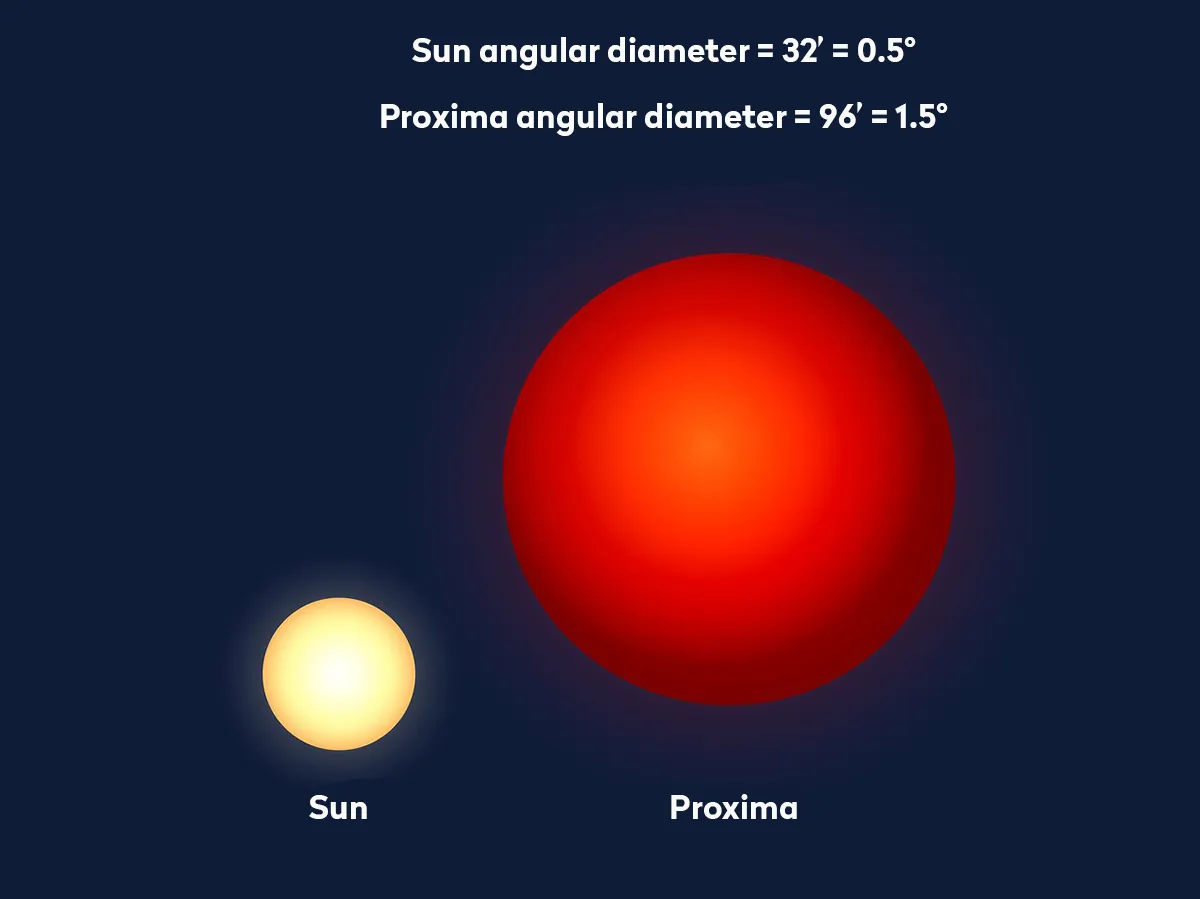
However, its habitability cannot be confirmed as it could be subject to blasts of radiation from its host star.
"That's the worry in terms of habitability," says Scott Gaudi, an astronomy professor at Ohio State University, Columbus.
"This thing is being bombarded by a fair amount of high-energy radiation.
It's not obvious if it's going to have a magnetic field strong enough to prevent its whole atmosphere from getting blown away.
But those are really hard calculations, and I certainly wouldn't put my money either way on that."
Due to its proximity to its star, scientists believe Proxima b is tidally locked. This means one side of the planet always faces the star (permanent day), while the other side is shrouded in eternal darkness (permanent night). Life, if it exists, might huddle in the "twilight" ring between the two halves.
If you were to stand on Proxima b, the gravity is likely only slightly stronger than Earth's, meaning you'd just feel a bit "heavier" – roughly like carrying a small backpack.
So can we visit Proxima b?
It may be the closest to us, but while "4.2 lightyears" is close compared to other known exoplanets, our current space travel technology is slow. Using a spacecraft like Voyager 1, it would take about 73,000 years to get there. However, projects like Breakthrough Starshot could send tiny laser-powered probes that could make the trip in just 20 years.
Despite this, astronomers are still excited. "This is really a game-changer in our field," says Olivier Guyon of NASA's Jet Propulsion Laboratory.
"The closest star to us has a possible rocky planet in the habitable zone.
That's a huge deal. It also boosts the already existing, mounting body of evidence that such planets are near, and that several of them are probably sitting quite close to us.
This is extremely exciting."

