
You might be forgiven for thinking that these images of Saturn are the creation of Andy Warhol or any of his pop art contemporaries.
They are, in fact, real images of the planet captured by the Hubble Space Telescope using a variety of different filters.
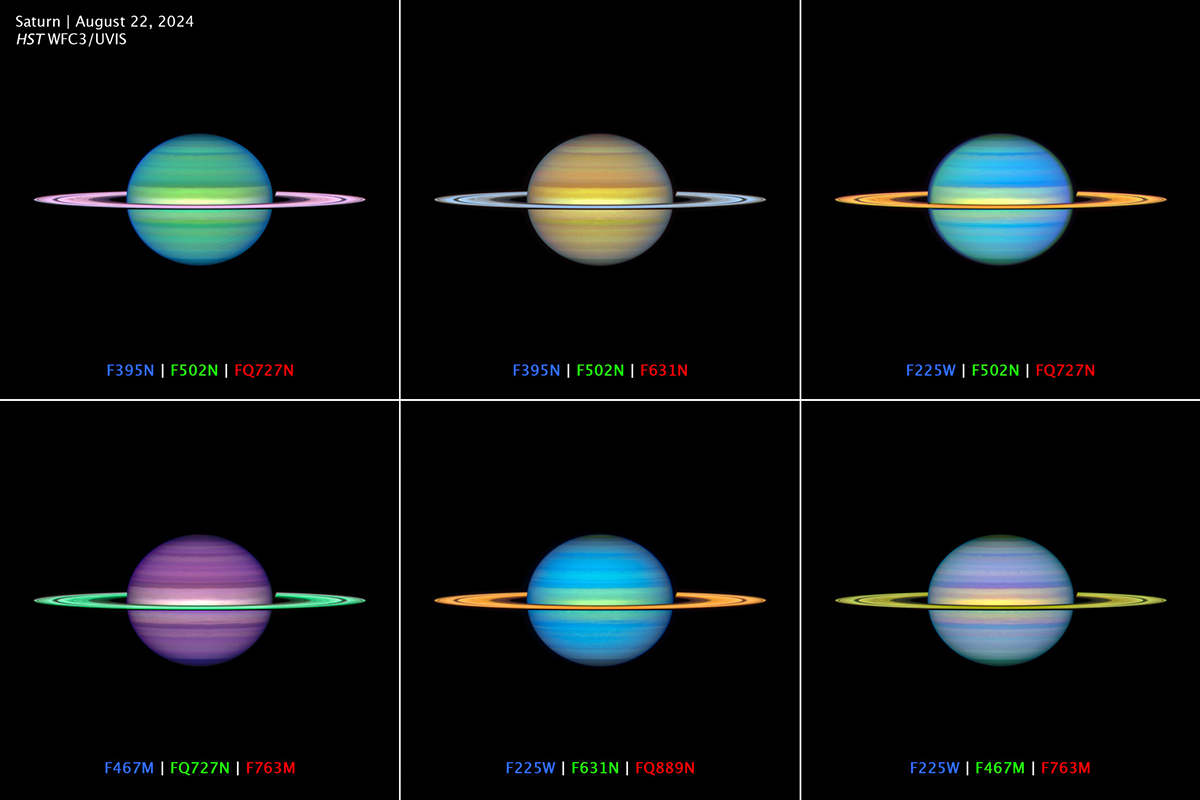
These colourful Saturn images show real data captured by Hubble with filters, which is then mapped onto the RGB (red, green, blue) colours visible to the human eye.
By observing celestial objects using filters, astronomers can hone in on different wavelengths of light and see features that would normally be invisible.
Each filter combination reveals differences in Saturn's cloud altitude or composition.
Hubble is seeing Saturn's rings disappear
The images were captured as part of the Hubble Space Telescope observation program called OPAL (Outer Planet Atmospheres Legacy).
This programme observes the outer planets of our Solar System – Jupiter, Saturn, Uranus and Neptune – to track how their atmospheres change over time.
OPAL began observing Saturn in 2018, just after the end of the NASA Cassini mission at the ringed planet system.
This means it has been following Saturn for about one quarter of the planet's year (it takes over 29 years to orbit the Sun).
As a result, Hubble gets to see how the orientation of the Saturn's ring system changes over time, relative to Earth.
Every 15 years or so, Saturn undergoes a 'ring plane crossing', when its rings are edge-on from our perspective, making them seem to disappear.
That last occurred in 2025, at which point Saturn's rings were incredibly difficult to see from Earth.

