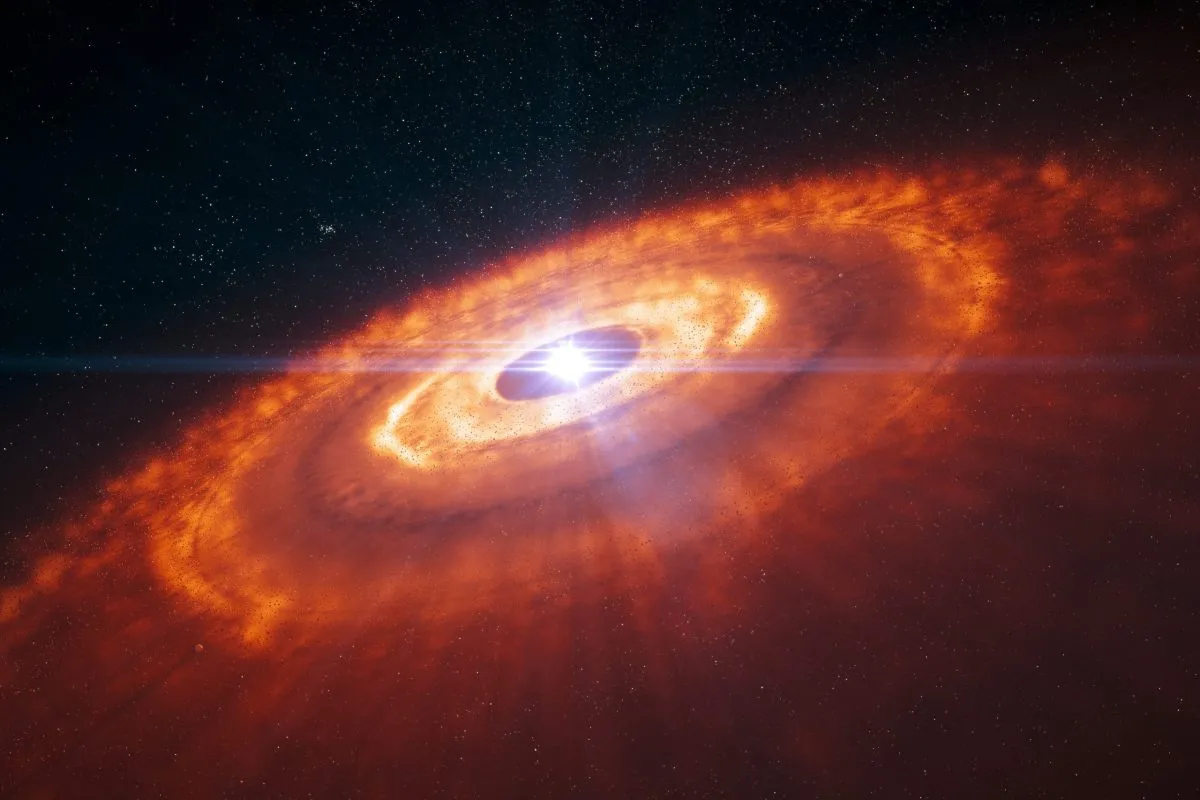
Scientists have successfully manufactured artificial cosmic dust in a laboratory, offering new clues to how the building blocks of life may have formed in deep space long before planet Earth came along.
The University of Sydney team used simple gases and high-voltage electricity to mimic the extreme environments found around dying stars, producing carbon-rich grains that match the infrared fingerprints of dust seen across the Galaxy.

Led by PhD candidate Linda Losurdo, the research provides a new platform for studying complex space chemistry without having to wait for rare meteorite falls.
By subjecting a mixture of nitrogen, carbon dioxide and acetylene to 10,000 volts, the team created a ‘glow discharge’ plasma.
This process breaks apart gas molecules and drives them to recombine into solids.
“It’s like we have recreated a little bit of the Universe in a bottle in our lab,” says Losurdo.
“We no longer have to wait for an asteroid to come to Earth to understand its history. You can build analogue environments in the laboratory and reverse-engineer their structure using the infrared fingerprints.”

The resulting dust contains a cocktail of carbon, hydrogen, oxygen and nitrogen – known as the CHON elements.
These are the fundamental ingredients for organic compounds like amino acids.
They aim to build a database of these infrared signatures to help astronomers find regions of the cosmos where life-relevant chemistry is most active, further illuminating the long journey from stardust to biological life.

"By making cosmic dust in the lab, we can explore the intensity of ion impacts and temperatures involved when dust forms in space," says Professor David McKenzie, co-author on the paper.
"That’s important if you want to understand the environments inside cosmic dust clouds, where life-relevant chemistry is thought to be happening.
"This also helps us interpret what a meteorite or asteroid fragment has been through over its lifetime. Its chemical signature holds a record of its journey, and experiments like this help us learn how to read that record."
Read the full paper at the Astrophysical Journal