
Our Sun was part of a mass migration of stars from the centre of our Galaxy 4–6 billion years ago, and this may have been key to the emergence of life on Earth.
A team of astronomers say they've found evidence that our Sun and other Sun-like stars, or 'twins', left the core regions of our Galaxy around the same time as the Sun formed.
More amazing space science

They say the discovery sheds light on a key stage in the evolution of our Galaxy, and in particular the development of a spinning bar-like structure at its core.

Cosmic archaeology
Astronomers have been able to piece together a lot of information about our Galaxy, and even our Universe.
The cosmos is thought to be 13.8 billion years old, and our Sun is about 4.6 billion years old.
But our Sun wasn't always where it is today, according to astronomers. The current understanding is that the Sun was born 4.6 billion years ago about 10,000 lightyears closer to the centre of the Galaxy than it is today.
A team of scientists from Tokyo, Japan looked at a catalogue of stars created by the European Space Agency's Gaia satellite, to learn more about the evolution of our Galaxy and what that means for our Solar System.
Gaia operated for just over 10 years, finishing its mission in 2025, and in that time measured the positions, distances and motions of about two billion stars to produce the largest 3D map of the Milky Way galaxy ever made.
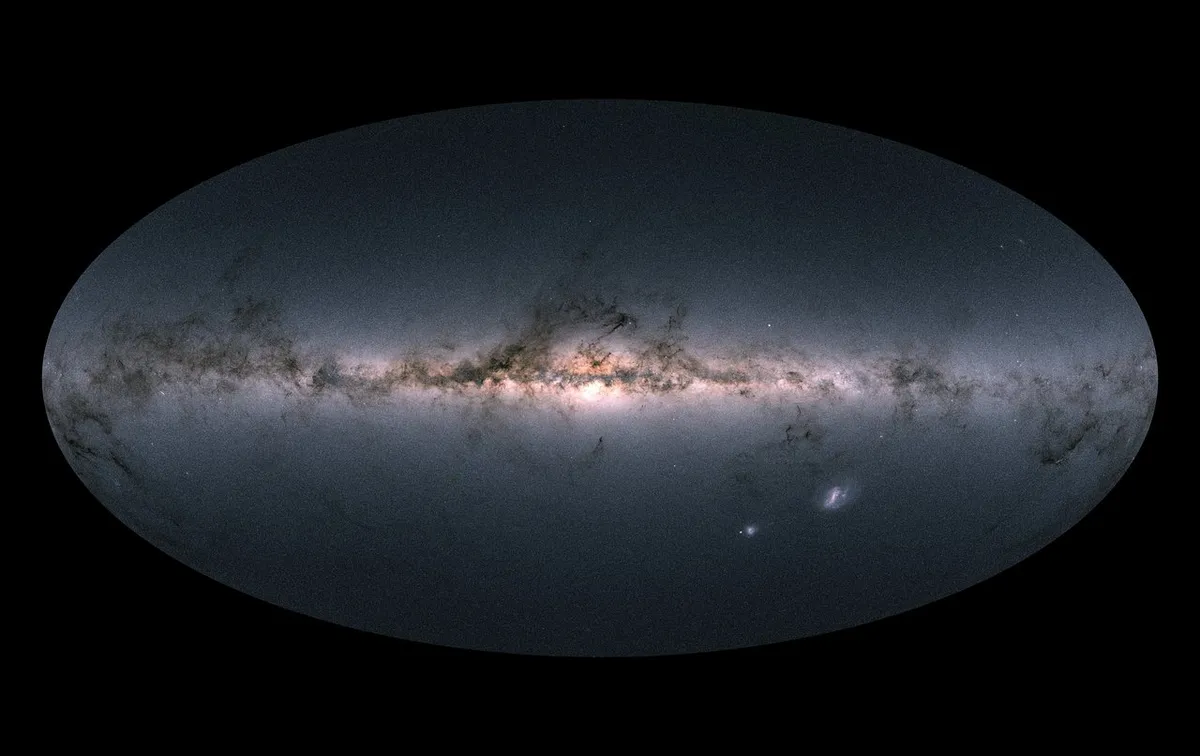
This data proved invaluable to the galactic archaeology team, led by Daisuke Taniguchi from Tokyo Metropolitan University and Takuji Tsujimoto from the National Astronomical Observatory of Japan.
They conducted a study of solar 'twins', i.e. stars with similar temperature, surface gravity and composition to our Sun.
Using Gaia data, the team produced a catalogue of 6,594 stellar twins, then used that to get an accurate view of the ages of the stars.
They say they also corrected for 'selection bias' of stars that are easier to see.

A clue to stellar migration
The team say they noticed a broad peak for stars around 4 to 6 billion years old, including our Sun, positioned around the same distance from the centre of the Galaxy.
They say this means our Sun is not at its current position by accident, but was part of a larger stellar migration.
And, the team say, this discovery doesn't just affect what we know about our Solar System, but what we know about the evolution of our Galaxy itself.
In particular, it tells the team a lot about the so-called 'corotation barrier', which is a known bar-like structure at the centre of the Milky Way that should make it difficult for stars to escape from the core.
The team say the corotation barrier wouldn't allow for such a mass migration of stars, unless it was still being formed at the time.
That means the ages of the Sun and its stellar twins reveal not only when the mass migration from the centre of the Galaxy occurred, but the time range over which the bar was formed.

This migration could also have had huge implications for the emergence of life in our Solar System.
The centre of the Galaxy is a chaotic place, and life is far less likely to emerge there.
But the migration of our Sun from the centre of the Galaxy brought it into a region where it was much more likely for life to develop.
That could mean that, without this mass migration of Sun-like stars, life may never have emerged on Earth.
Read the full paper at Astronomy & Astrophysics


