
The Milky Ways’s most distant spiral arms may extend significantly farther into space than previously believed, meaning fundamental models of our home Galaxy may need to be revised.
Astronomers used an innovative measurement technique based on X-ray echoes from powerful gamma-ray bursts captured by NASA’s Chandra X-ray Observatory and ESA’s XMM-Newton.
Publishing in Astronomy & Astrophysics, the international team measured the distances to dust clouds within the Milky Way’s spiral arms by studying expanding X-ray rings produced by bright gamma-ray bursts in distant galaxies.
As the X-rays travelled towards Earth, some were scattered by the dust clouds, creating ‘light echoes’.
These illuminated the clouds and allowed researchers to calculate their precise distances from Earth, with larger rings produced by dust clouds closer to us.
More on our Galaxy
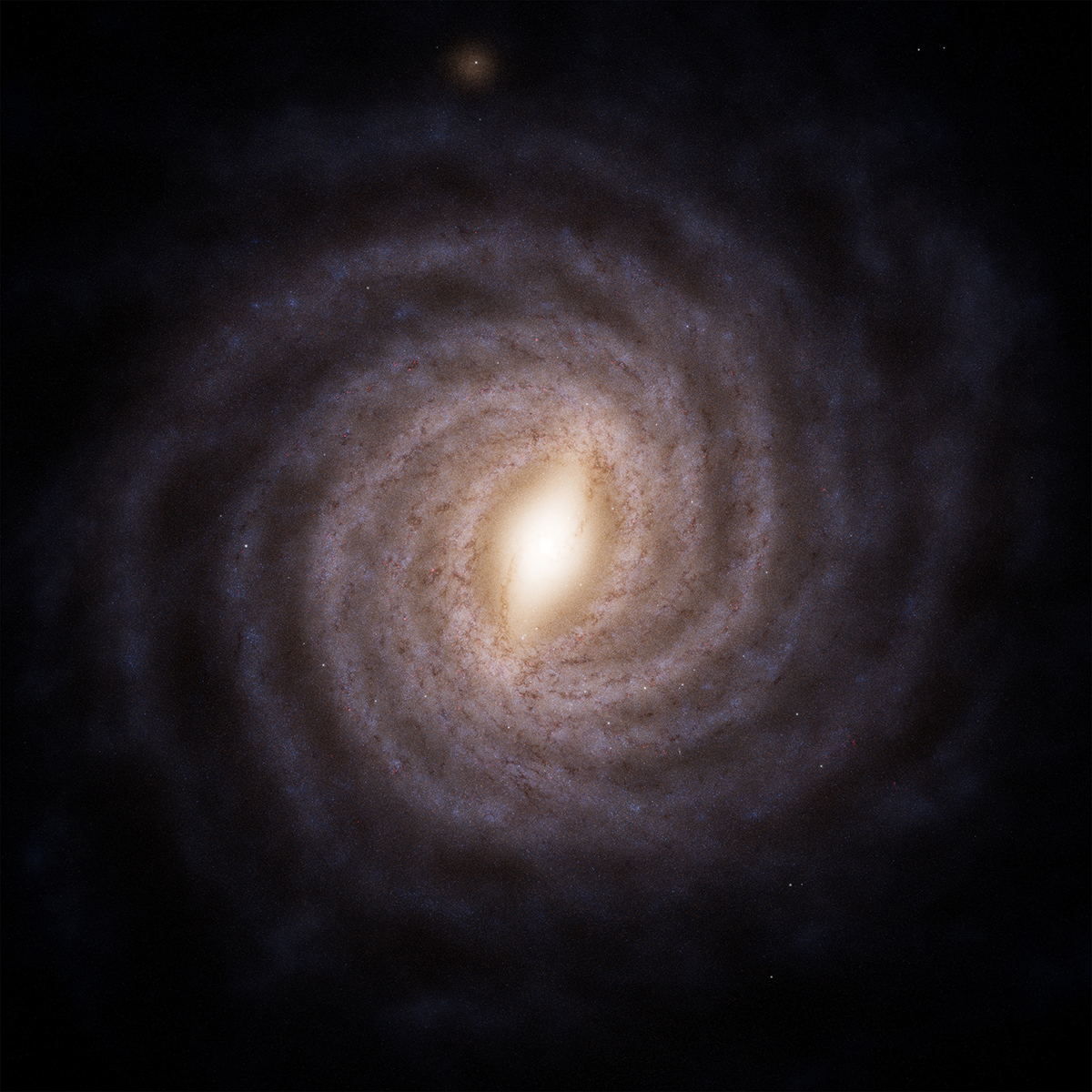
The measurements confirm the accepted distance to the Milky Way’s Perseus Arm, but indicate that the Outer Arm and the Outer Scutum–Centaurus Arm lie up to 10 per cent farther away than previously estimated.
Lead author Beatrice Vaia says: "This is a very direct way, relying only on geometry, to precisely measure distances to the spiral arms.
"Most other methods rely on assumptions about how the Milky Way rotates, which become increasingly uncertain in the outer regions."
But the new, precise technique is unlikely to be applied more widely soon, because suitable gamma-ray bursts are so rare.
"We’re relying on the Universe to provide us with these events and so far, over 25 years, we’ve only found a handful that we can use," comments co‑author Andrea Tiengo.

