
On 9 June 2026, Venus and Jupiter will appear so close together in the sky, they'll be separated by the same distance as your little finger held out at arm's length.
These are two of the brightest planets in the night sky, and their close approach from May into June will be an amazing sight to behold.
Key to enjoying this close conjunction of Venus and Jupiter will be following the pair from late March onwards, as they'll appear to get closer and closer to one another in the run-up to 9 June 2026.
In this guide, we'll reveal how you can prepare for it, what you'll see on the day and tips for photographing it.
Get weekly Moon phases and stargazing advice delivered directly to your email inbox by signing up to the BBC Sky at Night Magazine e-newsletter
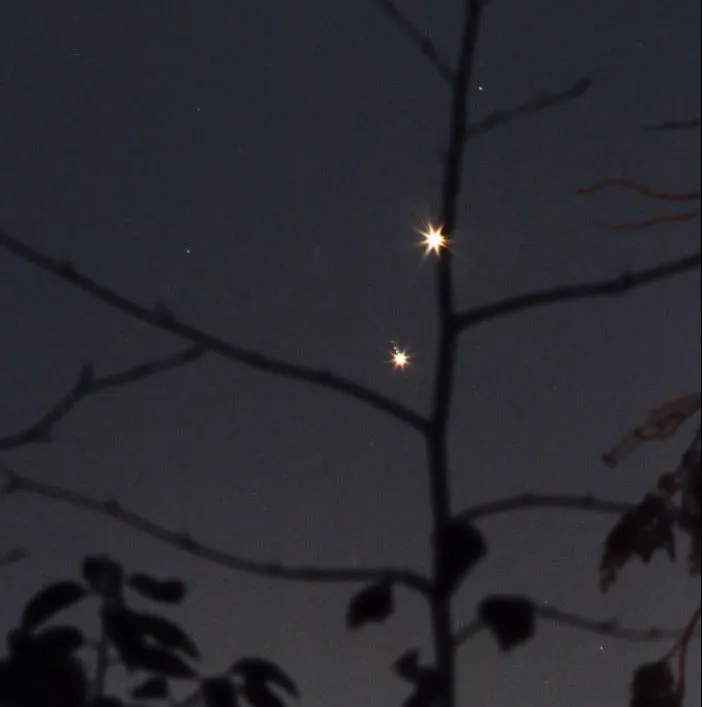
The build-up
As of later early June 2026, Venus is now a glorious evening sky object.
It sets in the west after sunset, which means you should only attempt to observe it once the Sun has fully set.
But Venus is getting better; lingering longer above the horizon after sunset as the days go by.
Jupiter, meanwhile, is heading slowly into the Sun's glare and will eventually be lost from view by mid June, before emerging as a morning planet in autumn 2026.
That's why this month, the two planets will meet in the sky, like celestial ships temporarily passing each other in the night.

If you start observing Venus and Jupiter in early June 2026, you'll be in a prime position to track their apparent movement across the sky, night-by-night, over nights running up to their close approach on 9 June 2026.
And you may be thinking that we're approaching prime summertime in the build-up to the Venus-Jupiter conjunction, which is hardly ideal for spotting planets under a dark night sky.
However, Venus and Jupiter are very bright and able to withstand the ever-increasing twilight, given their positions in June 2026.

Observing the Venus-Jupiter conjunction on 9 June 2026
The Venus-Jupiter conjunction is one of those celestial events that isn't restricted to a single evening's viewing, and you can watch the two planets close together in the sky in the days approaching 9 June 2026.
Some readers may remember the Venus-Jupiter conjunction of 12 August 2025, and how the two planets were visible together for a good time before and after that date.
It's just that 9 June 2026 is the day when Venus and Jupiter will be at their closest, so this is the date that most people are likely to be observing and photographing the conjunction.

To put it into true astronomical parlance, on 9 June 2026 Venus and Jupiter will appear 1.6° apart in the night sky.
That's about the same distance in the sky as the width of your little finger held out at arm's length.
Venus and Jupiter will be low in the west just after sunset, only giving you around an hour between the Sun setting and the two planets setting.
It's imperative not to look at the Sun with the naked eye, which is why you must wait until the Sun has fully set before attempting to observe the planets.
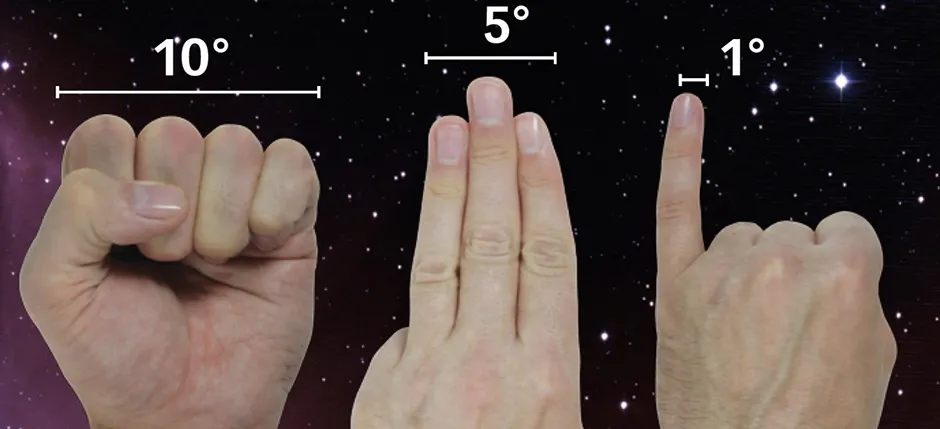
Give yourself the best chance of seeing the conjunction by finding a clear, flat, western horizon, unobstructed by buildings or trees.
Venus and Jupiter will be located near Castor and Pollux, the twin stars of Gemini, but these stars will be tricky to see against the dawn twilight. Venus and Jupiter will be much brighter and easier to see.
Venus will be the brightest of the two, sitting above Jupiter as the pair head towards the northwest horizon after sunset.
While binoculars or a telescope would in theory give you a better view of the planets, this is not recommended unless you're an experienced astronomer, as accidentally observing the Sun through binoculars or a telescope could seriously damage your eyesight.

Venus, Jupiter and the Moon
In the weeks leading up to Venus and Jupiter's close approach on 9 June 2026, the Moon made a few significant appearances in the same region of sky. Did you catch any of these?
The thin crescent Moon was above Venus after sunset on 19 April, but at this early stage Jupiter was high in the sky and far from Venus.
A very thin crescent Moon was to the right of Venus after sunset on 18 May 2026, with Jupiter now closer to Venus.

The following evening on 19 May 2026, the crescent Moon was higher in the sky and between Venus and Jupiter: Venus lowest, the Moon in the middle and Jupiter highest.
On 17 June 2026, after the close conjunction of Venus and Jupiter, the thin crescent Moon will be close to Venus just before sunset.
This will be difficult to see given the brightness of the evening twilight, and Jupiter will be below the horizon by that stage.
Photographing the Venus-Jupiter conjunction

The Venus–Jupiter conjunction will take a bit of planning to photograph, given how close the two planets will be to the horizon so close to the summer solstice.
Use a stargazing app to help you work out where the planets will be during your chosen night, from your location.
The planets will appear as two bright dots in the sky, which may not make for the most spectacular photograph! Consider including an interesting foreground object to give your image scale and interest.
You could even capture multiple images of the planets over several nights from the same location, then stitch them together to show their apparent movement across the sky.
Plan to capture extra shots either side of your chosen image time, to give you every chance of catching the pair.
Get more advice in our guide on how to photograph the Venus—Jupiter conjunction

Venus-Jupiter conjunction quick questions
Do I need a telescope to see the conjunction?
No. Venus and Jupiter will be bright enough to see with the naked eye, and with conjunctions like this it's often better not to restrict your view by looking through a telescope eyepiece. Also, observing the western horizon with a telescope so soon after sunset could be dangerous.
Where and when should I look?
Look to the west-northwest horizon just after sunset.
What will I see?
You'll see Venus looking like a bright evening 'star' in the dawn twilight and Jupiter, slightly dimmer, just below it. By 9 June 2026, the two planets will be very close together.
How long will it last?
Not long. You'll have maybe an hour between sunset and the two planets setting beneath the horizon. That's why finding a clear western horizon is important.
Are the planets really close together?
No, it's just a matter of perspective, caused by how we observe the 3D cosmos in our 2D sky. In reality, the orbits of Venus and Jupiter around our Sun are incredibly far from each other. Even at their closest, Venus and Jupiter are 670 million km (416 million miles) apart.
If you observe or photograph the close conjunction of Venus and Jupiter on 9 June 2026, share your images with us by emailing contactus@skyatnightmagazine.com

