
At the centre of galaxy Messier 77 lies a cosmic behemoth glowing so intensely, it outshines its entire galactic neighbourhood.
The James Webb Space Telescope has captured the piercingly bright core of the barred spiral galaxy, offering astronomers a view of the tremendous energy released by the central supermassive black hole.
Located 45 million lightyears away in the constellation Cetus, M77 is an active spiral galaxy.
More Webb images
Its heart contains a compact region of hot gas known as an active galactic nucleus (AGN).
This AGN is powered by a supermassive black hole eight million times as massive as our Sun.
As material is sucked into a tight, rapid orbit by the black hole’s gravity, it generates friction and heats up, releasing a brilliant light that outshines the rest of the galaxy.

Webb's view of the M77 black hole
The image above was produced using Webb’s Mid-Infrared Instrument (MIRI) to reveal the swirling spiral arms and the dust in the galaxy's disc.
The bright orange lines radiating from the centre are not physical parts of the galaxy; they are diffraction spikes.
These occur when intense light from a concentrated source—like this AGN—is bent at the edges of Webb’s hexagonal mirrors.
Below is another image of Messier 77, captured by the James Webb Space Telescope's Near-Infrared Camera

A factory for star formation
M77 is aso a prolific star-forming galaxy. Webb’s near-infrared data reveals a central bar enclosed by a starburst ring.
This ring, spanning more than 6,000 light-years, is visible as a collection of densely concentrated orange bubbles.
These bubbles represent regions with extremely high star-formation rates.
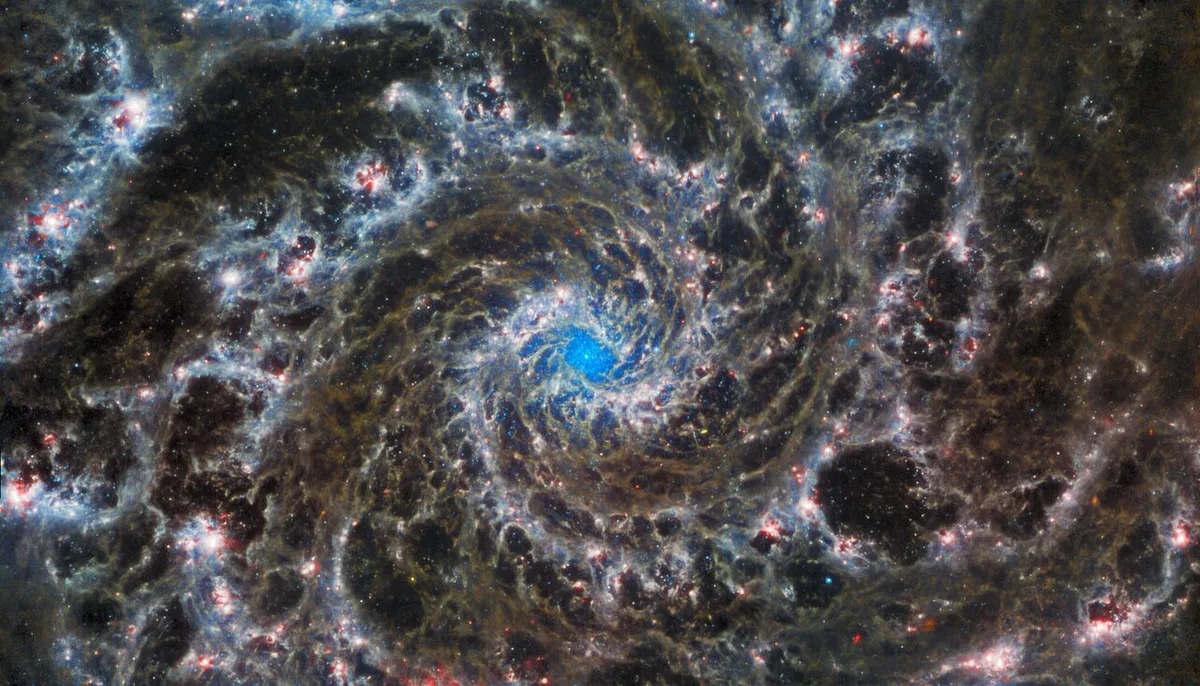
Beyond the bright core, Webb’s MIRI has captured the glow of interstellar dust grains, shown in blue.
This dust forms a vast vortex of smoky, swirling filaments. Farther out, the galaxy’s arms join an extended ring of hydrogen gas.
Because of the tentacle-like appearance of these outer gas filaments, M77 has earned the nickname the Squid Galaxy.
Data from this observation is part of a Webb programme surveying massive, nearby galaxies.
The high resolution of Webb’s instruments allows astronomers to see star clusters and gas reservoirs in incredible detail, helping them explore the cycle of star formation, life and death across the Universe.

