In 2015, astronomers discovered something downright weird in a star with the unassuming catalogue number KIC 8462852.
Slightly larger than the Sun, this F-type star in the constellation Cygnus is in a binary system with a red dwarf companion.
Citizen scientists sifting through data from the Kepler space telescope as part of the Planet Hunters project spotted some highly unusual variations: very deep dips of up to 20% in the star’s brightness.
For comparison, a Jupiter-sized exoplanet would block only about 1% of such a star’s light.
The dimming is also completely irregular, not showing any of the periodicity you would expect if it were due to an orbiting planet.
More cosmic mysteries
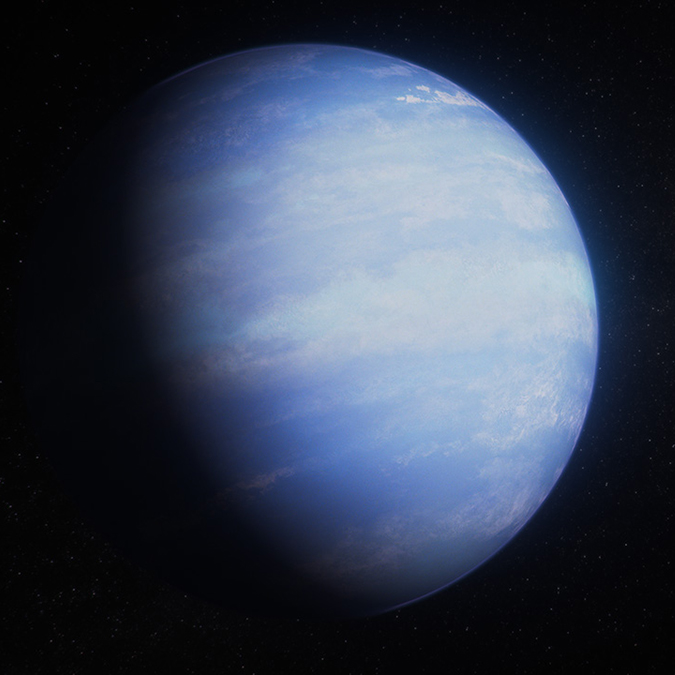
What could Tabby's Star be?
This curious celestial object has come to be nicknamed Tabby’s Star or Boyajian’s Star after the astronomer Tabetha Boyajian who wrote the paper announcing the discovery.
Theories have abounded as to what might be causing this peculiar behaviour.
These include an uneven ring of dust around the star, or a swarm of disintegrating comets, or perhaps a planet that has just been destroyed by a giant collision.
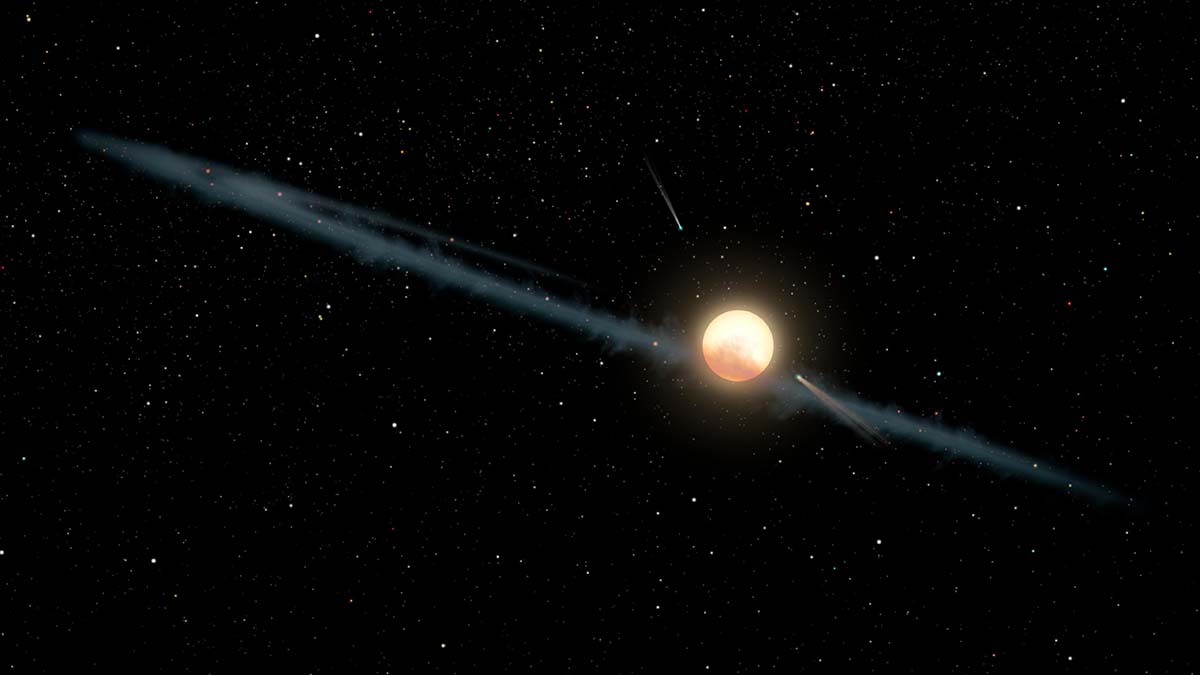
Some astronomers have even suggested that we might be witnessing the construction of an alien megastructure, something like a Dyson swarm.
But none of these proposals can perfectly account for the weird brightness variations.
Cristina Madurga-Favieres, a physics PhD student at the University of Warwick in the UK and her team reanalysed data from the Transiting Exoplanet Survey Satellite (TESS) to test these competing theories.
They found a new dimming of the star, dating to 3 September 2019, that hadn’t been spotted before.

The case for a hidden giant
This roughly 1% dip in the light curve is neatly symmetrical and lasted about 21 hours – highly suggestive of a transit from an unknown planet orbiting Tabby’s Star.
The problem is that it’s impossible to determine an exoplanet’s orbit with just one transit to work from.
The team did some clever detective work to narrow down the possibilities.
They know, for example, that it must have an orbit longer than about 776 days, otherwise multiple transits would have been detected.
They checked archive data from several telescopes, as well as new observations of the star with the Las Cumbres Observatory to further constrain the details of this potential planet.
Their analysis suggests the companion is on a slightly eccentric orbit, with a period of at least 1,030 days, and lies roughly 2.35 AU from the star.
This object would have a mass around nine times that of Jupiter, close to the boundary between giant planets and brown dwarfs (a mass limit where objects begin to undergo nuclear fusion of deuterium).
If this exoplanet is real, it could also explain the other irregular and mysterious variations in Tabby’s Star’s brightness.
Such a large gas giant in the outer system would gravitationally disrupt the orbits of comets or planetesimals and send them plunging inwards towards the star.
As they break up, they release clouds of dust that block the starlight and so cause the fluctuations our telescopes have been watching.
The team can’t yet confirm the planet’s existence, but the data due from the Gaia space telescope this December will be able to confirm or deny its presence.
Tabby’s Star remains mysterious, but we may soon be one step closer to understanding its bizarre fluctuations.
Lewis Dartnell was reading Evidence for a Giant Companion Orbiting Tabby’s Star by Cristina Madurga-Favieres et al. Read it online at arxiv.org/abs/2607.20643