Saturn's icy moon Enceladus is one of the best places to search for signs of alien life in our Solar System.
The moon has a liquid ocean beneath its frozen crust, meaning it could have the conditions needed to support life.
It's a fascinating world. When the Cassini spacecraft conducted its plume dives in 2015, flying through icy eruptions from beneath the surface of Enceladus, it found evidence of organic material.
Clearly, there's more to Enceladus than meets the eye. Here are 22 facts about the Saturnian moon.

Enceladus is the the 18th-largest moon in the Solar System
Quite a lot of the Solar System’s natural satellites are bigger, but Enceladus can at least claim to be the sixth-largest moon of Saturn (beaten by Titan, Rhea, Iapetus, Dione and Tethys)… and sixth out of 292 or so isn’t bad!
It has a diameter of 500km (310mi)
That makes Enceladus around 1/7th the size of Earth’s own Moon, and approximately 1/10th the size of Saturn’s largest moon, Titan.
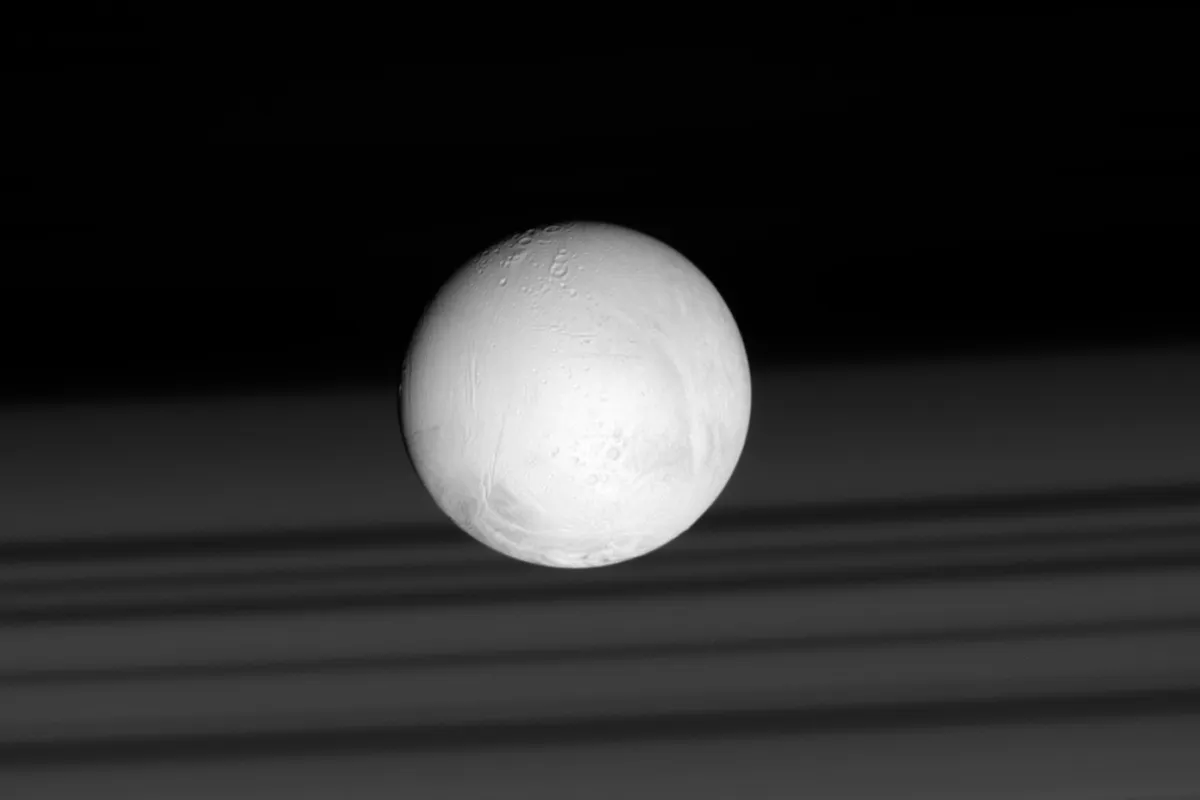
Enceladus is made of rock and ice
We used to think it was made entirely of ice, but NASA’s Cassini mission (2004–17) showed that it must have a much higher proportion of metals and silicates than had previously been assumed, based on the gravity it exerted upon the Cassini craft.
It’s a scalene ellipsoid
This means that, like a lot of objects in space, it’s a slightly deformed sphere.
A sphere has three axes of symmetry, all of the same length. Earth – because it’s flattened slightly at the poles, like a basketball with someone sitting on it – has two axes of symmetry that are the same and one that’s different, and is classed as an oblate spheroid.
But Enceladus’s three axes of symmetry are all of different lengths, so it’s a scalene ellipsoid.
Its diameter can be measured as 497, 503 or 513km, depending on whether you measure between the north and south poles, between the trailing and leading hemisphere, or between the sub-Saturnian and anti-Saturnian poles.
More about the icy moons

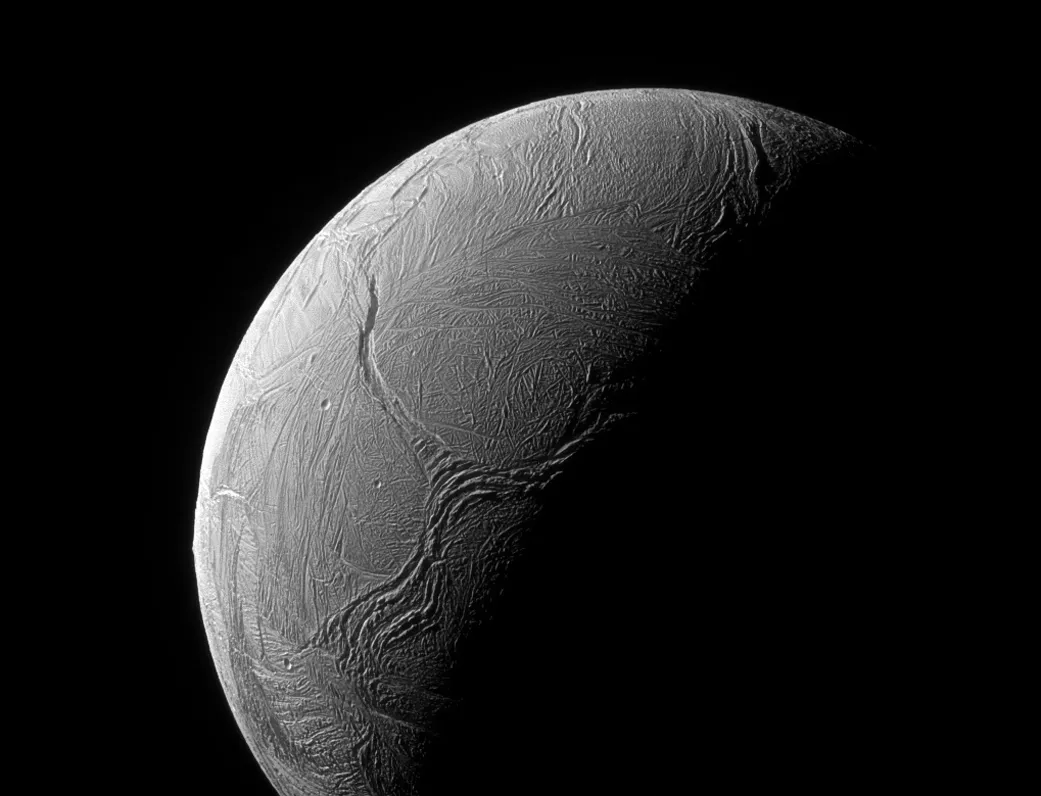
Enceladus is covered in snow
Enceladus is one of the most reflective bodies in the Solar System – and that’s because the entire surface is covered in a layer of snow.
We’re not talking a light dusting here, either – the blanket of snow in which this natural satellite is wrapped is up to 700 metres (2,300 feet) deep in some places!
It has an icy crust
Debate rages as to how differentiated or otherwise the interior of Enceladus may be – is it neatly stratified into layers, like Earth’s interior, or are different materials all jumbled up together?
But what we do know is that it has an icy crust that is unconnected to its core, and that said crust ranges in thickness from just a few kilometres at the poles to a maximum depth of 30-40km, with an average thickness of c.20-25km.

Enceladus has a vast subsurface ocean
The reason Enceladus’s crust is detached from its core is that it’s basically floating atop a vast underground ocean.
This ocean is believed to have an average depth of around 26-31km (16-19mi); for comparison’s sake, average ocean depth on Earth is around 3.6km (2.2mi), though the deepest areas can reach 11km (7mi).
That ocean may support life
Enceladus is thought by astrobiologists to be one of the best places in the Solar System to look for extraterrestrial life.
That’s partly because there’s so much water there, and partly because there’s evidence of hydrothermal activity in its subsurface ocean.
On Earth, there are extremophile bacteria that live around hydrothermal vents on the ocean floor, in an environment that would be extremely toxic to humans.
There is no obvious reason why similar vents on Enceladus shouldn’t support similar forms of life.
Enceladus's ocean is highly alkaline
Earth’s oceans have a pH of around 8.1 – down from 8.2, where we were a century ago (which is why environmentalists talk about the ‘acidification’ of the oceans), but still alkaline.
The pH of Enceladus’s sub-surface ocean, however, is around 11 or 12 – roughly the same as household bleach.
It’s got beautiful plumage!
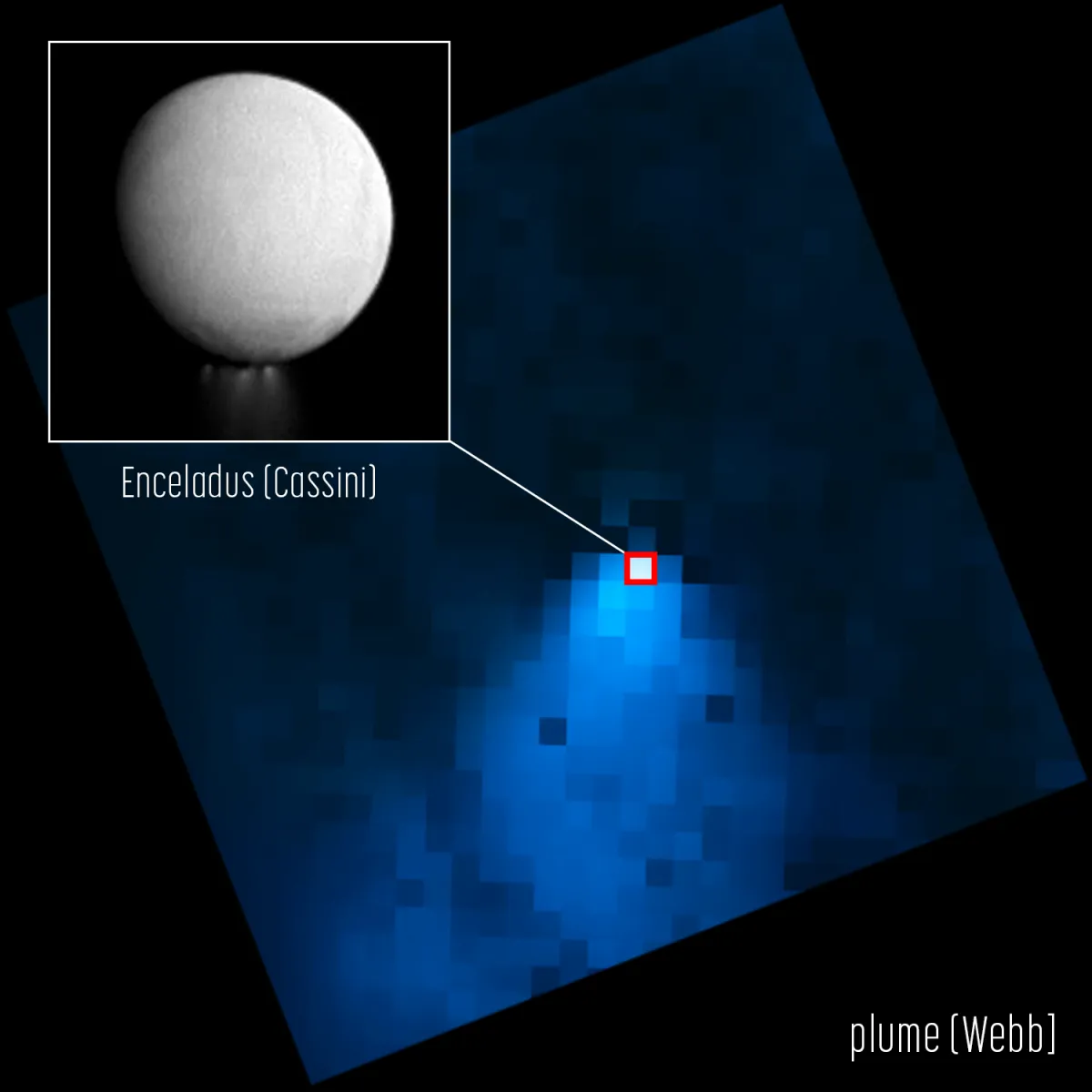
Perhaps the most interesting thing about Enceladus are the huge, water-rich plumes that erupt from its south polar region.
These are similar to the geysers we see here on Earth, except that they more closely resemble ‘curtains’ of water rather than narrow jets – and that they can extend up to 310km (500mi) out into space, travelling at speeds in excess of 2,000km/h (1,250mph) and transporting 200kg of water and water vapour out into space every second.

Enceladus is the source of Saturn’s E Ring
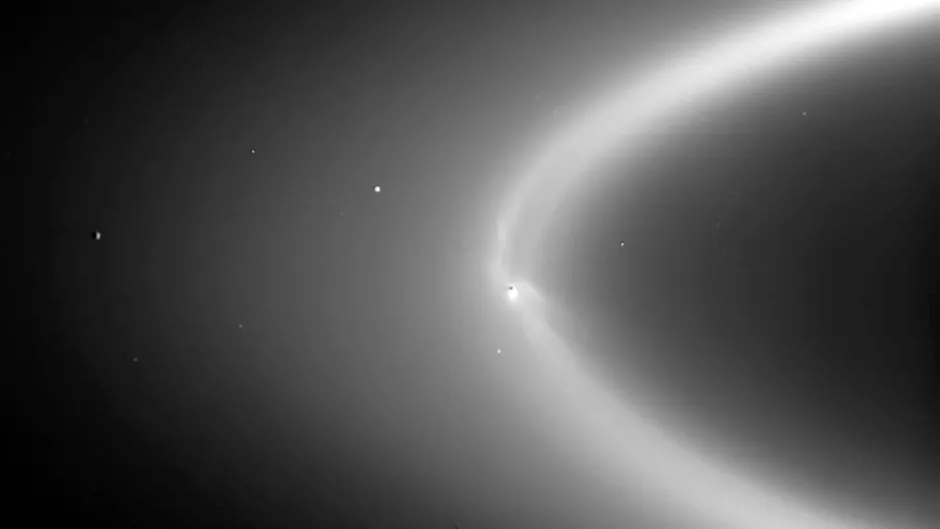
Enceladus’s orbital path lies entirely within Saturn’s E Ring, the outermost of its main rings (though the faint Phoebe ring is even more distant), and scientists now believe that the ring is in fact composed of material ejected in Enceladus’s plumes.
It’s cold and it snows a lot
Material from the plumes that doesn’t get whisked off into outer space to form the E Ring instead falls back to Enceladus in the form of snow.
So it’s no surprise that it’s a bit parky there: the average daytime surface temperature is -198°C.
Enceladus was discovered by William Herschel
German-British astronomer William Herschel became the first person to view Enceladus through a telescope on 28 August 1789… though he was, it should be pointed out, using the world’s largest telescope at the time!
The name was suggested by Herschel’s son
In 1847, William Herschel’s son John, also a keen astronomer, published his Results of Astronomical Observations made at the Cape of Good Hope, in which he suggested that Saturn’s moons should be named after characters from Greek mythology. His proposal was adopted.

Enceladus takes 32.9 hours to orbit Saturn
Enceladus whizzes around its host planet so fast that its motion can be seen in a single night’s observing (whereas an observer on Enceladus, looking at Earth’s Moon, would need to study the satellite for several nights before any motion became apparent).
It is tidally locked with Saturn, with its orbital path lying about 180,000km (110,000mi) above the Saturnian cloud tops, and about 238,000km (148,000mi) above Saturn’s center.
It has diverse terrain and topography
Enceladus has regions of smooth plain, and other areas that show evidence of both impacts and tectonic activity, in the form of rilles, ridges, cliffs and so on.
Such geological features are named after characters and places featured in Richard Francis Burton’s 1885 translation of The Book of One Thousand and One Nights (AKA Arabian Nights).

Enceladus's south polar region has four large, near-parallel depressions
Known as the “tiger stripes,” these four depressions average 130km (80mi) long, 2km (1.25mi) wide and 500m (1,640ft) deep, with flanking ridges 100m (330ft) tall and 2-4km (1.25-2.5mi) wide.
The ice in this region is rougher-grained than ice elsewhere on the surface, and they are believed to have resulted from cryovolcanism (ice volcanoes).
It has a thin, tenous atmosphere
There isn’t much of an atmosphere at all on Enceladus. What there is, seems to be concentrated above the south polar region, and consist mostly of water vapour.

We knew little about Enceladus for two whole centuries
Herschel might have discovered Enceladus in 1789, but fast forward to the late 1970s and we still didn’t know much about it except its location and its orbital path (and rough estimates of its mass and density).
That all changed with the Voyager missions.
Voyager 1 flew by at a distance of 202,000km (125,520mi) on 12 November 1980, sending back grainy images that revealed the presence of smooth plains on the surface, and confirmed its orbital position within the E Ring.
The following year, Voyager 2 got closer, coming within 87,010km (54,065mi) of the surface on 26 August 1981, and sent back higher-resolution images that revealed the extent of tectonic activity on its surface.

Most of what we know about Enceladus is thanks to Cassini
Funded jointly by NASA, ESA and the Italian space agency ASI, the Cassini-Huygens mission launched from Cape Canaveral on 15 October 1997.
Cassini went into orbit around Saturn in 2004 and stayed there until 2017, carrying out numerous fly-bys of Enceladus during that time – the closest coming within 49km (30mi) of the surface.
Cassini first discovered the plumes that emanate from Enceladus’s south pole, then flew through them – gathering a trove of scientific data for analysis.
It’s because of these fly-throughs, for instance, that we know the plumes don’t just consist of water.
There are also traces of carbon dioxide, molecular nitrogen and simple hydrocarbons such as methane, propane, acetylene and formaldehyde.
Having that detailed information available enabled scientists to develop a much more informed picture of Enceladus’s composition and structure.

Enceladus's plumes contain compounds believed essential for life
More detailed analysis of Cassini data has, in the past few years, thrown up several surprises.
These include the presence in the plumes not just of hydrogen (providing evidence for hydrothermal activity in its subsurface ocean) but also of hydrogen cyanide, other organic molecules and various phosphates.
Such materials are often held up as “the building blocks of life,” fuelling further interest in Enceladus as a good place to look for extraterrestrial life.
Sadly, no further missions are currently planned
With astrobiologists keen to learn more about Enceladus, several mission proposals have been put forward for consideration by different space agencies, but most of these have already been rejected.
One or two are still under consideration, including NASA’s Enceladus Orbilander and ESA’s L4 lander and orbiter, but no such mission has yet been given the green light.