Who hasn’t watched a show like Gladiators or Total Wipeout and thought: “Yeah, I could do that”? Or even: “I bet I could do better”?
In my case, that thought also extended to – wait for it – astronaut training. Yes, I can almost hear everyone’s eyebrows collectively shooting skyward.
More on human spaceflight

But in those days I used to spend my time running marathons and doing triathlons (okay, one triathlon), so when I saw footage of NASA’s Chosen Ones doing underwater training and zero gravity flights, I thought it looked… easy?
I say “in those days” because obviously something happened to put me firmly in my place.
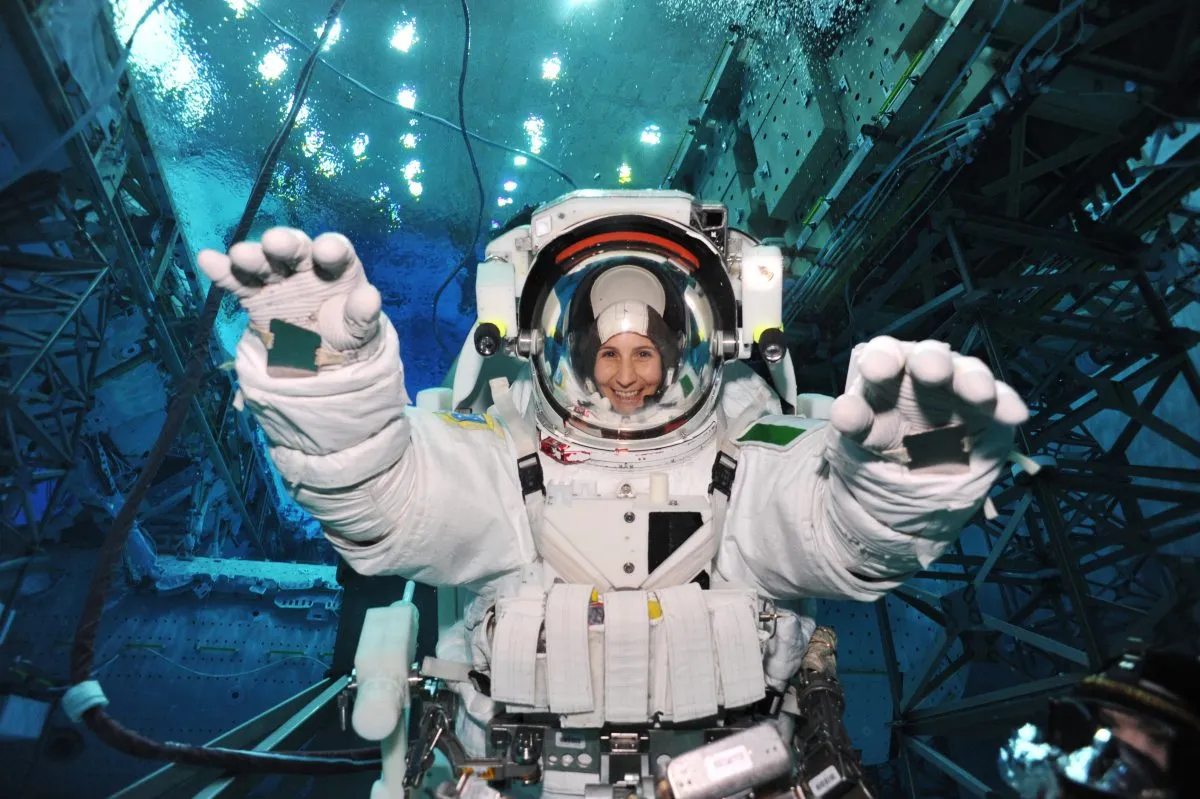
My attempt to be an astronaut
Early in 2018, I went to a residential teacher-training course hosted by the European Space Agency in Belgium.
The goal was to equip science teachers to use space in their teaching, but there were also some activities that were just for fun, including getting to play around with kit that simulated elements of astronaut training.
I’m pleased to report I was a natural at Moonwalking. However, I did poorly at riding a giant gyroscope.
Imagine a Venn diagram of screaming, crying and hysterical laughing – the intersection gives you an idea of the sound I made throughout my ride.
All the while, I was also attempting to trace a grid with a crayon on a piece of paper to simulate the navigation of a capsule that was spinning out of control.
I don’t exaggerate when I say I felt nauseous for weeks after.

So really, it was made clear that astronauting is not for me, and may best be left to those with stronger constitutions.
In the October 2025 episode of The Sky at Night, ‘Brits in Space’, Maggie and guest presenter Jen Gupta talked to people who are significantly better suited to space travel than I am.
It’s an exciting episode, giving insights into what it really takes to become one of the select few allowed the opportunity to venture away from Earth’s atmosphere.
It’s particularly brilliant to see the return of John McFall, the world’s first astronaut with a physical disability.

Who gets to go to space?
Here’s what I’m curious about: how is it that the ESA has done feasibility studies regarding disabled astronauts, and is green-lighting McFall for a long space mission, but we still don’t have disability representation in Antarctica?
Bases in Antarctica, such as Concordia Station, have long been used for proxy studies on the impact on the body of extreme conditions.
There, just as in space, you can’t be evacuated immediately if something goes wrong, making it an even better site for feasibility experiments.
To the best of my knowledge, disabled tourists can visit Antarctica, but even stations closer to the coast with less extreme conditions don’t have expeditioners or researchers with physical disabilities.
And it baffles me a bit.
Prior to my own expedition to Concordia in 2021, I had to undergo a series of medical tests to ensure I was healthy enough to participate.
It’s standard practice, as any health ticking time bombs would rule you out.
However, it’s very clear that you can have a physical disability and still be fit and healthy.

As Alice Oates argues in her Antarctic Disability Project, Antarctic research is missing out on some serious talent by excluding disabled folks.
As the idea of space tourism gains more traction, pioneers like John McFall will pave the way for the inclusion of disabled people in the future of space exploration, whether for science or just for fun.
My hope is that long before we reach a time when we’re booking holidays on the Moon, we’ll have made sure that no one is unfairly excluded from opportunities on Earth because of who they are.
ESA is doing the work and, hopefully, Antarctic research bases will follow suit eventually.
After all, who knows what knowledge, understanding and friendship we’re missing out on by not making space – or anywhere – as inclusive as it reasonably can be?
This article appeared in the November 2025 issue of BBC Sky at Night Magazine