
Jellyfish are very strange creatures. They almost look like alien, traversing our oceans with an appearance unlike anything else we see on Earth.
As it happens, jellyfish have been to space before. In 1991, NASA sent nearly 2,500 tiny little baby jellyfish into Earth orbit, along with seven (human) astronauts onboard a Space Shuttle.
More space science
The reasons behind this jellyfish space mission? To learn more about life in a weightless environment, to better understand the human body and, ultimately, to help astronauts spend much longer periods in space.
Although the experiment was carried out in 1991, the scientific reverberations can still be felt today, as humanity's space agencies prepare to send astronauts back to the Moon, or even to Mars.
The effects of microgravity
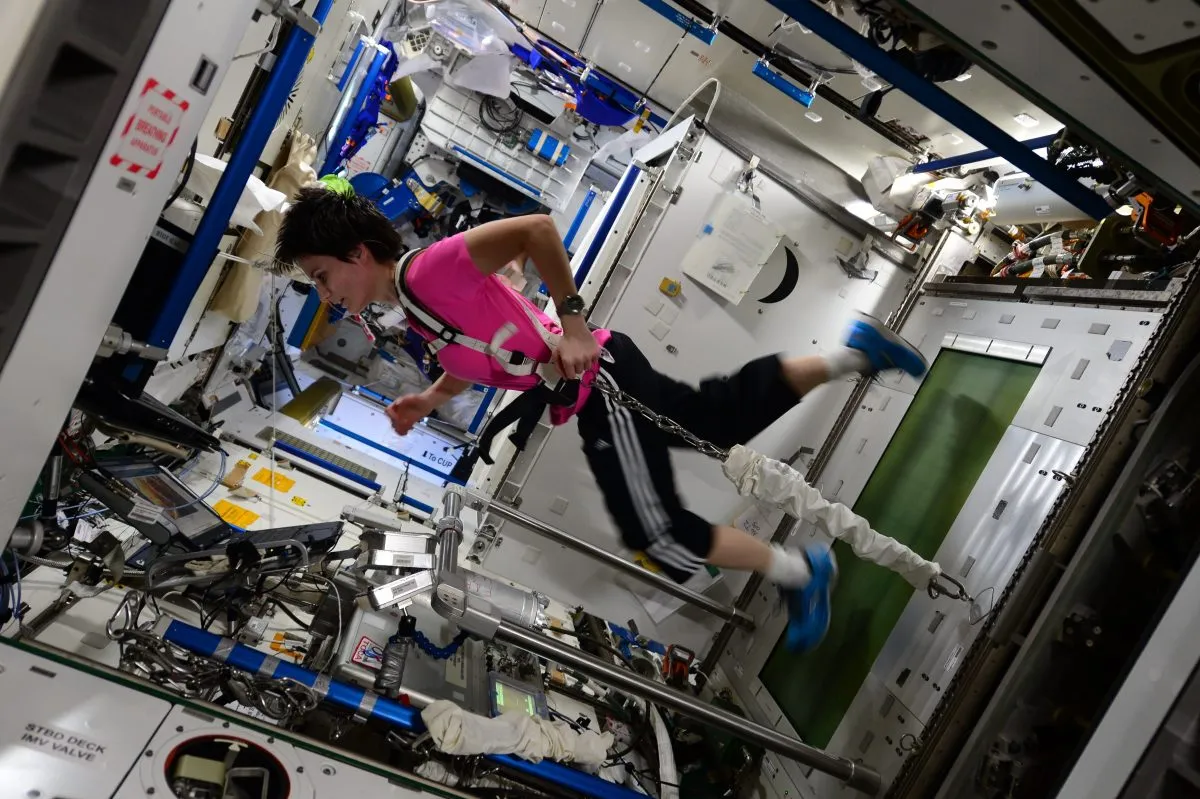
The human body doesn't like being in space.
Back on Earth, the effects of gravity are felt by our bodies every day, and the constant resistance we feel every time we pick something off the ground or walk across the street, keeps our bones and muscles in check.
In space, astronauts are effectively weightless, and so their bones and muscles quickly deteriorate.
That's why astronauts onboard the International Space Station exercise for hours every day, performing cardio exercises while tethered to a treadmill, or lifting weights, for example.
This keeps astronauts' muscles and bones working, and prevents deterioration of their bodies during long stays in space.
Why jellyfish?
Before we humans made our first journeys into space and back, we sent animals first.
Monkeys, mice, cats and dogs were among the first animals sent into space (not that they had much say in the matter), in order to test whether spaceflight might have a detrimental effect on living organisms.

That was in the 1940s and 1950s, even before the advent of the Cold War Space Race and the battle between the Soviet Union and the USA to put the first human feet on the Moon.
So why, in the early 1990s, did NASA decide to send over two thousand jellyfish into space?
It all started when a cell biologist named Dorothy Spangenberg and her students began working on that very project.
Despite appearances, jellyfish are similar to humans in some key ways.
They're among simplest organisms on Earth, in that they lack a brain, heart, bones and complex respiratory systems.
But they have neurons, or nerve cells, similar to humans, and they also have gravity receptors.
These gravity receptors help tell the jellyfish which way is up and which way is down, which enables them to adjust their depth in the ocean by pulsing upwards or relaxing to float downwards.
Humans also have gravity receptors, in our inner ears, and these too help us maintain our balance.
The effects of motion sickness can affect astronauts working in space, so by learning more about gravity receptors, Dr Spangenberg, her team and NASA hoped to learn more about the effects of space sickness, and how to mitigate it.

Would jellyfish react differently under microgravity? Would they still know which way was up and which was was down?
Would lift-off damage the jellyfish? Would life in Earth orbit affect their development?
There was only one way to find out for sure.
Another reason for using jellyfish was that astronauts who spend a long time in space suffer from calcium deficiency, due to the effects of prolonged weightlessness, and this imbalance in calcium can cause osteoporosis, which is a deterioration of the bones.

Each jellyfish gravity receptor has a sac of calcium sulphate crystals, just as humans' inner ears have calcium-containing crystals.
So the science team hoped that, by studying thousands of jellyfish, they could learn more about the effects of space travel on human bones.
The added bonus of using baby jellyfish was they they would be small enough to send thousands into space, making for quite a substantial sample of individual animals for study.
Jellyfish develop in distinct, individual phases, from 'polyp' to 'ephyra' and then 'medusa'. Medusa is the 'adult' stage of jellyfish, and the type most commonly seen in the ocean.
These distinct, defined stages of life also made jellyfish ideal candidates for the study.

Launching the jellyfish into space
2,478 tiny jellyfish polyps were launched into Earth orbit during mission STS-40 onboard Space Shuttle Colombia, on 5 June 1991.
It was a nine-day mission, landing back on Earth on 14 June 1991.
STS-40 was the first Space Life Science mission, known as SLS-1, and the first space laboratory dedicated entirely to life sciences research, 'life sciences' being the study of living organisms.

Prior to launch, the jellyfish were placed in plastic bags filled with salt water, then carried in an incubator to stabilise their environment for the journey into space.
Scientists poured an iodine mixture into some of the bags to encourage development and stimulate rapid reproduction.

What happened
Before launch, Dr Spangenberg and her team studied the jellyfish's appearance and development on Earth, so they would know what changes to look for in the spacefaring jellyfish.
As well as this, a sample of the same jellyfish was kept behind on Earth, acting as the 'control' for the experiment, so the scientists would have Earth-bound jellyfish with which to compare the jellyfish that had been sent into space.
The very first test for the jellyfish was the launch itself. Would the tiny jellyfish be able to withstand the sheer force of launching a rocket into space?
They passed the first test with flying colours, proving a smaller organism could survive lift-off.

The next test was whether or not the jellyfish would still know which way was up and down.
Both groups of jellyfish – on Earth and in space – were video-recorded to monitor any changes in movement or behaviour
The astronauts observing the jellyfish on the Space Shuttle found that, in microgravity, the jellyfish went round and round in circles – clearly affected by the microgravity environment – but were still able to pulse and swim.
What's more, the polyps grew and developed normally, just the same as they would have on Earth.
After nine days, the astronauts began to prepare the jellyfish for the trip home.
Once back on Earth, one group of jellyfish was taken and stored for immediate study after landing.
The second group was stored in liquid in a bag to be compared to the jellyfish that had been studied simultaneously on Earth.
Dr Spangenberg and her team then spent a year studying the two sets of jellyfish.

They found that, after swimming in circles in space, some of the space jellyfish still swam a little strangely after returning to Earth, but most went back to their normal ways
Cell studies found the space jellyfish were completely normal. What's more, in just nine days, the population of jellyfish had grown from the initial 2,478 to nearly 60,000 ephyrae, or juvenile jellyfish.
The results of the study revealed a great deal to scientists about the effects of microgravity on living organisms, but also raised a few questions, such as how an organism born in space might adapt to life on Earth.
As humans seek to spend longer periods in space and push ahead for permanent settlements on the Moon, or even crewed journeys to Mars, the successes of these missions could, in part at least, be down to a few thousand baby jellyfish who once made the 9-day trip of a lifetime.

