
By 1990, Voyager 1 was heading towards the edge of the Solar System at close to 65,000km/h.
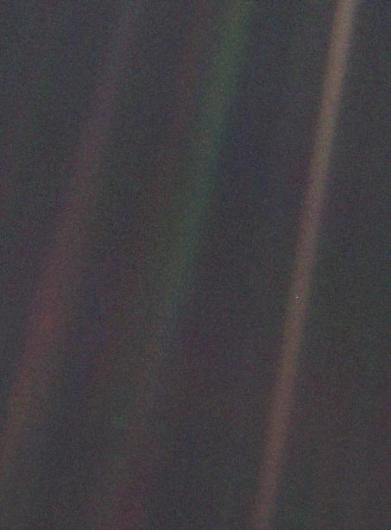
It was then, after its successful encounters with Jupiter and Saturn, that it produced a portrait of our home in the Galaxy, including an iconic image of the Earth known as the ‘Pale Blue Dot’.
On 14 February 1990, when it was almost six billion km away, beyond the orbits of Neptune and Pluto, the spacecraft turned itself around to gaze back at the family of worlds it was leaving and give us a view that had never been seen before.
It collected a sequence of 60 images – the last pictures taken by either of the Voyager probes – that would take three months to beam home. A valentine to our planetary neighbourhood.
More on Voyager
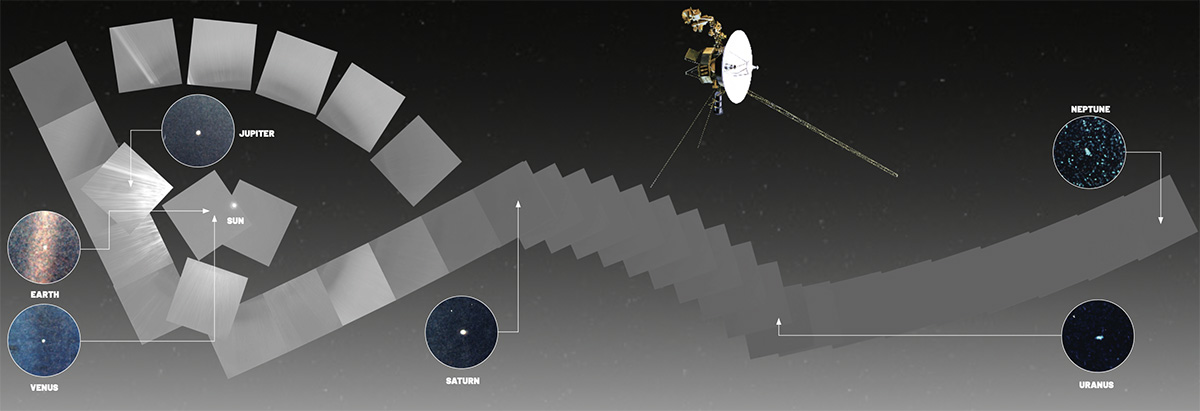
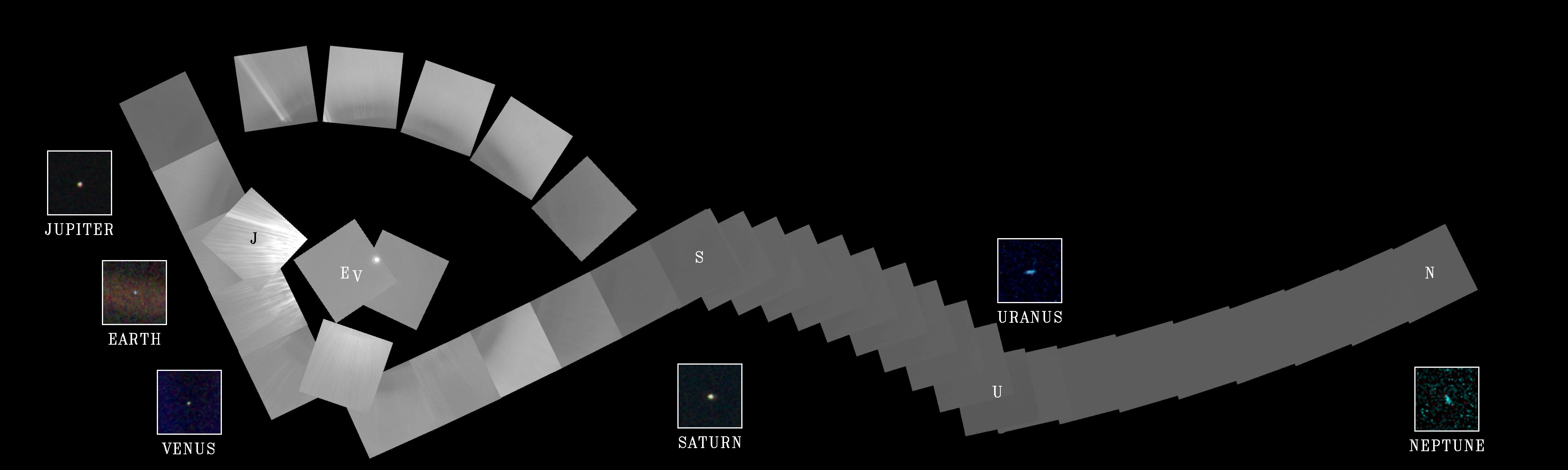
They were transmitted back during March, April and May 1990. When combined, they produced a snapshot of six planets.
It included the Earth as a tiny speck caught in a ray of light caused by sunlight reflecting within the camera’s optics.
Mercury was lost in the Sun’s glare, while Mars and Pluto, which was then still regarded as a planet, were too small to show up.
Uranus and Neptune look smeared because they moved during the exposure.
Great minds…
The idea for this family portrait came from two people, the astronomer and science populariser Carl Sagan and Carolyn Porco, then a young member of the Voyager team from the University of Arizona.
But they came up against opposition from mission managers at NASA’s Jet Propulsion Laboratory (JPL) in Pasadena, who failed to see the point of the exercise and feared it could damage Voyager 1.
"Soon after I joined the Voyager project in October 1983 I started promoting the idea of having Voyager 1 turn around to take a picture of Earth and all the other planets. I thought it would be a magnificent ‘we are here’ look at our cosmic place," says Porco.
"The mission managers at JPL looked at me like I was crazy because there was no science in doing so – all these objects would be a pixel across or less – and the engineers didn’t want to waste resources to make a useless observation.
"A couple of years later I learned that Carl Sagan had also proposed this ‘portrait of the Solar System’ for the same reasons and he got the same response. I spoke to him about it and we decided to join forces."
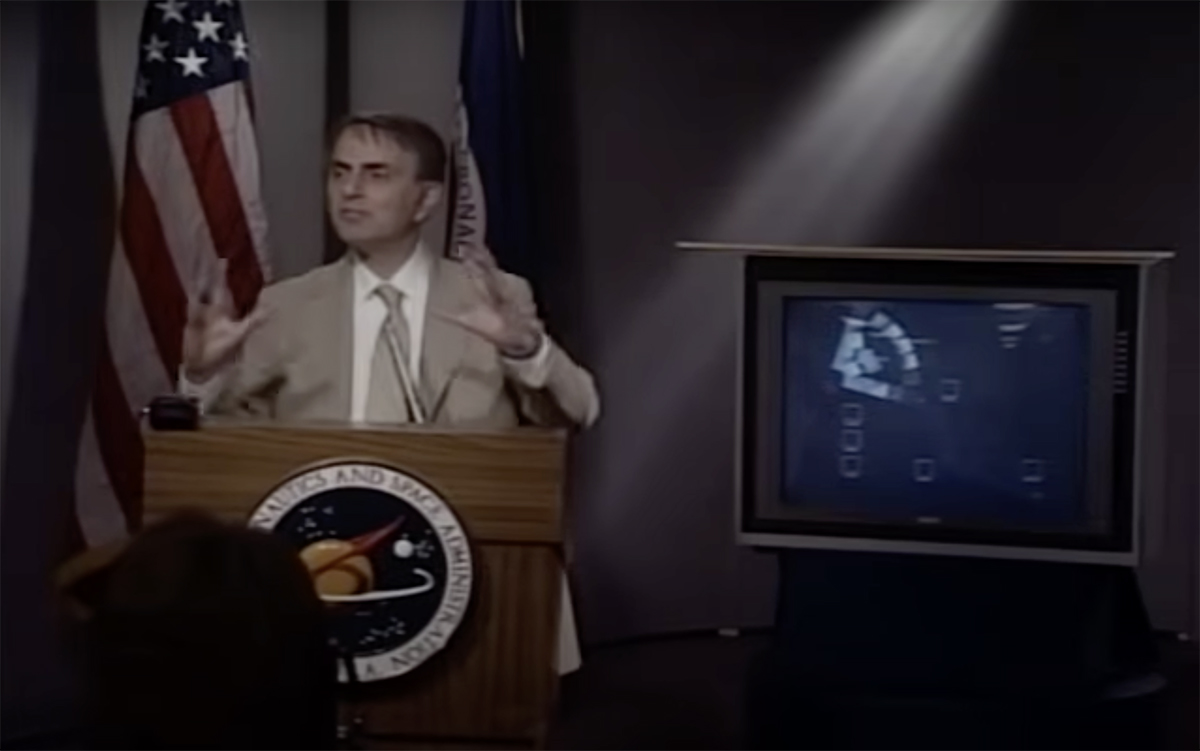
Sagan went to the very top, persuading NASA administrator Richard Truly to agree to the picture, while Porco worked with JPL’s Candy Hansen on making it happen.
Voyager 1 was chosen because it would be able to capture Jupiter free from the glare of the Sun.
"I worked on designing the observations with Hansen, who was responsible for executing the Voyager imaging team’s image sequences. She worked out the commands to turn the spacecraft from one planet to the next," Porco explains.
“My job was to figure out how long the exposures had to be. Believe it or not, the biggest challenge was figuring out how to expose correctly on Earth. No one had taken this kind of observation of Earth before, so we weren’t sure how bright it would be.”
Looking back on the Solar System
Shown above, the combined picture is an odd one at first glance. Rather than a single panorama, the individual frames are quite distinct, each exposed to bring out the detail within.
In many ways, this project defied common sense, like looking the wrong way through a telescope. Space probes are meant to bring us close-ups of unexplored worlds.
Instead, the world we know best – our own – was close to invisible, occupying less than a pixel in the shot. But from a distance of around six billion km, it revealed the fragile nature of Earth, small and vulnerable, suspended in the infinite void of space.
Sagan dubbed the picture the ‘Pale Blue Dot’. In a book of the same name, he later wrote: "Look again at that dot. That’s here. That’s home. That’s us. On it everyone you love, everyone you know, everyone you ever heard of, every human being who ever was, lived out their lives.”"
Today, the family portrait and the ‘Pale Blue Dot’ have lost none of their power to bring home the unknowably vast spaces of the Universe.
