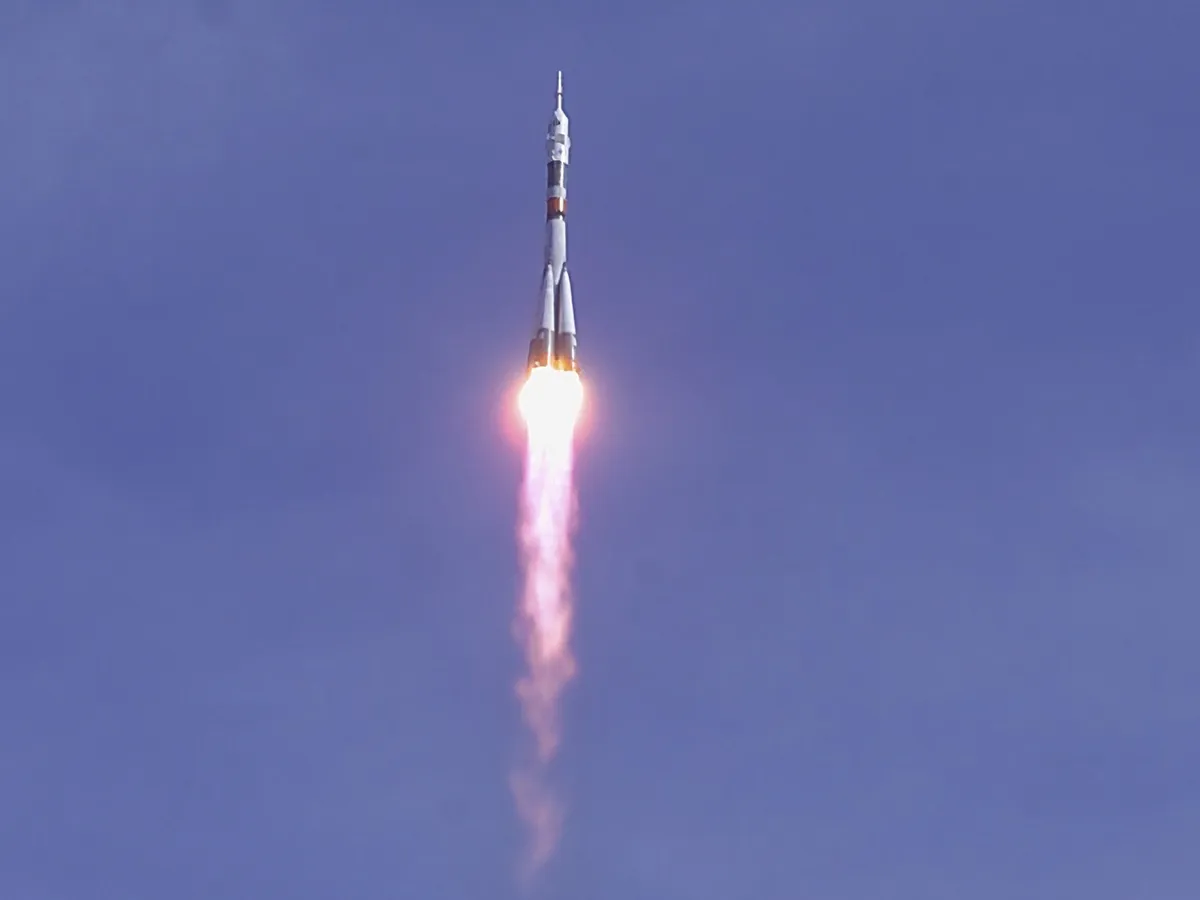
Liftoff, the moment when rockets unshackle themselves from Earth and rise into space, has always made human hearts race with excitement.
But a key oddity in getting to space, and reaching orbit, is that the launch from Earth’s surface is not in a straight vertical line. So why is that?
For the first few seconds of a rocket’s arrow-like ascent, it does climb vertically – but this doesn’t last long.
Up to an altitude of 10–20km (6–12 miles), Earth’s atmosphere is at its thickest and gravity’s effects at their strongest.
Here, the rocket needs a lot of thrust to overcome our planet’s gravitational clutches, push through the thick air and gain altitude as quickly as possible.
Following liftoff, a rocket’s climb is relatively slow as it expends huge quantities of fuel battling air resistance.
But by a minute into its flight, as it encounters the thinner upper atmosphere, it has accelerated to speeds of more than 1,600km/h (1,000mph).
Go fast sideways
If simply reaching an extreme altitude was the endgame, a rocket heading straight up could make it in minutes.
But doing so would very quickly exhaust its fuel, after which Earth’s gravity would halt progress and inexorably drag it back to the ground.
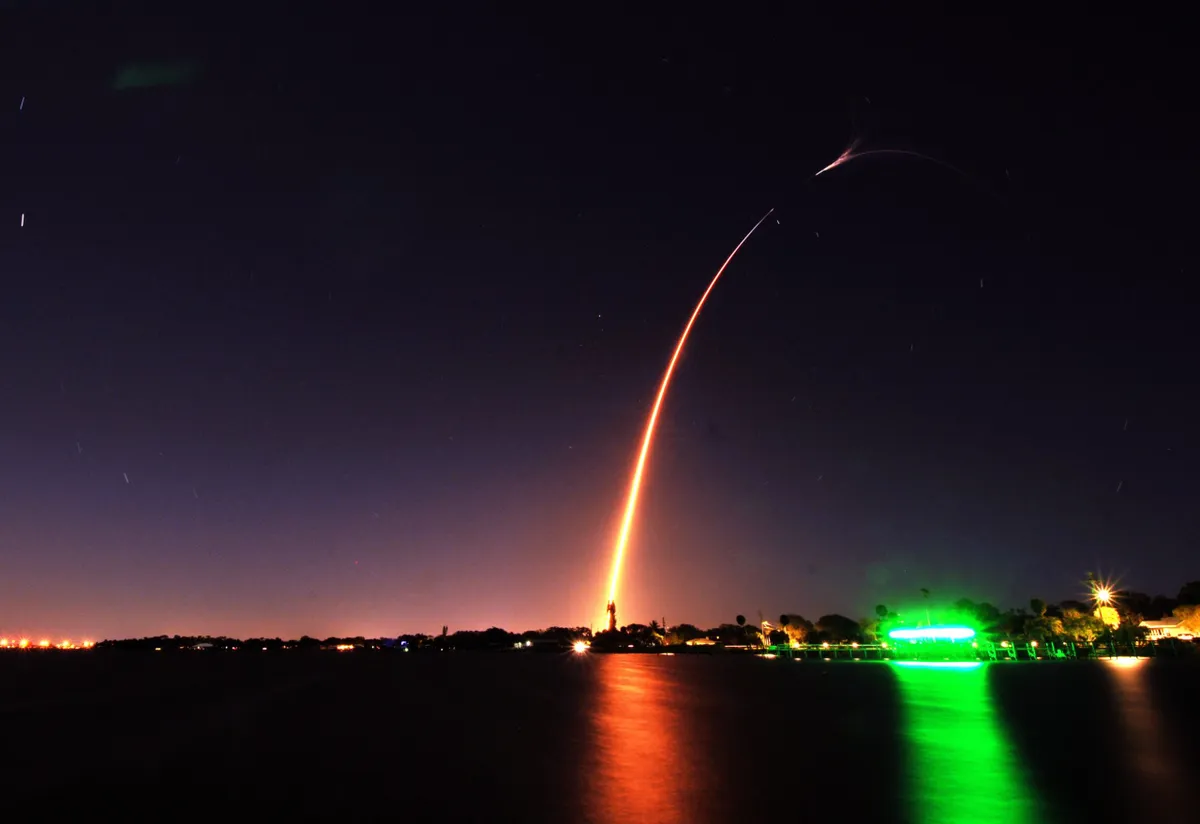
Instead, to get its cargo into space and ensure it stays there, a rocket has to accelerate fast enough in a ‘sideways’, horizontal direction that it ends up coasting away from Earth at the same rate that gravity pulls it back.
When these two factors of moving away and falling back are balanced, a rocket enters orbit.
The trick, then, is not just launching vertically upwards but also flying ‘downrange’ fast enough so that, as gravity tugs on the rocket, it follows the curvature of Earth and enters a condition of perpetual free-fall.

To transition from vertical to horizontal flight, rockets carry out a pitch-over manoeuvre, gimballing their engines or using aerodynamic controls to slightly angle their thrust and gradually curve their flight paths in a ‘gravity turn’.
By tilting their flight paths to horizontal, rockets use Earth’s gravity instead of fuel, gaining acceleration and saving precious energy to reach orbit in the most economical manner possible.
This horizontal acceleration must be tightly controlled: accelerating too fast, too low in the thicker atmosphere, risks increasing air drag; accelerating too slowly imposes aerodynamic stress that can harm astronauts or delicate payloads.
After completing its gravity turn, the rocket continues accelerating to gain vertical altitude and horizontal distance downrange.
It gradually increases its tilt, aiming for an elliptical orbit around Earth. By the time reaches about 160km (100 miles), its trajectory begins to ‘flatten’, while acceleration continues.
A rocket’s cargo has to reach 28,000km/h (17,500mph) – about 8km (5 miles) every second – to remain in a stable orbit.
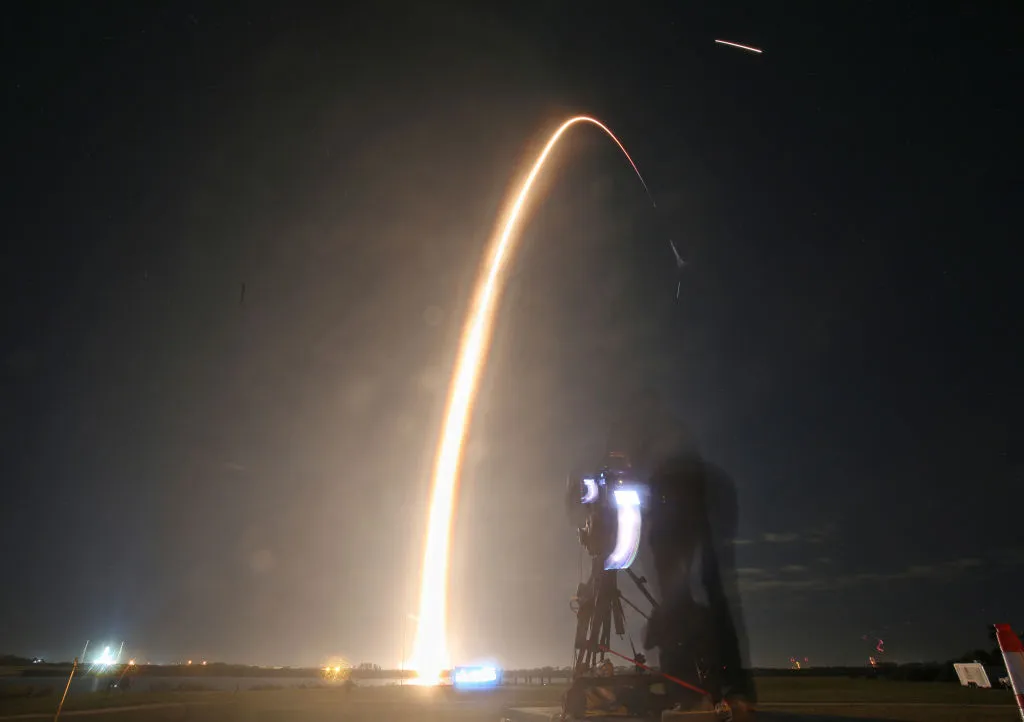
Rockets also take advantage of Earth’s eastward rotation.
Launching eastwards from equatorial regions – think Cape Canaveral in Florida or Kourou in French Guiana – gives a ‘free’ energy boost of about 1,600km/h (1,000mph) from our planet’s rotation speed, reducing the need for extra fuel and affording a 15–20 per cent hike in payload capacity.
Although rockets can launch in a westerly direction, they have to accelerate by an extra 3,200km/h (2,000mph) to counteract Earth’s rotation – an inefficiency that translates into less payload capacity. Space may be relatively close, but getting and staying there really is rocket science.
Even in space, travel is far from straightforward
As complex as it is to escape Earth’s gravity and reach orbit – whether that’s the International Space Station, 400km (250 miles) up or geostationary satellites 35,780km (22,236 miles) above the planet – these challenges pale in comparison to the problems involved in reaching other worlds.
To break free of Earth’s gravitational clutches and achieve ‘escape velocity’, a spacecraft must be propelled to more than 40,000km/h (25,000mph), or about 11km (7 miles) per second.
Interplanetary missions then typically rely on gravitational slingshots and a fuel‑efficient orbit‑changing manoeuvre known as a Hohmann transfer to reach their distant targets.
But since the destination planet is also moving on its own orbital path around the Sun, mission planners must precisely launch and insert the spacecraft onto the right trajectory, at exactly the correct time, to ensure they arrive when the planet is there – a task that’s been likened to throwing a dart at a moving target.
Spacecraft also use a planet’s angular momentum (its spin plus orbital motion) to speed up, slow down or change direction.
Voyager 2 employed an intricate sequence of gravity assists to slingshot from Jupiter to Saturn, then to Uranus and finally Neptune, with minimal fuel expenditure.
The Galileo probe, launched from a Space Shuttle, even used a close fly-by of Jupiter’s moon Io to shed enough energy to insert itself into orbit around the planet.
This article appeared in the April 2026 issue of BBC Sky at Night Magazine