The year 2025 was a vintage one for astronomy. In January, we were hooked on reports of a building-sized asteroid – 2024 YR4 – on course to collide with Earth.
The risk was quickly downgraded from worrying to virtually non-existent, but it set the tone for a year packed with discoveries and surprises.
We’re living in a golden era of space observation.
Telescopes on the ground and up in orbit are revealing more of the Universe than ever before, and in exceptional detail.
And we’re not just talking about the distant cosmos – some incredible discoveries have taken place close to home.
Visitors from outer space, leopard print on Mars, vast hydrogen clouds hiding in plain sight…. At times
it’s felt like science fiction.
More space science

So, let’s take a whistle-stop tour through 10 of 2025’s most astonishing discoveries.
Records have been broken, new objects discovered, and we’re ending the year with more questions than answers.
But hey, that’s how science should be…
The Quipu superstructure
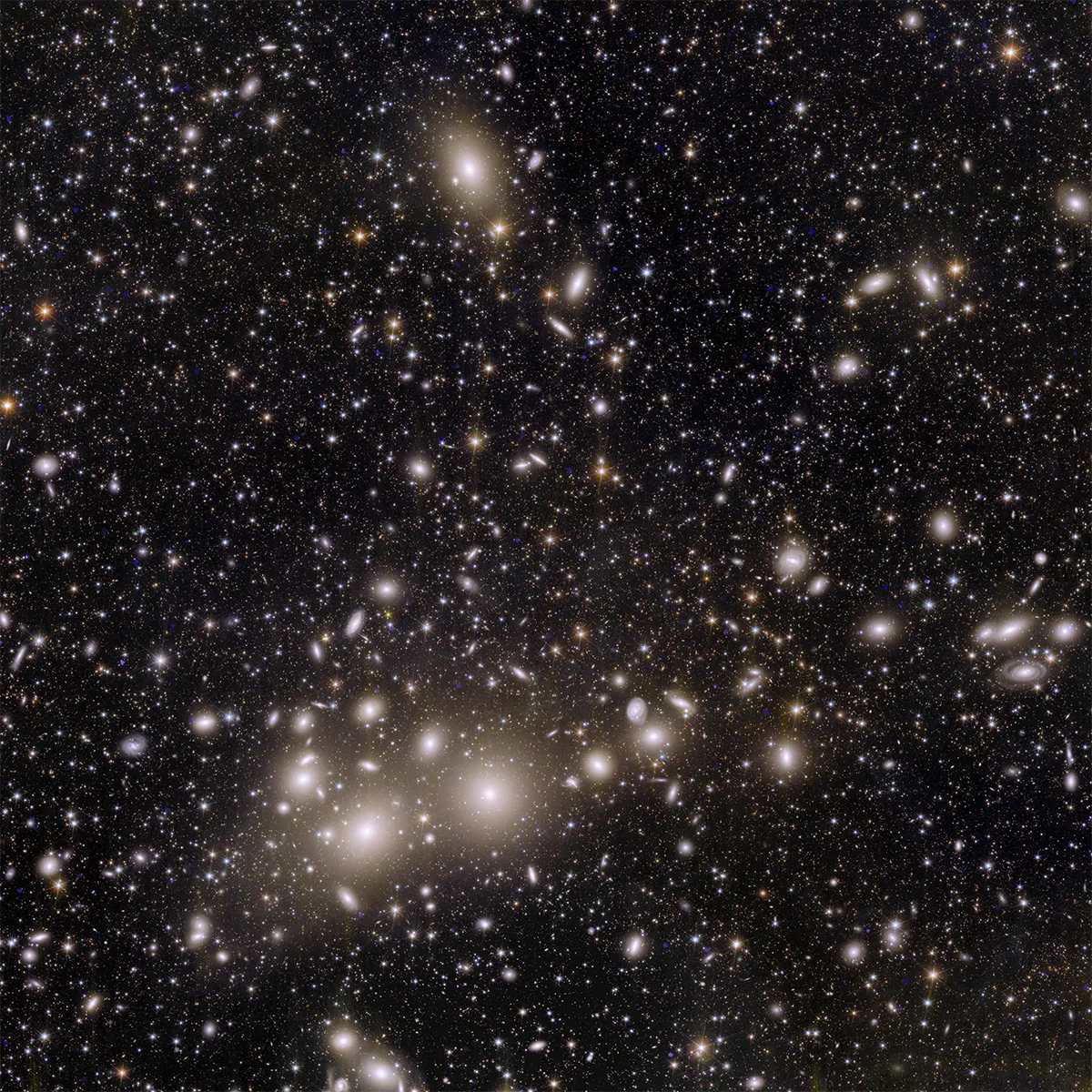
Let’s start BIG. Early in 2025, astronomers revealed the largest cosmic superstructure ever detected.
It’s a vast chain of galaxy clusters linked together in three-dimensional space. The team behind the discovery named it ‘Quipu’ after the Incan knotted cords used for record keeping, both because of its resemblance and as a nod to the key observations being made at the European Southern Observatory in Chile.
So, how big are we talking? The answer is almost unfathomable. Quipu consists of 68 galaxy clusters. Its length is at least 1.4 billion lightyears.
Its mass is approximately 240 million billion times the mass of the Sun. So yes, this is huge, and not just on a physical scale – superstructures such as Quipu help us understand how matter is distributed across the Universe.
A rogue black hole

Everyone loves a black hole – but only from afar.
Our Galaxy feels safest when black holes stay exactly where we expect them – in galactic centres – given their proclivity to indiscriminately feed off the matter around them. But not all black holes stay put. Some go rogue.
In 2025, researchers discovered a new candidate for a wandering black hole in a dwarf galaxy named MaNGA 12772-12704, around 230 million lightyears from the Sun.
The black hole isn’t in the galaxy’s centre, but roughly 3,000 lightyears from it. As if that isn’t surprising enough, this black hole is emitting huge radio jets, showing it’s still actively accreting material despite having been kicked out of its usual home.
Discoveries like this are super exciting as it means we now get to figure out how the black hole got there and where it might go next. And that’s the fun bit.
Little red dots explained?

One of the coolest things that the James Webb Space Telescope (JWST) can do is look so deep into space it finds objects from our Universe’s infancy. Even better, it sometimes finds stuff we don’t recognise at all.
This was the case with the aptly named ‘little red dots’ (LRDs). These bright, small and very red objects were detected in some of JWST’s early images, but they’ve been challenging to explain.
Initially, researchers suspected they were very early galaxies, but they’re so small it would mean they were inexplicably compact.
As of 2025, the leading theory is that LRDs are a new classification of object: a black hole star (BH*). Black hole stars are thought to be active black holes surrounded by hot, dense gas.
The black hole itself is the thing that warms the gas enough that it glows. It’s genuinely wild how much there is still to learn out there!
Exoplanet milestones

We can’t talk about space discoveries without mentioning exoplanets – and 2025 featured two epic milestones for exoplanetology.
In October 2025, the very first planet discovered orbiting a Sun-like star turned 30! To clarify: 51 Pegasi b is likely to be billions of years old, but our knowledge of its existence has only been around for three decades.
The second epic milestone was in September – the 6,000th exoplanet was discovered and added to the NASA Exoplanet Archive. We passed the 5,000-planet milestone back in 2022, but what’s really exciting is that the newest planets are not just ‘more of the same’.
Thanks to TESS, NASA’s all-sky planet survey, many being discovered orbit far brighter stars. This means we can do more than just catalogue them: we can study them in exquisite detail.
K2-18b's 'signs of life'

Ah, the K2-18b biosignature debacle. If you were hiding in a hole in April, you may have missed the news that a “potential biosignature” had been “detected” in the atmosphere of a “habitable-zone” “hycean planet”. I’m quoting, because we need to digest the report with caution.
There’s a category of planet we often refer to simply as mini-Neptunes: too big to be super-Earths, much smaller than Neptune, and something of a mystery. One theory is that they’re ‘hycean worlds’, hypothetical ocean-covered planets that could harbour life.
K2-18b is everyone’s favourite hycean candidate (although there are several other competing theories as to its nature) and new JWST observations of its atmosphere were published in 2025.
They revealed… well, it depends on how you model the data. There might be hints of dimethyl sulphide, a molecule that on Earth is only produced by life. However, other models show no evidence of this.
The exciting part is that we’re now able to have this type of discussion. We’re probing atmospheres of distant worlds and have new ideas on what ‘habitable’ might mean.
So far, there has not been an unambiguous detection of a biosignature on another planet. Sorry to disappoint – but watch this space.
An interstellar visitor

Right now, the oldest object in the Solar System could be significantly older than the Sun. How can that be? It’s because we’re currently hosting an interstellar visitor, an object from outside our Solar System.
The comet 3I/ATLAS (the ‘I’ stands for interstellar and the ‘3’ refers to this being only the third such interstellar object ever found) was first spotted making its way through our bit of space in July, and astronomers have been pointing every telescope possible at it ever since. They even pointed NASA’s Perseverance rover’s cameras at it from Mars.
3I/ATLAS was likely ejected during the early formation of another planetary system. This means that examining its composition will provide us with insights into the formation environment around other stars – and that’s something we almost never get the chance to study.
The results have already been surprising: lots of carbon dioxide, nickel vapour and water activity all hint at chemical behaviour very different from comets formed in our own Solar System.
A vast molecular cloud

If we’re discovering galaxies that are over 13 billion lightyears away, surely there’s nothing sizeable left to discover nearby… right? Actually, very wrong.
Bigger telescopes help us spot objects that are further and fainter, but other breakthroughs come when we look differently. That’s how astronomers discovered an enormous molecular hydrogen cloud on our doorstep, a mere 300 lightyears from Earth.
Usually, these clouds are found by detecting radio signatures from carbon monoxide, another gas typically present in abundance. However, the team behind this discovery used a brand-new technique: detecting far-ultraviolet radiation emitted by the molecular hydrogen itself.
The cloud, named Eos after the goddess of dawn, doesn’t emit any visible light, so we can’t see it in the sky – but if we could, it would appear about 40 times the size of the Moon, like something straight out of Doctor Who.
A new moon orbiting Uranus

My favourite fact about Uranus is that its original name was George, a name I am personally quite partial to.
It was changed (sensibly) after non-British astronomers pointed out that naming a planet after a monarch was a little too nationalistic. I like this silly bit of history, and I’m overjoyed that as of August 2025, Uranus has 29 known moons.
The new moon, provisionally designated S/2025 U1, is only about 9.6km (6 miles) in diameter, which explains why it was missed in previous observations. While it would likely have been present in images taken by Voyager 2 and the Hubble Space Telescope, its faintness would have made it invisible.
Thanks to new long-exposure, infrared observations from the JWST, astronomers finally detected it and calculated its orbit.
Aurorae on Neptune

Ever since Voyager 2 flew past Neptune in 1989 and imaged hints of auroral activity, astronomers have been trying to confirm its existence. All other giant planets in the Solar System have aurorae, but it took until March 2025 for the light show on Neptune to finally be recorded in all its glory.
Intriguingly, hypothetical Neptunian beings wouldn’t need to trek to the poles of their planet to witness the spectacle, like we do on Earth. Neptune’s magnetic field is tilted about 47° away from its rotation axis, which means aurorae there occur roughly over a region where South America is on our planet.
It was JWST’s infrared capabilities that provided the critical data to reveal the long-hidden aurorae on Neptune, and it turns out they were fainter than expected because the Neptunian atmosphere has cooled by hundreds of degrees in the last few decades. Clearly, there’s a lot still to learn about our planetary siblings.
Life on Mars

If only David Bowie had asked an easier question, then we’d be closer to an answer. But alas, “Was there ever life on Mars?” doesn’t fit the chorus quite so well.
In 2024, NASA’s Perseverance rover recovered a rock sample with what looked like leopard spots on it. In 2025, researchers announced they’d identified them as minerals and textures that on Earth are often associated with microbial activity.
A bit like with potential biosignatures in exoplanet atmospheres, this is a strong indication that once there might possibly have been life on Mars.
While other, non-biological explanations do exist and can’t yet be ruled out, we don’t have to dampen the excitement completely. We’ve genuinely never been closer to finding evidence of life somewhere other than Earth.
And if sample-return missions succeed, we’ll get to study these striking speckled rocks in our labs, and perhaps get nearer to a definitive answer.
What were your favourite space discoveries of 2025? Let us know by emailing contactus@skyatnightmagazine.com