Keanu Reeves pauses while climbing the stairs. A black cat passes by, closely followed by another, padding along precisely the same path. “Oh, déjà vu,” he says absentmindedly. Or is it?
Keanu has in fact discovered a glitch in The Matrix. It's a great plot device for science fiction writers, but sadly if such clues were all around us, we would already know about our computational overlords’ existence.
In reality, if we find ourselves living in a perfect, glitch-free, virtual replica of our Universe, there's likely no way we could ever know.
But does this mean that questioning the very nature of our reality is an entirely worthless endeavour?
Let me assure you, it’s not. Allow me to convince you.
More thought experiments

Is possible to construct an artificial reality?
The approach I’ve taken in my book How to Design a Universe is to start with a different question.
That is, knowing everything we know about the laws of physics, could humanity design its own mathematical, electronic, fully functioning, artificial and conscious Universe?
Could we, in short, simulate our own reality?
If the answer to this question is definitively no, then we cannot be living in a computer simulation: reality would be too complex for any computer to reproduce.
But if the answer is plausibly yes, then we face a problem. It would be extraordinarily vain to assume that our Earth-bound civilisation was the first in the infinite Universe to overcome this technological challenge.
And if we are not the first – the pioneering designers of virtual worlds – then everything we see when we gaze into the Universe could be the work of those who came before us.
Even ancient starlight might simply be a stream of computer impulses within an elaborate simulation that feels real.
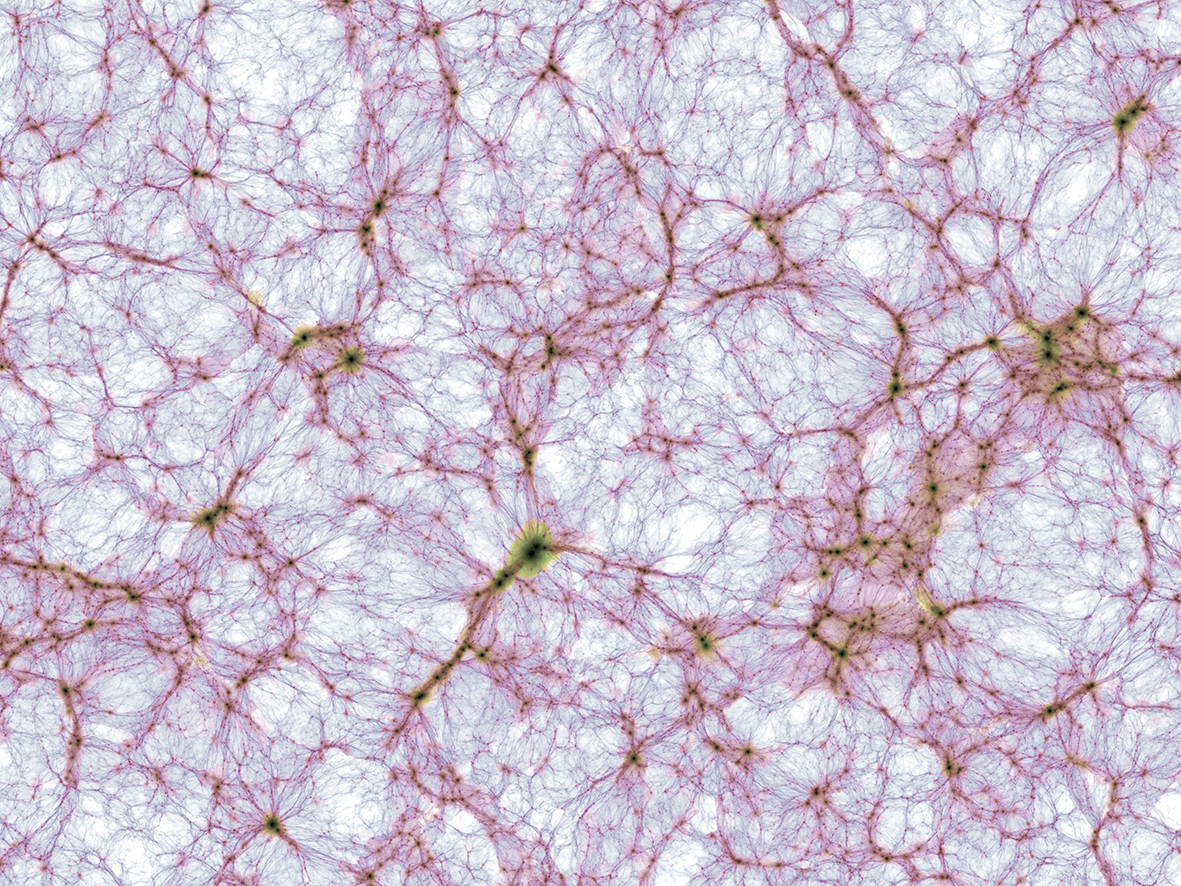
If you wanted to become a designer of universes, you’d first need to develop a language that concisely spells out the relationships we observe between different aspects of our reality.
And that language needs to be programmable, at something like a futuristic high-performance quantum computer centre.
While our current dictionary is incomplete, it’s clear we’ve already made significant progress exploring nature on both the smallest and largest of scales.
We’ve found that mathematics provides an excellent description when we look out to the furthest reaches of the cosmos, or zoom down into the sub-atomic world and the quantum realm.
What a pity then, that these two extremes of scale, the largest and the smallest, currently fail to connect.
The highly acclaimed standard model of particle physics has nothing to say on the origin of the invisible dark matter and mysterious dark energy that appear to make up 95% of our Universe.
But I feel confident that given enough time, theoretical physicists will find a solution to that cosmic conundrum. And if they do, we’ll be able to conclude that our reality is entirely mathematical.

Could the strange behaviour of the quantum realm be harnessed to computer-generate the world virtually on
As mathematics is the language that computers speak, in principle, there would then be nothing preventing the creation of our Universe from virtual qubits instead of real-world quarks (and other sub-atomic particles).
In practical terms, however, it’s highly unlikely to be achievable.
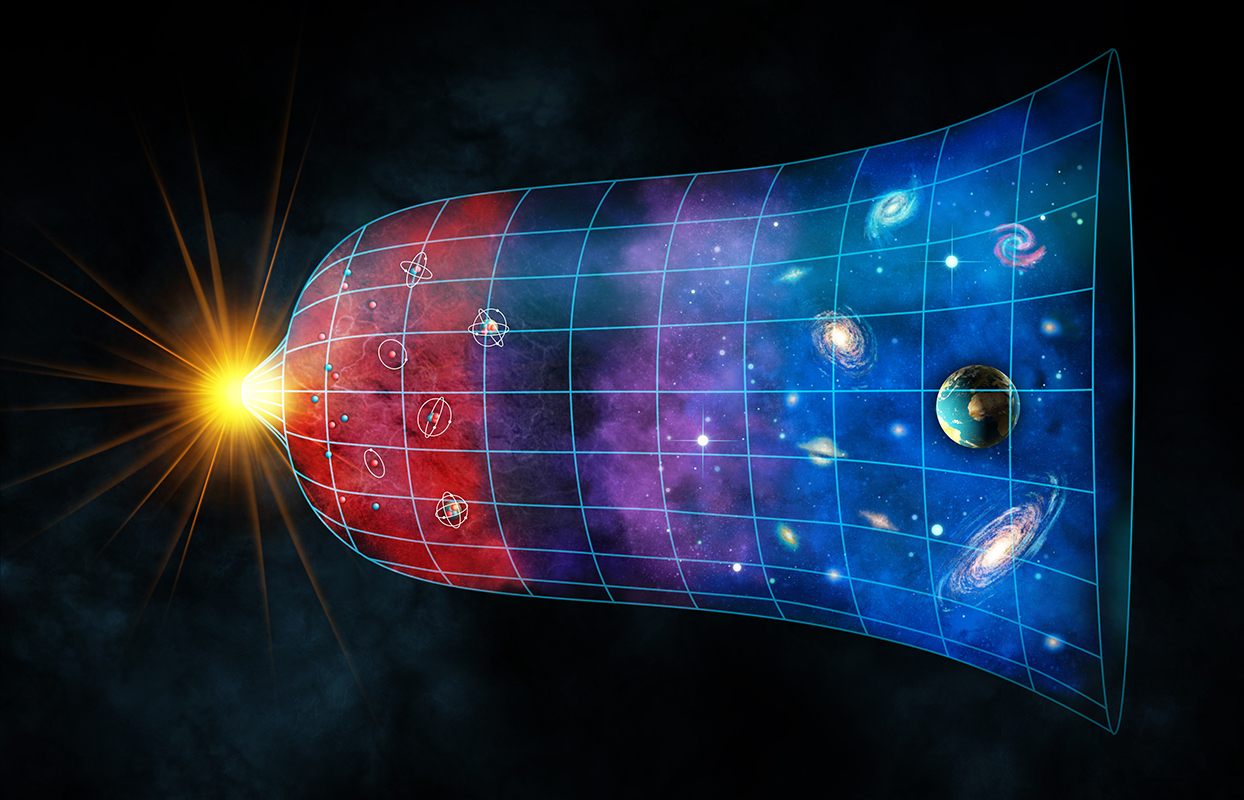
To simulate everything in the entire cosmos on subatomic scales, while evolving curved space and time from the Big Bang all the way into the present day, would require an inordinate amount of energy – at least as much as is contained in an entire galaxy.
Before you breathe a sign of relief, though, I feel compelled to point out that the computational overlords wouldn’t need to simulate everything.
Right now, they would only need to simulate you, your local surroundings and your experience of reading this article.
This fake world would likely be a grid in both space and time, but you wouldn’t notice because your experience of the real world is already pixelated.
Humans vs computers
We’re all used to seeing the boxy grid when we zoom into digital images, but did you know that a grid also exists in human vision?
The retina at the back of your eyeball is made from millions of cells called rods and cones. Each one is a light-collecting bucket no different from a pixel in your smartphone camera.
And what about time? You experience time as change: breathing in and breathing out; your heart beating roughly once every second.
Over the course of weeks, you notice your nails have grown; over the years, you witness children turning into adults.
Your sense of time is driven by sequences of biochemical reactions, and none of these are instantaneous.
For example, let’s watch television. Every second, our eyes are shown 60 distinct images in a row, but as the cells in our retinas take time to absorb the light, transferring that information to be understood by our brain, our experience of an on-screen period drama evolves as seamlessly as if the actors in their sumptuous ballgowns were dancing right next to us.
Humans, like computers, have a finite processing speed, so whether we’re in the real world (where experimental evidence has confirmed that the refresh rate of life is significantly faster than 60 frames per second) or a process-limited virtual world, we’re unlikely to sense the difference.

Science is currently unable to provide us with a definitive answer to the question of whether we are living in a virtual reality, and frustratingly for someone who wants to believe that we’re real, I’ve found no way to rule out the hypothesis that my computational overlords are currently spitting out their tea in surprise as they watch me type these words.
But I can tell you that I believe it’s highly unlikely they exist.
On this point, I disagree with the judgement of the world’s richest man, Elon Musk, who in 2016 stated that there was only a one-in-billions chance that we are real.
This difference of opinion traces back to 1637 and French philosopher René Descartes.
As Descartes pointed out, the one fact that we can never doubt is: ‘I think, therefore I am’.
And while it is straightforward to simulate the birth of stars, the evolution of galaxies, the structure and dynamics of DNA and the behaviour of quarks and gluons inside atoms, to create a virtual environment where a conscious, fully artificial human could plausibly develop and experience the notion of free will – well, that would have to be a very specialised scientific computer simulation indeed.
If we assume that the driving force behind the creation of any conscious virtual humans would be purely scientific and not for entertainment, then we can set a limit on the number of simulations that would be made.
At some point, there will be nothing more for the scientists to learn from them.
Of course, I cannot predict what that number would be, but rest assured that your chance of being simulated is somewhat lower than your chance of winning the lottery jackpot this weekend.
I wish you the very best of luck though, if you decide to go out and buy yourself a ticket.
Let us know your thoughts on this topic by emailing contactus@skyatnightmagazine.com