Jupiter's moon Ganymede is the largest moon in the Solar System, larger even than planet Mercury and dwarf planet Pluto.
It has its own magnetic field and hosts a vast subsurface ocean that's larger than all of Earth's oceans combined.

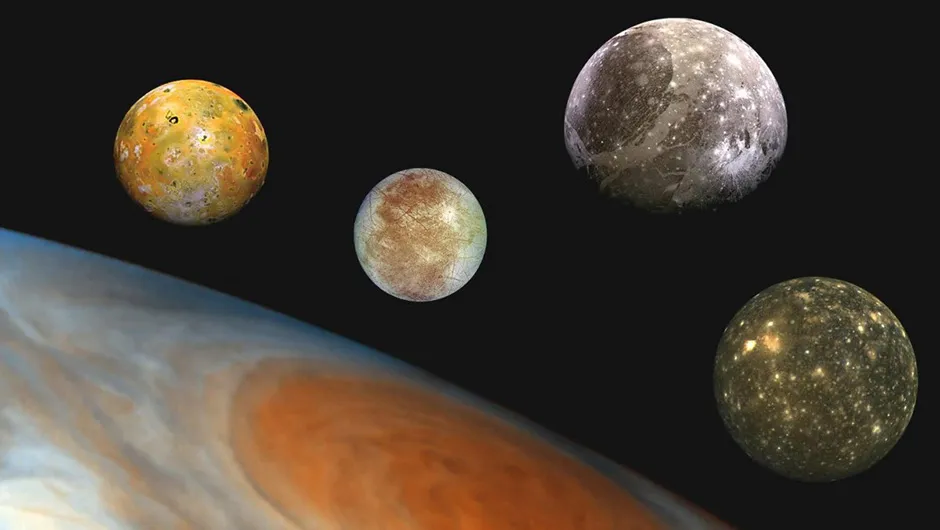
Ganymede is one of Jupiter's four Galilean moons, so-called because they were observed and recorded by the 17th century astronomy Galileo Galilei.
Humanity has sent several missions into space that have given us amazing views of Ganymede, as well as revealing its scientific secrets.

These include the Pioneer spacecraft, the Voyager missions, the Galileo probe and the Juno orbiter.
Here are 24 facts about Ganymede, the Solar System's biggest Moon, revealing what we've learned so far.
Credit: NASA/JPL/DLR
Ganymede is the largest moon in the Solar System
Ganymede isn’t just the largest of Jupiter’s moons – with a mean radius of 2,634km (1,637mi) and a mass of 1.4819 x 10²³ kg, it’s the Solar System’s ninth-largest object (by volume, albeit only the 10th largest by mass) and its largest natural satellite.
The second largest is Saturn’s moon Titan, with two more Jovian moons (Callisto and Io) and Earth’s own Moon completing the top five.
Given Ganymede is 5,260km (3,270 miles) wide, and Earth's moon is 3,475 km (2,159 miles) wide, that makes Ganymede 1.5 times wider than our Moon.
It orbits Jupiter once every seven Earth days
Ganymede has an orbital speed of 10.88 km/s, which is pretty nippy.
For comparison’s sake, the orbital speed of our own Moon is just 1.02 km/s, and even that equates to 3,683 km/h (2,288 mph).
It orbits Jupiter at a distance of 1.07 million kilometres (665,000 miles).
It’s mostly made of rock and ice
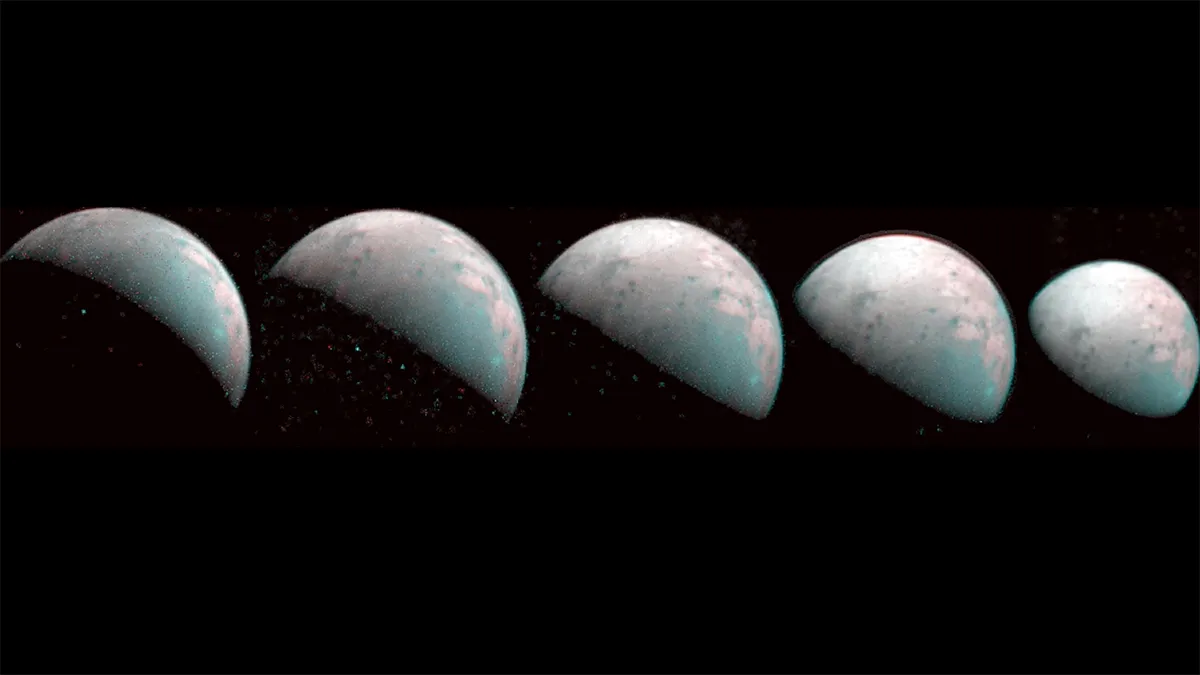
Overall, Ganymede is roughly 50% rock and 50% ice. But unlike many smaller satellites, Ganymede is a fully differentiated body, meaning it is constructed, like a planet, of well-defined layers of different materials.
On Ganymede, those layers mainly consist of silicate rock and water ice of different kinds.
Ganymede is cold at the surface
The Jupiter system is roughly five times farther from the Sun than Earth, and receives just 1/30th the sunlight.
As a result, the average surface temperature on Ganymede is -163°C, though it can vary from –203°C to -121°C. Either way, you’re going to want your big coat.
Then again, that’s not really surprising, because the surface of Ganymede – unlike the rocky crusts of Mercury, Venus, Earth and Mars, or the non-existent ‘surfaces’ of gas giants Jupiter and Saturn – is made almost entirely of water ice.

It’s not usually visible to the naked eye
With an apparent magnitude of +4.3-4.6, Ganymede is technically bright enough to be seen with the naked eye.
But it’s so close to Jupiter, which is around 2,750 times brighter, that to most ordinary observers it’s effectively not visible.
Experienced observers can occasionally get lucky though, if they are under very dark skies when Ganymede is at its greatest distance from Jupiter.
It has an iron core
Like Earth, Ganymede has a core of iron, and just like Earth’s, this can be broken down further into a solid inner core and a liquid outer core.
Above the core lie a rocky mantle, a layer of tetragonal water ice, a layer of liquid water and then, finally, the 150km (95mi)-thick layer of hexagonal water ice that forms the satellite’s surface.

Ganymede is home to a huge subsurface ocean
That layer of liquid water we just mentioned? It’s huge. So huge, in fact, that it’s believed to contain more water than all Earth’s oceans put together.
It’s been suggested that this subsurface ocean could potentially be home to life of some kind, but that’s a debate that remains ongoing – and at time of writing, no evidence for the existence of such life has yet been found.
Its atmosphere is mostly oxygen
While Ganymede’s atmosphere is thin compared Earth's, it does consist mostly of oxygen, in the molecular forms O and O2, and possibly O3 as well. There is also a small amount of hydrogen.
So could you breathe on Ganymede? Sadly not. Even if the extremely low temperatures and high surface radiation didn’t kill you, there’s just not enough oxygen there to support human life: the atmosphere is much thinner than Earth’s.
In any case, O2 is only breathable for short periods (our lungs are built for an oxygen/nitrogen mix, not pure oxygen) and O3 (ozone) is toxic to humans even in small quantities.
It has its own magnetic field
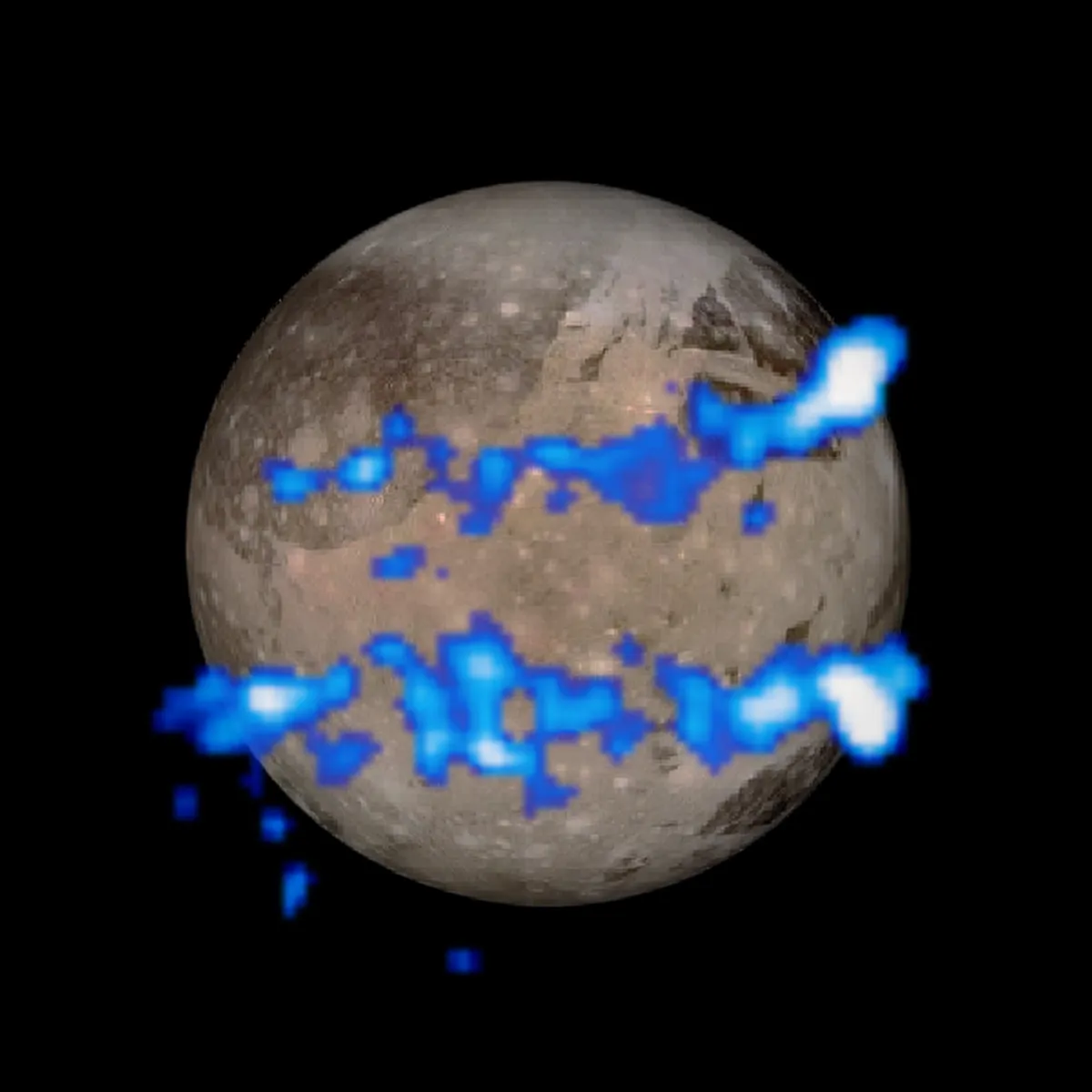
Most natural satellites don’t have an internally generated magnetic field, but Ganymede does.
This is thought to have resulted from convection currents within the body of the satellite, and it is embedded within the magnetic field of Jupiter. Ganymede is the only Solar System moon to have this feature.
Ganymede has two types of surface terrain
About one-third of the surface consists of darker regions with multiple impact craters, while lighter regions crossed with grooves and ridges make up the other two-thirds.
The former regions are thought to be around 4 billion years old (i.e. as old as Ganymede itself). The lighter regions are believed to be slightly younger, and to have formed as the result of tectonic processes, though the precise mechanism is not yet understood.

Ganymede was officially discovered in 1610
German astronomer Simon Marius and Italy’s Galileo Galilei both observed Ganymede independently in 1610, though Chinese records show that ancient astronomer Gan De may have spotted it – with the naked eye – as early as 365 BC.
It's named after a Trojan prince in Greek mythology
Simon Marius called Ganymede “the Jupiter of Jupiter”, while Galileo proposed naming them after members of the Medici family.
It was Johannes Kepler who suggested a system of nomenclature based on Greek mythology: Marius then agreed, and so ‘Ganymede’ became the name that stuck.

Ganymede used to be called Jupiter III
It took a while for the Greek-based naming system proposed by Kepler and Mariust to catch on: accordingly, in much astronomical literature of the 17th-19th centuries, Ganymede is referred to as Jupiter III.
It is tidally locked to Jupiter
Like most known moons, Ganymede is tidally locked with its parent planet, meaning the same side always faces the planet.
The same is true of our Moon, which is why we always see the same side of the Moon from Earth.
It orbits Jupiter at a distance of 1,070,400km (665,100mi) and takes 7.155 Earth days to complete one orbit, meaning that a day on Jupiter also lasts 7.155 Earth days.

It has very low axial tilt
Ganymede is tilted, relative to its orbit, by just 0-0.33° – it’s essentially sitting bolt upright, in other words.
By comparison, Earth's Moon is titled 6.7° on its axis, relative to its orbit around Earth.
Ganymede has polar ‘ice’ caps
As we’ve already seen, it’s cold everywhere all the time on Ganymede!
All the same, it does have polar ‘ice’ caps – areas of water frost on top of the ubiquitous icy surface, thought to be formed when bombardment by plasma causes droplets of liquid water at the surface to migrate towards (even) colder polar regions.

The first spacecraft to visit Ganymede were Pioneer 10 and 11
NASA’s Pioneer 10 and Pioneer 11 Solar System probes flew by Ganymede as they passed through the Jupiter system in 1973 and 1974, respectively.
Though these were high-speed flybys at some distance (the closest either probe ever came to the surface was 446,250km, or 277,287 miles) they enabled scientists to measure the satellite’s physical size more accurately.
Voyager I and II followed in Pioneer’s footsteps in 1979
Like the Pioneer probes, Voyager I and Voyager II flew by only briefly, but it was these two missions that sent back the first clear images of Ganymede, revealing the mysterious grooves that cover over 60% of the moon’s surface.

Galileo made six close fly-bys of Ganymede in 1996 and 2000
Launched in 1989, NASA’s robotic Galileo probe was the first humanmade spacecraft to orbit Jupiter, arriving at the planet in 1995.
While it was there it conducted six flybys of Ganymede, coming within 264km (164mi) of the surface during the closest of these.
Data sent back by Galileo enabled the discovery of Ganymede’s magnetic field (in 1996) and its sub-surface ocean, which was announced in 2001.
New Horizons flew by in 2007
The purpose of the New Horizons mission was to study the outer Solar System – i.e. Pluto and other Kuiper Belt objects.
But it flew by Ganymede on the way, providing valuable data that was used for topographical and compositional mapping.
Juno is the most recent spacecraft to visit Ganymede
NASA's Juno mission was and is the successor to Galileo: launched in 2011, it entered Jovian orbit in 2016 and is still there.
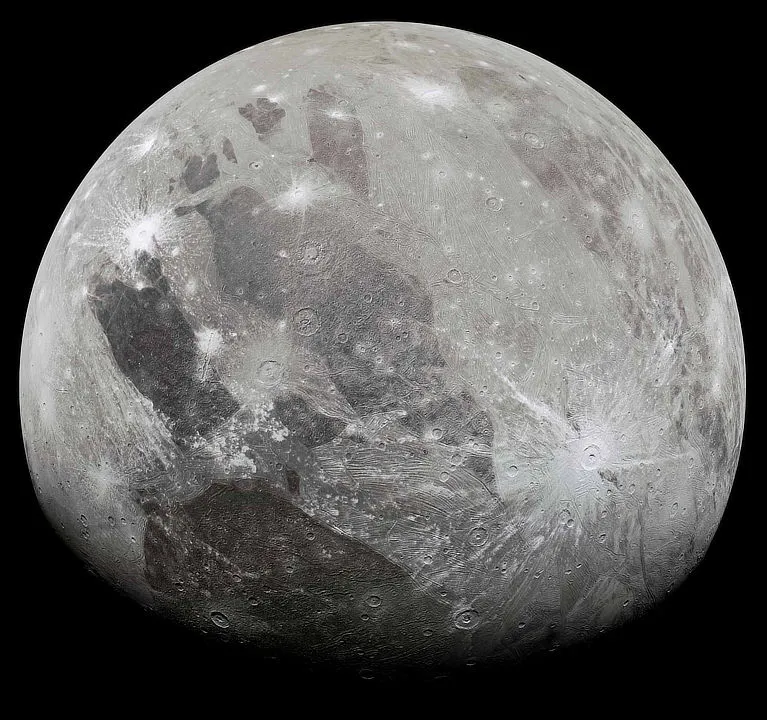
It has completed two close flybys of Ganymede: one in 2019 that came within 100,000km (62,000mi) of the surface and provided new information about the moon’s polar regions, and one in 2021 the came with 1,038km (645mi) on the surface and sent back new surface images.
Juice will become the first spacecraft to orbit Ganymede
Launched in April 2023, the European Space Agency’s Juice mission is designed to explore three of Jupiter’s icy moons: Ganymede, Callisto and Europa.
It’s expected to reach the Jupiter system in 2031 and go into orbit around Ganymede in 2034.
When it does, it will become the first human-made spacecraft to orbit any moon other than Earth’s own.

Juice should improve our understanding of Ganymede considerably
Juice’s scientific objectives include further topographical, geological and compositional mapping of the surface, learning more about the satellite’s iron core and subsurface ocean, and investigating its atmosphere and magnetic field.
Sadly, it will have less than a year to do all that – after which the spacecraft is expected to run out of fuel and crash into Ganymede’s surface.
Europa Clipper will also make several close flybys
NASA’s Europa Clipper mission is primarily designed, as the name suggests, to study Europa.
But it will need to fly past Ganymede to get there, and should make four close flybys in 2030 – pipping ESA’s Juice to the post even though it launched 18 months later, in October 2024.
What are your favourite facts about Ganymede? Let us know by emailing contactus@skyatnightmagazine.com