If you've been reading about this week's supermoon, you may have come across the terms ‘lunar perigee’ and ‘lunar apogee’.
They might sound rather complicated, but they're actually simple terms that help us mark the points when the Moon is closest, and farthest, from Earth.
More astronomy definitions

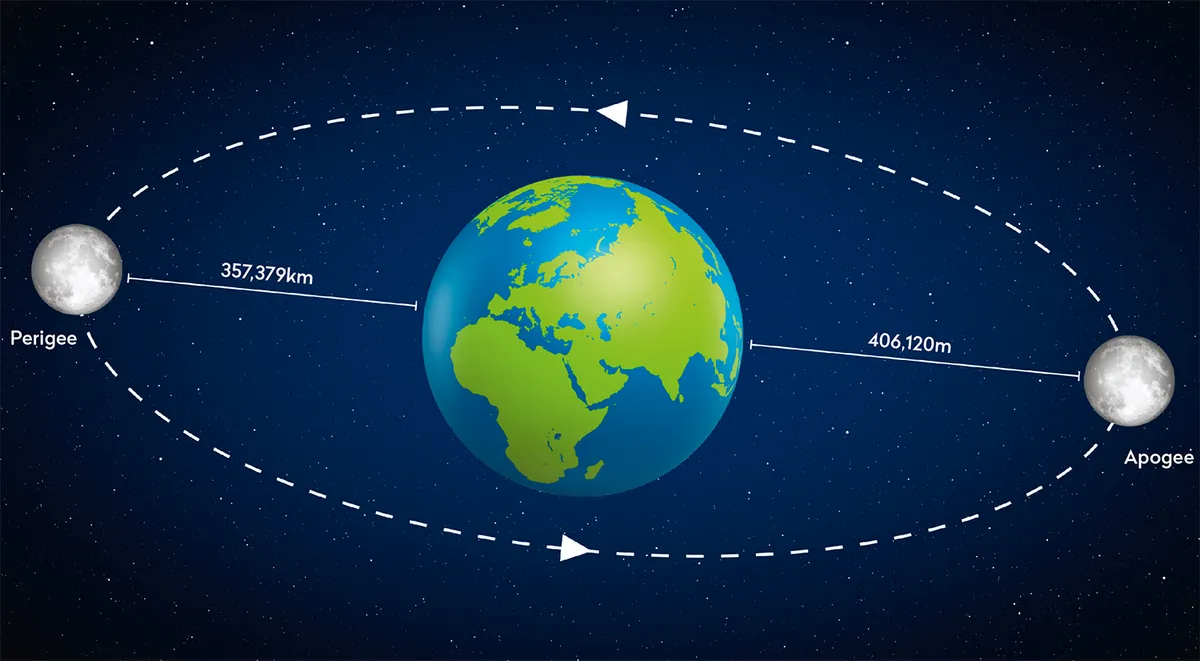
Lunar perigee is the point in the Moon’s orbit when it’s closest to Earth, while lunar apogee – as you may have already guessed – is the point when it’s furthest from Earth.
The names of the two locations/occurrences are derived from Greek.
Peri means ‘near’ or ‘approaching’, while apo means ‘away’ – hence perigee when the Moon’s close to us, and apogee when it’s further off.
Why we get lunar perigee and apogee
If you’re confused as to why the Moon is at different distances at different times, the thing to remember is that just as 'there are no straight lines in nature' (as the old saying goes), few things in the natural world are perfectly circular, either.
And that’s very much true of the orbital paths of planets around their parent stars and – in turn – of the orbital paths of natural satellites around those planets.
In fact, while we have in recent decades discovered a handful of exoplanets whose orbits appear (at least from the great distance at which we’re observing them) to be very nearly a perfect circle, science has yet to discover a single celestial body, anywhere in the Universe, that orbits another body in truly perfect circular fashion.
Orbits, in a nutshell, are elliptical, which is why the distance between Earth and the Moon can vary considerably.
According to the Royal Observatory Greenwich, the AVERAGE Earth-Moon distance is 384,400km (238,855mi), but at any given moment in time, the ACTUAL distance can range from 363,104km (225,623mi) to 405,696km (252,088mi).
When the Moon’s a mere 363,000km away – that’s perigee, and when it’s 405,000km away – that’s apogee.
A full list of past and future full Moon perigees is available via AstroPixels.com.
Effects of perigee and apogee
How do lunar perigee and apogee affect us here on Earth? In short, they don’t – much. But there are two detectable effects.
The first is on tides – at lunar apogee, the pull of Moon’s gravity is reduced by the greater distance, so high tides are slightly lower than they are at lunar perigee, when the Moon is closer and so the pull of its gravity is that much stronger.
But the difference is no more than 5cm (2in), and given that the average tidal range (the difference between high and low tide) along the UK coastline is 4m (156in), you’re not going to notice such a tiny fluctuation.

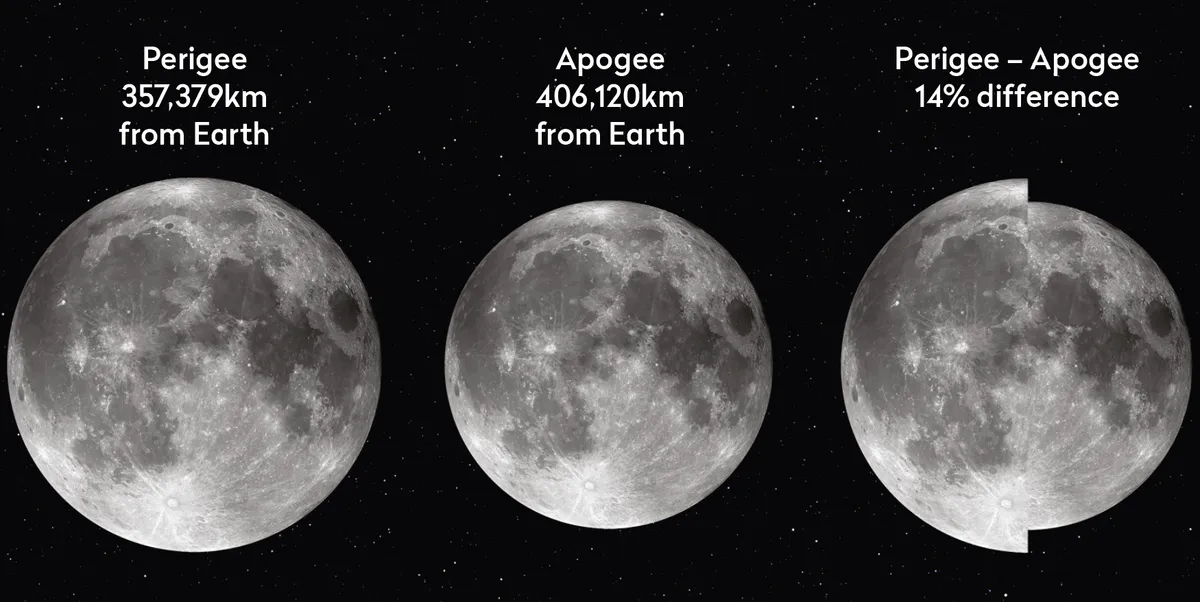
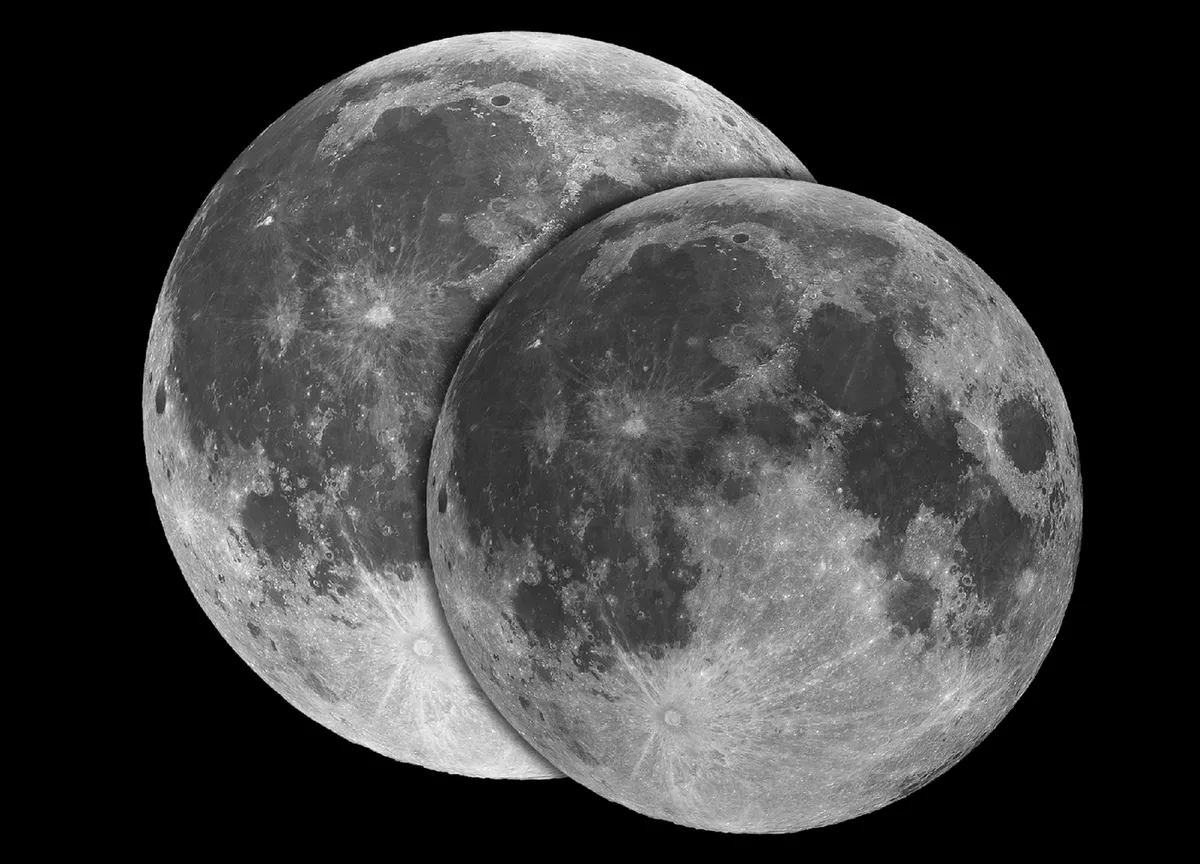
The other effect is slightly more noticeable, but only just! Naturally enough, at lunar perigee the Moon – being that much closer to Earth – appears slightly larger than it does when it’s at perigee.
A ‘supermoon’ is the name we give to a full Moon that coincides with lunar perigee – but again, in real life the difference is minimal.
So minimal, in fact, that you may need to compare images of two consecutive full moons to even notice it at all!
One final thing to note is that everything we’ve just said also applies to Earth’s orbit around the Sun – so ‘aphelion’ is the point in Earth’s orbit when we’re furthest from the Sun, and ‘perihelion’ is the point when we’re closest to it.
Both names are derived by combining the peri and apo prefixes described above with Helios – the Ancient Greeks’ god of the Sun.