
What happens when a star collapses?
This isn't just a hypothetical thought experiment, but rather a key question in astrophysics.
Massive stars are constantly trying to collapse in on themselves, such is the enormity of their mass and gravitational pull.
What stops this happening, however, is the radiation pressure generated by the release of energy as atoms fuse in the star's interior.
More mind-blowing science

But nothing lasts forever, and this is true even across the vast cosmos.
Once a star begins to run out of fuel, it can no longer resist the pressure of its own gravity and it collapses under its own mass, until only single, dense point remains.
Astronomers call this the 'singularity'. But what happens next?

The case for black holes
When a star at least 20 times more massive than our Sun runs out of nuclear fuel, it collapses under its own gravity.
This occurs within a fraction of a second, triggers a fierce stellar explosion known as a supernova and leaves behind a core crushed into a dense singularity.
This is a black hole.
But, say scientists, while we have observed and detected black holes, they remain filled with mystery.
How can material the equivalent of 10 billion solar masses concentrate onto a single, tiny point?
General relativity states that spacetime itself may be curved infinitely steep at the singularity. How can this be?
Clearly, the very laws of physics seem to break down when it comes to black holes.
And it doesn't help that not even light can escape their gravitational pull, meaning we can't directly observe black holes, but instead observe their effect on material surrounding them.
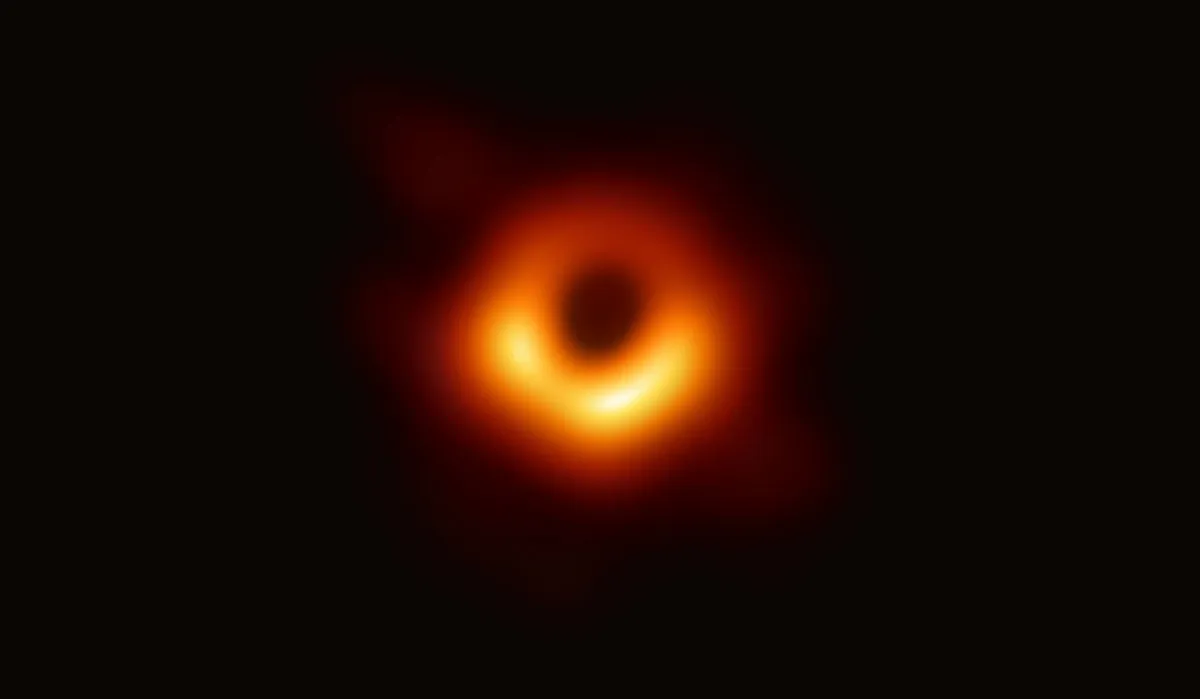
Collapsed stars could be full of dark energy
A team of astronomers say it could be possible that black holes are in fact a completely different type of object like an ultra-compact star, also called a 'gravastar'.
They say that, in addition to ordinary matter present in their outer layers, these gravastars could be filled with dark energy.
Dark energy is the name given to the unknown force that seems to be accelerating the expansion of the Universe.
In the case of gravastars, dark energy would exert an outward pressure and stabilise the gravastar's mass, preventing it from collapsing.
But how could gravastars actually form?

Gravastars and mini-universes
Theoretical physicists Daniel Jampolski and Professor Luciano Rezzolla have presented a solution to the physics behind the collapse of a star that could lead to the formation of a gravastar.
They say their solution shows that the collapse of the star could cause the creation of a mini-universe inside the collapsing matter.
That mini-universe, the pair say, wouldn't be very different from the Big Bang, from which our own Universe emerged.
And just like how the Universe's expansion is driven by dark energy, the mini-universe's expansion would counteract the star's gravitational collapse before a black hole could form.
That could lead to an equilibrium between the expanding mini universe and the collapsing matter, leading to a gravastar.

New physics?
"The Big Bang of the emerging universe can unfold once the star has already collapsed almost to the point of becoming a black hole," says Daniel Jampolski, who presented the solution in his master’s thesis, supervised by Luciano Rezzolla.
"It is easier to imagine that the Big Bang occurs only at a very late stage, when matter has already been compressed to an extreme degree, thereby giving rise to new effects."
"Looking for alternatives to black holes should not suggest a skepticism towards black holes, which still represent the most natural and simplest solution to the fate of gravitational collapse," says Rezzolla, Professor of Theoretical Astrophysics at Goethe University in Frankfurt, Germany.
"However, as scientists in general, and as theoretical physicists in particular, it is essential to maintain an unbiased approach towards what we do not know and hence explore both the accepted wisdom and the more exotic interpretations.
"History teaches us that it is not unusual for the latter to become the former."
Read the full paper via APS Journals

