Why do we keep putting dark matter detectors deep underground?

Why do we keep putting dark matter detectors deep underground?

A sensitive question: why dark matter detectors have to live deep beneath mountains

Get monthly inspiration to your door with BBC Sky At Night Magazine - subscribe today


Ever noticed that lots of dark matter detectors tend to be deep, deep underground?

On Earth’s surface, around 10,000 cosmic ray muons pass through every square metre around you every minute.

Born in the upper atmosphere, where incoming cosmic rays from space shatter air molecules, these subatomic particles then travel straight through almost everything, including you, largely unnoticed.

We can only see dark matter from its effect on stars and galaxies. Here, astronomers used the images of galaxies distorted by gravitational lensing to map out the dark matter, shown in blue. Credit: NASA, ESA, M. Jee and H. Ford (Johns Hopkins University)
Astronomers used images of galaxies distorted by gravitational lensing to map out dark matter, shown in blue. Credit: NASA, ESA, M. Jee and H. Ford (Johns Hopkins University)
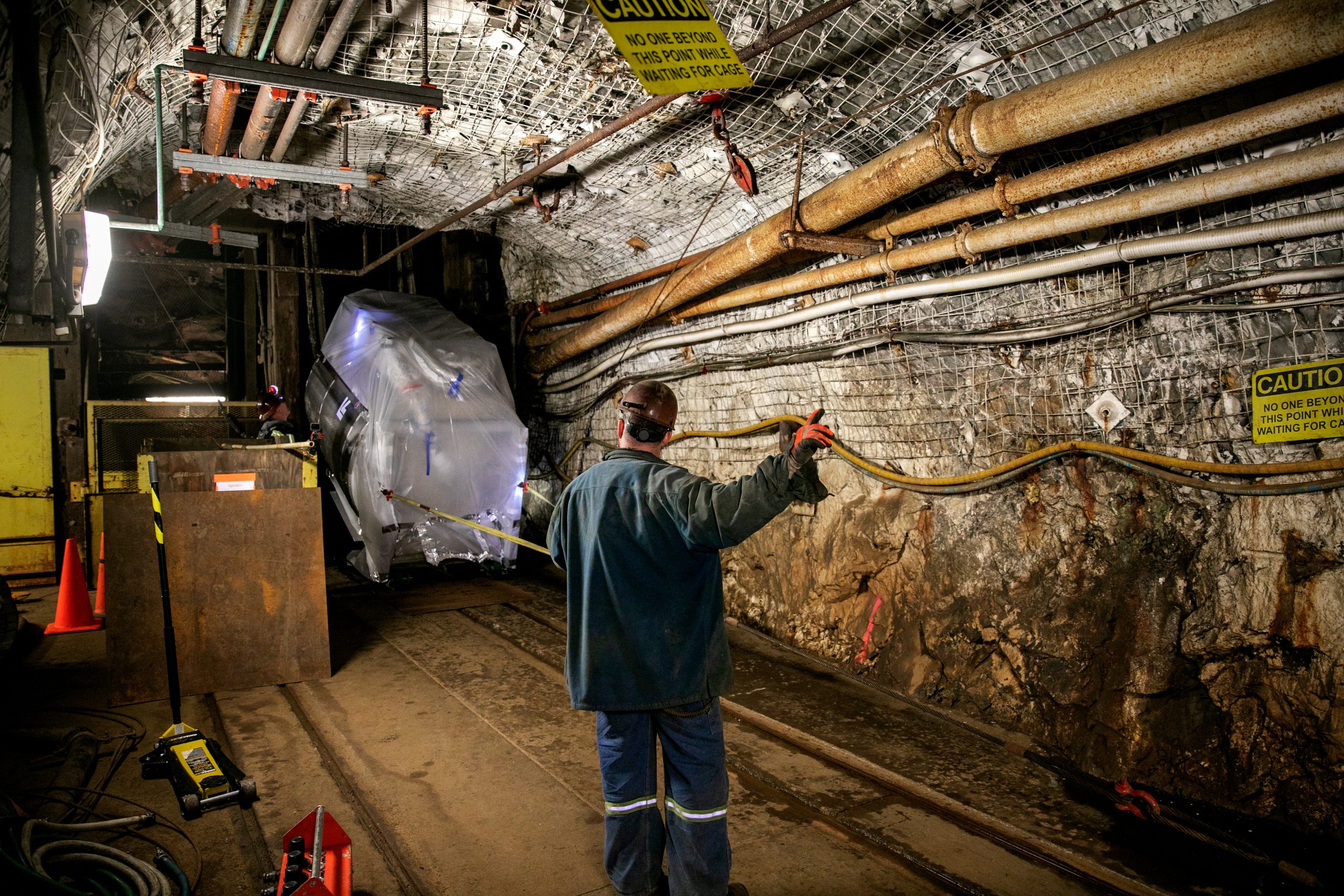
LZ’s central detector was assembled in a cleanroom on the surface, then moved a mile underground at the Sanford Underground Research Facility. The underground location shields the experiment from cosmic rays. Credit: Matthew Kapust/Sanford Underground Research Facility

For a highly sensitive dark matter detector trying to register the faintest possible interaction, they are an enormous problem.

A single muon passing through a xenon tank produces a signal orders of magnitude larger than a hypothetical WIMP event.

Rock, fortunately, is a good muon absorber. Every hundred metres of it reduces the flux by roughly a factor of 10.

Go deep enough and the muon rate should drop to a manageable trickle.

LUX-ZEPLIN, for example, sits almost at 1,500 metres (4,920ft) below ground in a former gold mine in South Dakota.
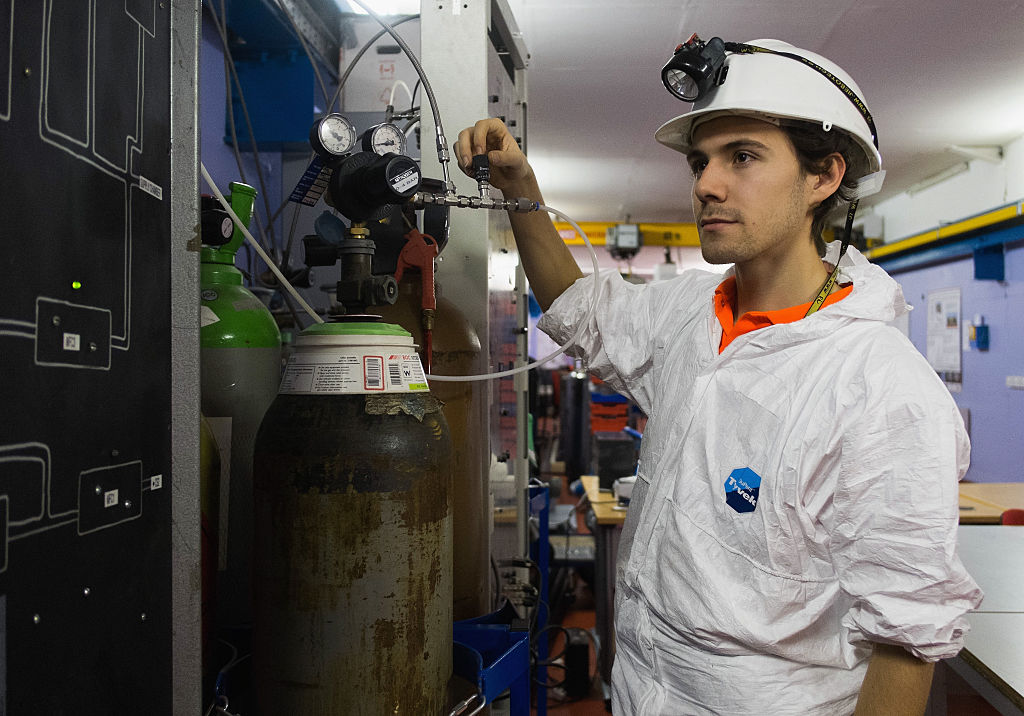
The Deep Underground Science Facility in Boulby Mine hosts research into astrophysics, climate change and dark matter research. Photo by Ian Forsyth/Getty Images

XENONnT is 1,400 metres (4,590ft) beneath Gran Sasso in Italy, inside a purpose-built hall that also hosts neutrino experiments.

The UK’s Boulby Underground Laboratory in North Yorkshire is 1,100 metres (3,610ft) down, in a working potash and polyhalite mine.

Depth is only part of the solution.

The detectors are built from materials chosen for exceptional radioactive purity, since even trace amounts of uranium or thorium produce background radiation.

Finally, surrounding water tanks and scintillator shields mop up whatever does get through. 

Footer banner
This website is owned and published by Our Media Ltd. www.ourmedia.co.uk
© Our Media 2026