Why is the sky blue? It's one of those facts about nature in our everyday life that we take for granted.
Yet when we pause to think about it, it's a great question to ask.
In this article we'll look at the science behind why the sky is blue, or at least why it appears blue to our eyes.

Where sunlight and Earth's atmosphere fit in
When sunlight reaches Earth’s atmosphere, it contains virtually every wavelength on the electromagnetic spectrum.
This includes all the colours of visible light, from the shorter waves of violet and blue, to the longer wavelengths of orange and red.
When our eyes see all these wavelengths together, they look like pure white.
As well as the sunlight, Earth’s atmosphere contains molecules like nitrogen, oxygen and carbon dioxide, as well as particles of dust, water vapour and pollutants.
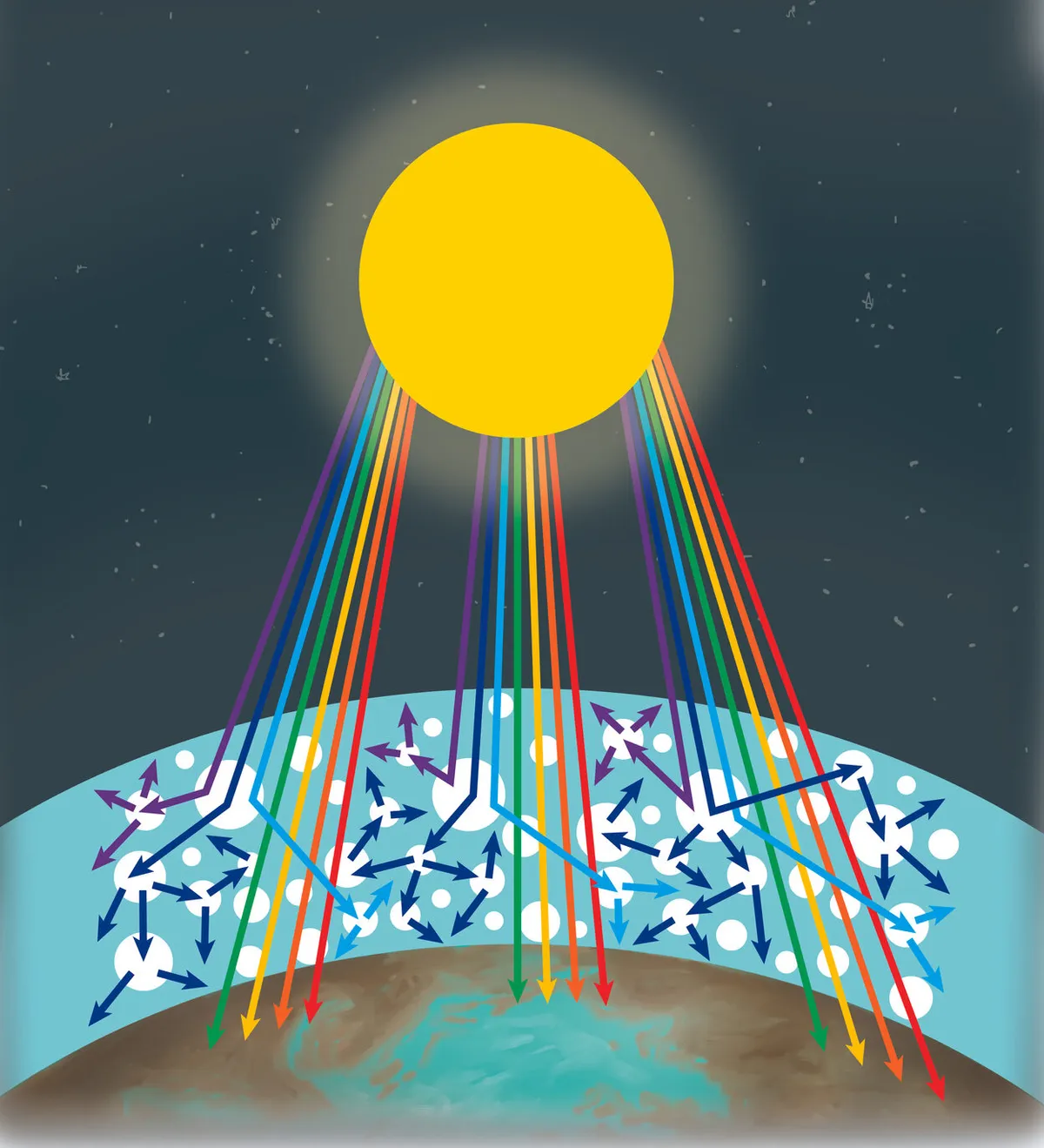
Where the sunlight first reaches us, the upper atmosphere, it will meet and interact with the most abundant molecules in our air: nitrogen and oxygen.
These molecules are small, and light at longer wavelengths manages to pass by nitrogen and oxygen without too much interference.
However, the shorter wavelengths of light are scattered by the molecules, sending out blue and violet light in all different directions.
This is called Rayleigh scattering, named after the physicist who discovered it.
More Earth science

So, the sky appears blue because the molecules of nitrogen and oxygen in the atmosphere scatter light in short wavelengths towards the blue end of the visible spectrum.
The other colours pass through the Earth’s atmosphere to reach us, but because of the great abundance of blue light wavelengths, our eyes see the sky as blue.
Technically, the short wavelengths that scatter across the sky correspond to the colours blue and violet, making the real colour of the sky a bluish purple.
However, the cone cells in our eyes that detect colour aren’t very sensitive to violet, so we see the sky as blue.
What makes the sky blue, makes the Moon red

The same atmospheric phenomenon that makes the daytime sky look blue to our eyes is the same reason a Moon close to the horizon looks red.
It comes back to Rayleigh scattering and the amount of atmosphere the Moon's light has to travel through when it's low in the sky.
When the Moon is high in the sky, its reflected sunlight passes through a relatively thin layer of atmosphere to get to our eyes.
But when the Moon is just peeking over the horizon, its light needs to travel through a thicker, denser path of atmosphere to reach our eyes.
Because blue and violet light have short wavelengths, they collide with gas molecules and scatter in every direction.
Longer red and orange wavelengths are better at punching through the dense atmosphere.
So when the Moon is low and its light has to pass through a thicker section of atmosphere, the effect is that the Moon looks orange or rust-red.
The orange hue dissipates as the Moon rises higher in the sky and the Moon becomes paler in colour.