Your new telescope arrives and you plan to take it for a spin through the stars.
But a smog of light sits low in the sky, washing away your views to distant galaxies – along with your astronomy dreams.
Quickly you realise you need a quality dark-sky site. But how dark is dark?
And how do we compare one location’s sky to another? Enter the astronomer’s friend: the Bortle scale.
Origins of the Bortle Scale
Amateur astronomer John E Bortle set out to create a sky-brightness scale that would be easily accessible to stargazers and scientists alike.
Launched in 2001, it was quickly adopted by anyone curious about the darkness of their skies, and how theirs stacked up against others.
Light pollution, even in small amounts, impacts our view of the cosmos. Sadly, 99% of Americans and Europeans live under light-polluted skies.
This means that the majority of us have to travel if we want to experience a truly dark sky that offers unobscured views of distant stars, galaxies and other phenomena that are otherwise lost to light.
The Bortle scale runs from an increasingly rare Class 1: excellent dark-sky site, to the smothered skies of Class 9: inner-city sky.
Here’s a breakdown of what each level means, so you know what to expect from any rated stargazing site.

Class 1: Excellent dark-sky site
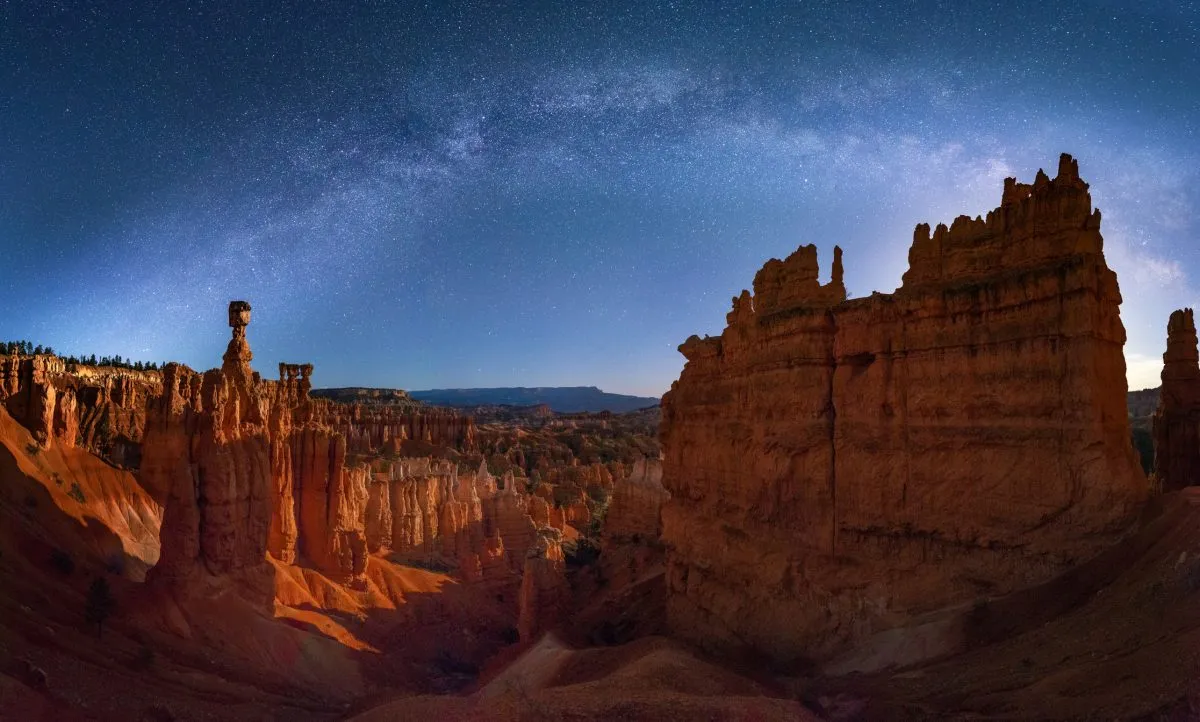
As light pollution extends its grip, these sites are on the road to extinction across much of Europe. Here, the night sky is unimpeded by any artificial light at night.
They’ve got it all: Zodiacal Light, gegenschien, and the Triangulum Galaxy, M33, and the Orion Nebula, M42, are all easily seen by the naked eye. One of the most magical features of these sites? The Milky Way is so bright it can cast a shadow on the ground.
Class 2: Typical truly dark sky
Away from any major settlement we get to Bortle Scale Class 2. These sites can sometimes be found closer than you think, if they’re shielded by natural features such as hills and mountains, although even here the sky is not truly black. The Orion Nebulais easily visible unaided.
Class 3: Rural sky
For many of us, Bortle Classes 3 and 4 are likely to be the most accessible, with some travel. Light pollution creeps in, visible as domes on the horizon, meaning you’ll lose detail in the Milky Way at the horizon but still get lots of detail visible overhead, especially through binoculars.
M42 and the globular clusters M4 and M22 are all visible with the naked eye. You’ll need averted vision to catch M33. Any clouds appear dark overhead, but if they hover over the horizon they will be illuminated.
Class 4: Rural/suburban transition Sky
Light domes fill the horizon in almost every direction over settlements, but the sky is still dark overhead. When well above the horizon, the Milky Way is still visible, mainly definable by the Great Rift. It’s still possible to see the Orion Nebula, M42, with the naked eye.
Class 5: Suburban sky
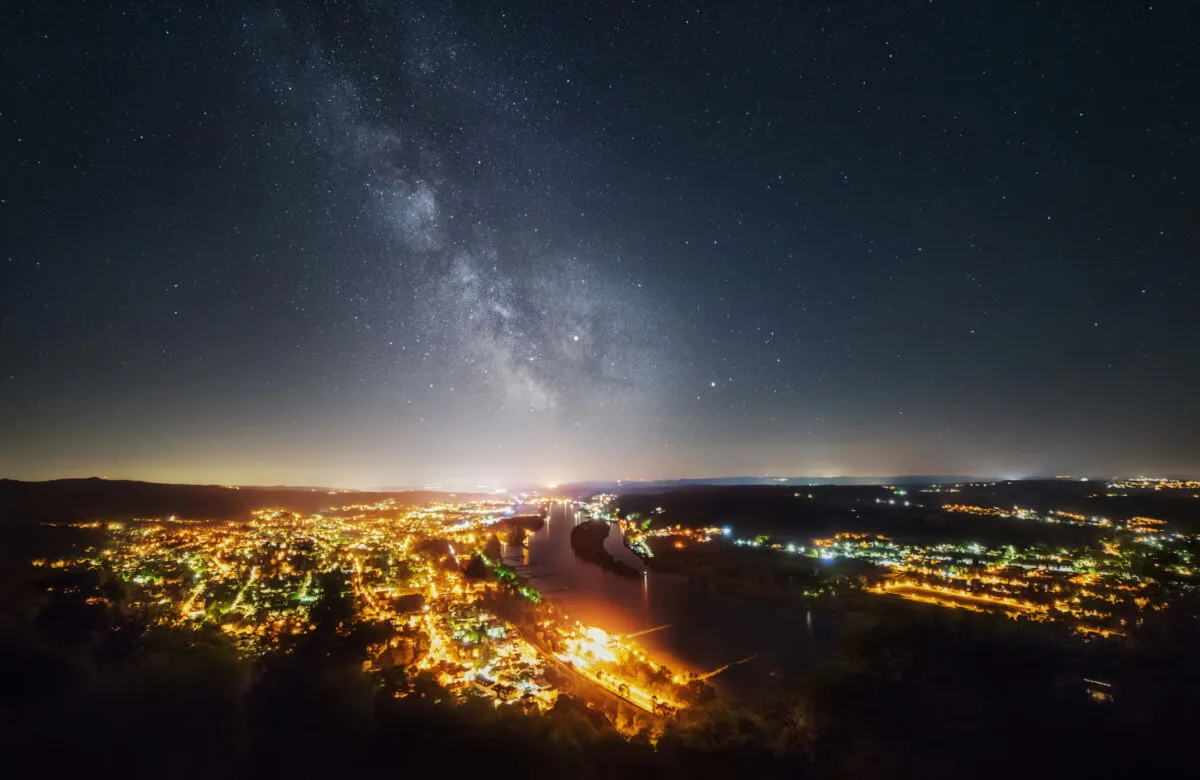
Light pollution is visible in most – if not all – directions, erasing the Milky Way completely on the horizon and making it appear noticeably faded even directly overhead. Any clouds are brightly lit by artificial light at night. We start to really lose galaxies, with M33 and M42 barely visible without binoculars or scopes.
Class 6: Bright suburban sky
Class 6 of the Bortle Scale means the entire horizon is aglow with light pollution, completely destroying views of the Milky Way unless you’re looking directly overhead – and even then, you’ll be using a fair bit of your imagination to make it out.
Viewing M33 and M42 is now impossible unless you have binoculars. On the plus side, you won’t be fumbling in the dark to find your equipment here!
Class 7: Suburban/urban transition
The night sky is obliterated by light and turned a murky shade of white. Bright light sources illuminate any clouds. Milky Way? No chance. Realistically, you’re not seeing much without binoculars or a telescope, beyond our brightest winter constellations such as Orion.
Class 8: City sky
Darkness has well and truly vacated the premises. The sky glows in shades of grey or orange, and even our brightest constellations and planets struggle against such a strongly lit sky.
A telescope is your only hope here, and even then, the brightest Messier objects such as M31, the Andromeda Galaxy, are mere shadows of their former selves.
Class 9: Inner-city sky
Under class 9 of the Bortle Scale, the sky is permanently ablaze with light. The only real observable objects in the night sky are the Moon, the brighter planets and passing satellites. Not even the brightest winter constellations fully perforate the heavy blanket of light pollution. A very sad sky.

Using the Bortle Scale
Using the Bortle Scale, assess your home skies and see how they compare to other sites.
Take a star chart or planetarium app and find the faintest star you can see with the naked eye.
This is somewhat subjective as it’s based on human perception, so expect small variations.
Remember to take into account the Moon phase, as even a Bortle 1 site becomes a Bortle 7 under the glare of a full Moon.
Always allow at least 20 minutes for your night vision to fully develop, as this will help you pick out the faintest visible targets.
Now, put your new knowledge into practice and get planning your next night under the stars. Whether at home or further afield, now you’ll know just how in the dark you are!
