
Are you a fan of the full Moon? From supermoons to lunar eclipses and even just plain old, regular full Moons, people all over the world love the sight of a beautiful, bright Moon in the night sky.
Unlike any other planet in our Solar System, Earth has just one Moon. Some, like Saturn, have well over 200 moons, while Mercury and Venus have none.
Mars has two moons, but our home planet has just one natural satellite. Perhaps that's why, when it's big and bright in the night sky, it seems so spectacular.
If you are a fan of the full Moon, there are a few key dates to mark in your calendar for 2026.
Keep up to date by bookmarking our next full Moon web guide and by signing up to receive our weekly e-newsletter directly to your email inbox, which includes timely stargazing tips, plus the coming week's lunar phases and times.
January's supermoon

When the Wolf Moon rises on 3 January 2026, it marks the first full Moon – and the first supermoon – of the year.
Granted, we'll have to wait until November and December for the second and third supermoons of the year, but at least we get to kick off 2026 with a beautiful, bright supermoon.
Supermoons appear slightly bigger and brighter than a 'regular' full Moon, and although in truth the difference is imperceptible to the naked eye, it still makes for a great reason to get out and looking up.
January's full Moon is also one of the highest-reaching full Moons of the year, because the full Moon mirrors the Sun's movement in the sky.
That means that, because the Sun is low in winter, the full Moon is high in winter.
And this 2026 Wolf Moon supermoon will be joined by Jupiter in the evening sky, making the spectacle even greater.
March's total lunar eclipse

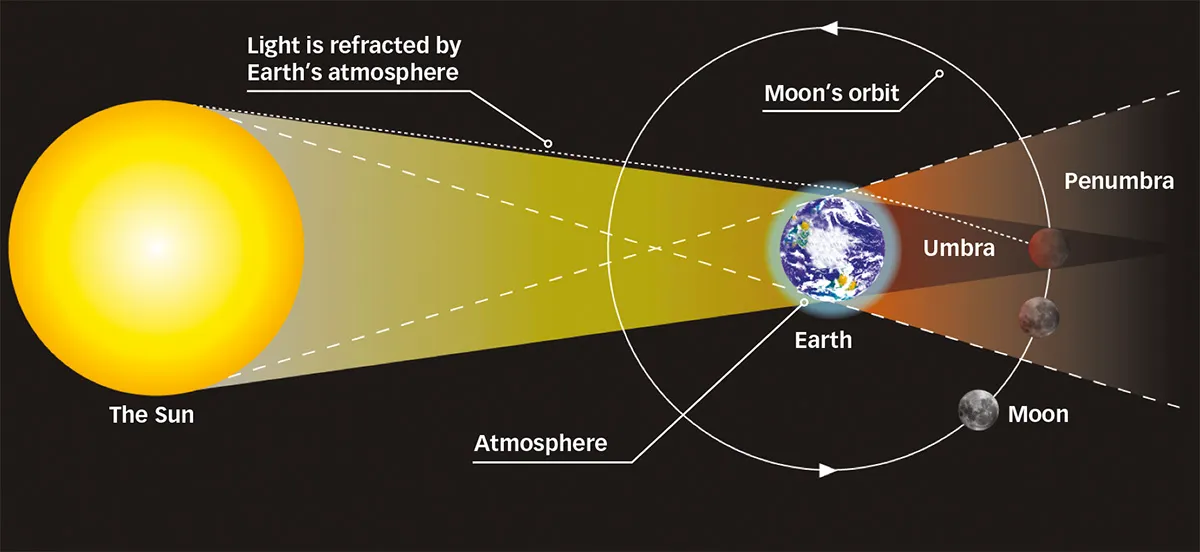
A full Moon occurs when the Moon and the Sun are opposite each other, with Earth in the middle. This causes the whole of the Earth-facing side of the Moon to be illuminated.
And when the Sun, Earth and the Moon in a line, Earth casts a shadow in the direction of the Moon.
Most of the time, Earth's shadow misses the Moon. Sometimes, however, the Moon passes through Earth's shadow, and we get to see the effects of this on the lunar surface.
This is known as a lunar eclipse.
On 3 March 2026, a total lunar eclipse will be visible from Earth.
This is a total lunar eclipse because we'll get to see the whole of the lunar surface covered by Earth's shadow.
The effect is that the Moon will become darker and even slightly red-coloured, as sunlight is refracted by Earth's atmosphere on its way to hitting the Moon.
Unlike a solar eclipse, a lunar eclipse is perfectly safe to view with the naked eye, which makes it a great event for kids.
The caveat with any lunar eclipse, however, is that not everyone in the world gets to see it.
The 3 March 2026 lunar eclipse will be visible in North America, South America, eastern Asia and Australia, among other places, but not in Europe or Africa.
To see a full map of where the eclipse is available, visit NASA's eclipse website.
May's blue Moon

We're getting not 12, but 13 full Moons in 2026.
That's because there will be two full Moons in May: one on 1 May, and another on 31 May. That makes the 31 May 2026 full Moon a blue Moon.
This will not a blue Moon in the true astronomical sense, however.
In astronomy, a blue Moon is what's referred to as a 'seasonal' blue Moon, which is the third full Moon in an astronomical season of four full Moons.
And an astronomical season is the period of time between a solstice and an equinox.
A monthly blue Moon, however, is a bit simpler, and is the name given to the second full Moon in a single calendar month.
That's what's happening in May 2026, and why we're getting 13 full Moons in 2026. Good news for full Moon fans!
August's partial lunar eclipse

While March 2026 will see a total lunar eclipse, when the whole of the Earth-facing side of the Moon is basked in Earth's shadow, August 2026 will see a partial lunar eclipse, when only a portion of the Moon is covered by shadow.
The August 2026 partial lunar eclipse is visible in North America, South America, Europe and Africa, but most of Asia and Australia will miss out.
Again, check NASA's eclipse web page for full details.
September's Harvest Moon

Harvest Moon is the name given to the full Moon that's closest to the September equinox.
That means some years the Harvest Moon is the September full Moon, and other years it's the October full Moon.
In 2026, the Harvest Moon rises on 26 September.
The Harvest Moon is so-called because its closeness to the September equinox means moonrise times over the nights around this date are virtually the same.
Historically, that meant the bright, fuller phases of the Moon rose at the same time every night, providing a reliable source of nighttime light for the gathering of harvest.
Today, it means we can watch the Moon rise at the same time each night, a pleasant reminder of the clockwork nature of the Earth-Moon system.
November's supermoon

The second supermoon of 2026 rises on 24 November, making this supermoon also the year's Beaver Moon.
November's full Moon is known as the Beaver Moon because that's the time of year when beavers are active, storing food and building dams for the harsh winter months ahead.
And the good news is that the 2026 Beaver Moon is also a supermoon.
It will rise close to the blue Pleiades star cluster, making for a beautiful winter spectacle.
The Christmas Eve supermoon

Christmas Eve 2026 will be marked by the rising of a bright full Moon, which is known as the Cold Moon and which will also be the last supermoon of the year.
This Christmas Eve Cold Moon will be quite the festive spectacle, making for a beautiful way to start the beginning of the holiday period.
And, it's also a great way to finish off a year that will incude more than just a few full Moon highlights.
If you observe or photograph the Moon in 2026, send us your images and they could appear in a future issue of BBC Sky at Night Magazine

