
We're kicking off January 2026 and a brand new year of stargazing with a beautiful supermoon that, tonight, will appear close to Jupiter in the evening sky.
Yes, the good news is that this week, we're about to get the first of three supermoons in 2026.
The bad news is, we'll have to wait until the end of the year for the final two!
This January 2026 supermoon follows three supermoons that occurred in a row at the end of 2025, in October, November and December, respectively.
Here we'll look at how to see the first supermoon of 2026 and how to catch its close encounter with the planet Jupiter.
For regular stargazing advice, sign up to the BBC Sky at Night Magazine e-newsletter and subscribe to our YouTube channel

The 2026 Wolf Moon
You may have heard already that this week's full Moon is known as the 'Wolf Moon'.
The term is one of many nicknames given to each full Moon of the year, which reflect major events or changes occurring in nature during the month in question.
Wolves, unlike many other wild animals, do not hibernate, and are still very much active throughout the winter months.
In the dead of winter, wolves' continued activity would have been marked by our ancestors, and so it makes sense that January's full Moon would become known by some as the 'Wolf Moon'.
But that's the only reason January's full Moon is known as the Wolf Moon. In reality, it won't look any different to any other full Moon of the year.
Why it's a supermoon

A supermoon is a full Moon that's closer to Earth than other full Moons.
This happens because the Moon's orbit around Earth isn't circular. It's elliptical, or slightly oval-shaped.
That means that, during the course of its orbit around our planet, sometimes the Moon is closer to us than at other times.
When the Moon is at its closest point to Earth, it's known as 'perigee'. When it's furthest from Earth, it's 'apogee'.
The true astronomical term for a supermoon is a perigee Moon, or even a perigee syzygy Moon, 'syzygy' referring to three or more astronomical bodies in alignment (i.e. the Sun, Earth and the Moon).
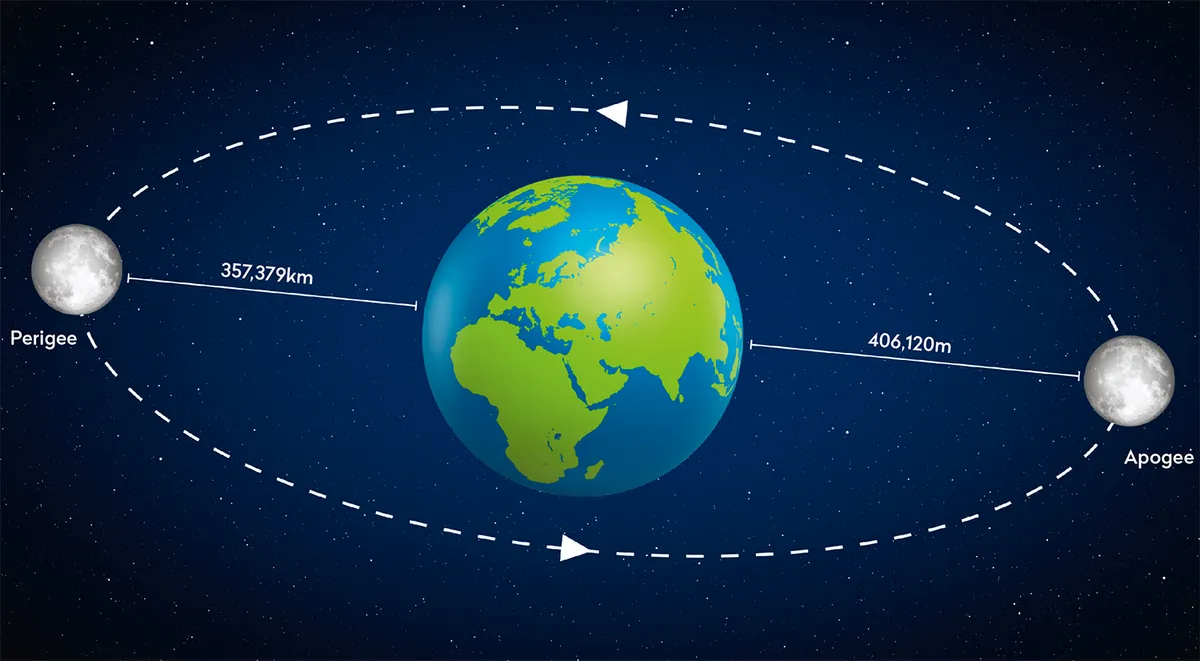
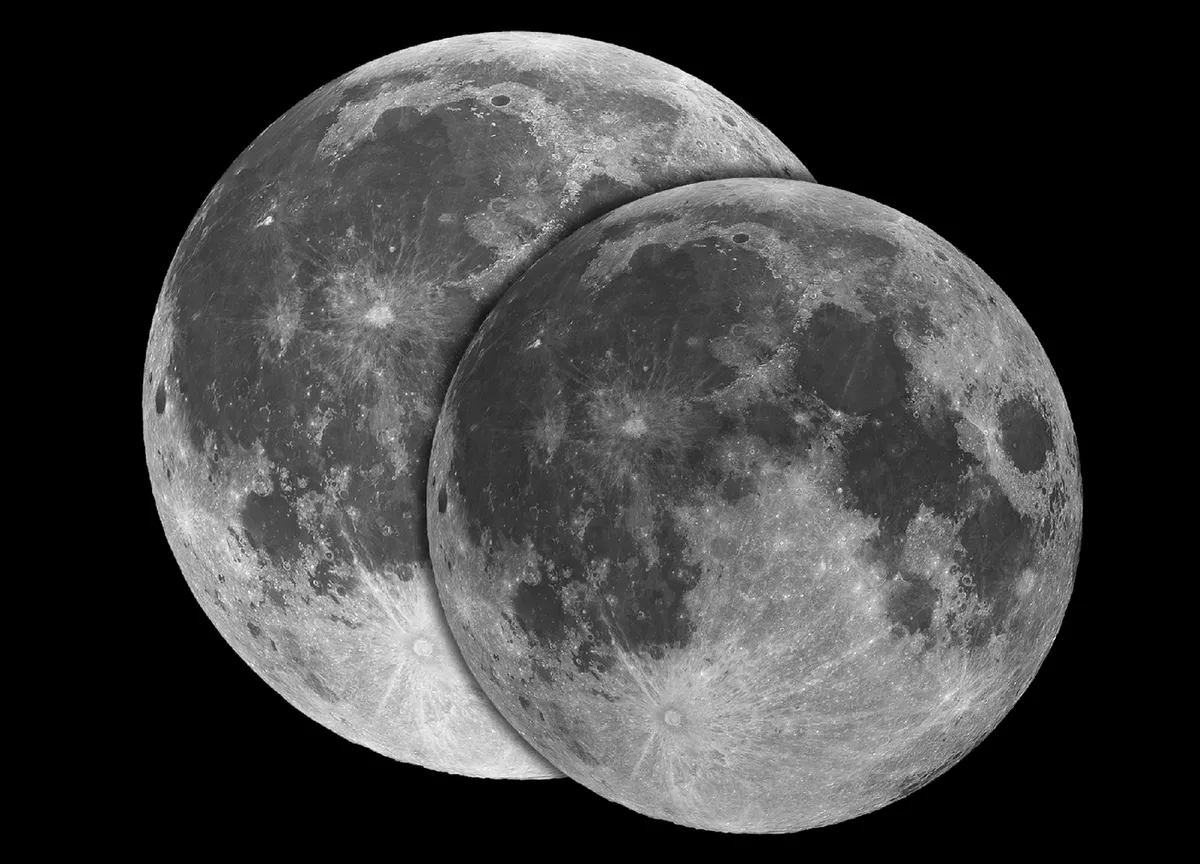
At its closest, a full Moon may appear 14% bigger and 30% brighter, when compared with a full Moon that's further away from Earth,.
That means during a supermoon, the Moon should technically appear bigger and brighter.
In truth, however, the difference is virtually imperceptible to the naked eye. You're unlikely to look at the Moon and notice that it's a supermoon.
If you do spot the Wolf Moon close to the horizon, it may look huge, but this will likely be because of a well-known optical effect known as the Moon illusion, rather than because it's a supermoon.
See the Super Wolf Moon and Jupiter together
The best thing about this week's Wolf Moon supermoon is that it will be joined by the planet Jupiter in the evening sky.
If you observe the Moon when it's almost full on the evening of 2 January, you'll see bright planet Jupiter below it.
Jupiter will look like a bright star to the naked eye, but closer inspection with binoculars or a telescope will reveal it is in fact the gas giant planet.
On 3 January, the supermoon rises in the northeast around 4pm, depending on your location.
As it climbs higher and the sky grows dark, Jupiter will be directly below the Moon, the pair closer together than they were on 2 January.

By around 8pm, Jupiter and the Wolf Mon will be in the east, and in the southeast you should be able to see the constellation Orion, too.
You may also notice two bright stars to the left of Jupiter and the Moon. These are Castor and Pollux, the twin stars of Gemini.
By midnight, Jupiter and the supermoon will be high the south, now beginning their descent towards the western horizon, which they'll dip below just as the Sun is rising.
Over the coming nights, as the full Moon wanes and gets further from Jupiter, take time to point your telescope at the planet.
Jupiter is approaching opposition on 10 January 2026, which is when it's at its best. For more info on this, read our guide on how to observe Jupiter with a telescope.

Also visible during the Super Wolf Moon
There are plenty of other things to see in the night sky this week, as well as the full Moon and Jupiter.
The Pleiades star cluster is easy to see with the naked eye. Through binoculars, it looks like a mini 'Plough' made up of bright blue stars surrounded by an ethereal blue glow.
You can find the Pleiades by following the stars of Orion's Belt from left to right.
Continue that imaginary line onwards until you see a faint 'smudge' in the sky. That's the Pleiades.
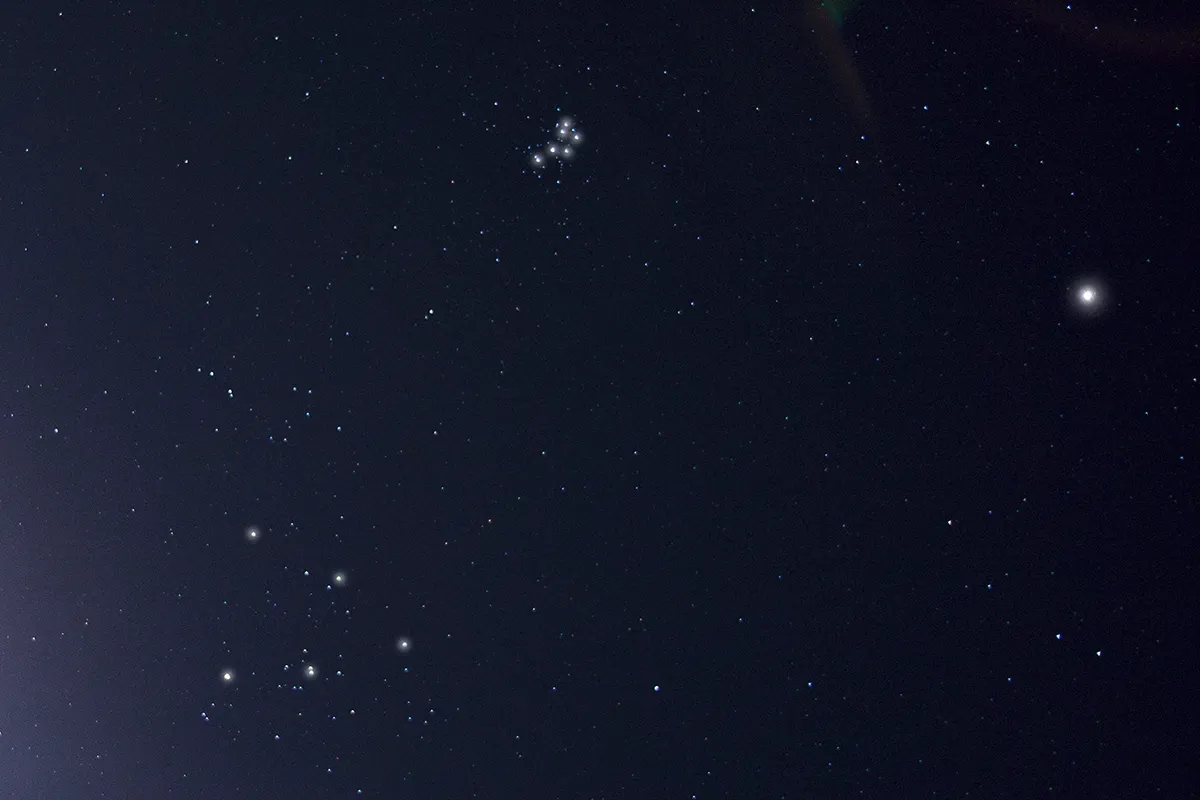
The Hyades is another stars cluster located below the Pleiades.
It can be found by first looking for the bright star Aldebaran in Taurus. Through binoculars, it looks like a sideways 'V' shape.
Look towards the southwest around 19:00 and you should be able see the planet Saturn, too, appearing like a bright star.
It will dip below the horizon around 22:30.
Share your stargazing observations and images with us by emailing contactus@skyatnightmagazine.com

