
The fourth full Moon of 2026, the Pink Moon, rises on 2nd April just after sunset.
Because the April full Moon rises so late, it should be bold and bright in the dark night sky, and this is when a full Moon is at its most majestic.
Sign up to the BBC Sky at Night Magazine e-newsletter for lunar times and phases delivered to your email inbox every week.

Should you observe a full Moon?
If you live in a dark location without much light pollution, the full Moon acts like a shining beacon in the night sky, lighting up our surroundings.
For this reason, many astronomers and stargazers avoid a full Moon, as it prevents us from seeing other targets in the night sky.
A full Moon will also wash out telescopic views of deep-sky objects like galaxies, nebulae and star clusters, meaning it can be an unwelcome presence for astrophotographers too.
But that aside, a full Moon can be quite a spectacle because it's easy to find, a glorious sight to behold and a great target for getting newcomers and children enthusiastic about the night sky.

Why it's called a Pink Moon
Every full Moon of the year has been given an informal nickname, but despite the fact that a full Moon has a name like 'Strawberry Moon' or 'Snow Moon', this has no bearing on what the Moon will actually look like.
So a Pink Moon will not look any more pink than the full Moon before it or after it, although it may take on an orange hue when close to the horizon (more on that below).
The term 'Pink Moon' is considered a reference to the onset of spring and the pink flowers that blossom around this time of year.
Search online and you'll find numerous outlets explaining that the Pink Moon is named after a type of flower called 'Phlox', which blossoms scented, pink flowers.

The Easter Moon
The Pink Moon of 2026, peaking on 2 April, serves as the year’s Paschal Full Moon, which is used to determine the date when Easter falls.
That's is because Easter Sunday is the first Sunday after the first full Moon of the vernal equinox.
The vernal equinox occurred on 20 March 2026, marking the beginning of astronomical spring.
That makes the 2 April Pink Moon the Paschal full Moon, which determines that Easter Sunday 2026 falls on 5 April.
For this reason, you'll hear some referring to the 2026 Pink Moon as the Paschal Moon, or even the Easter Moon.
Observing the Pink Moon

The Pink Moon rises on 2 April around sunset in the southeastern part of the sky. It won't rise very high in the sky, meaning a clear horizon will be of benefit.
The Pink Moon will be accompanied by star Spica, which is the brightest star in the constellation Virgo.
Many astronomers will tell you the best time to observe the Moon is during its crescent and gibbous phases, as this is when the terminator - the line dividing the lit and unlit portions of the Moon - accentuates lunar features.
During a full Moon, however, the surface of the Moon is washed out, being completely flooded in light, so you may struggle to discern its craters and other features.
Nevertheless, there are many ways to enjoy a full Moon, beyond simply gazing at it with the naked eye and contemplating our closest celestial neighbour.
Find out more about this in our guide on what to see during a full Moon and scroll down for more ideas.
The Moon illusion

Sometimes the Moon appears enormous when it's close to the horizon, and the effect of this can be spectacular.
This is the Moon illusion, and the apparent size of the Moon close to the horizon can catch observers unaware: it can appear abnormally huge.
There is no confirmed explanation as to why this happens, but it's likely to be perspective, as the Moon is big and bright and close to the horizon.
This means it appears to dwarf foreground objects like buildings and trees and seems much larger than when it's high in the sky.
Observe the Moon while it's rising and setting and see if it looks much bigger to you.
An orange Moon

Yes, this fourth full Moon of 2026 is known as the Pink Moon, but it's more likely to appear orange!
You can notice this, again, when the Moon is close to the horizon.
When low down, sometimes the Moon appears orange or rust red, and it's to do with sunlight bouncing off the Moon and passing through our atmosphere.
When it's closer to the horizon, light from the Moon has to contend with a thicker portion of Earth's atmosphere, which scatters more blue and violet light, meaning the light that does make it to our retinas is towards the red end of the spectrum.
Lunar halo

Equipment: iPhone 15 Pro Max. Exposure: 10 seconds.
You may often see a bright halo around the Moon during a full Moon, and this happens because light from the Moon is passing through surrounding clouds, causing the appearance of haloes and other atmospheric phenomena.
If you're observing the Pink Moon tonight, can you spot any tricks of light caused by the bright lunar glare?
Observe, sketch, photograph and marvel
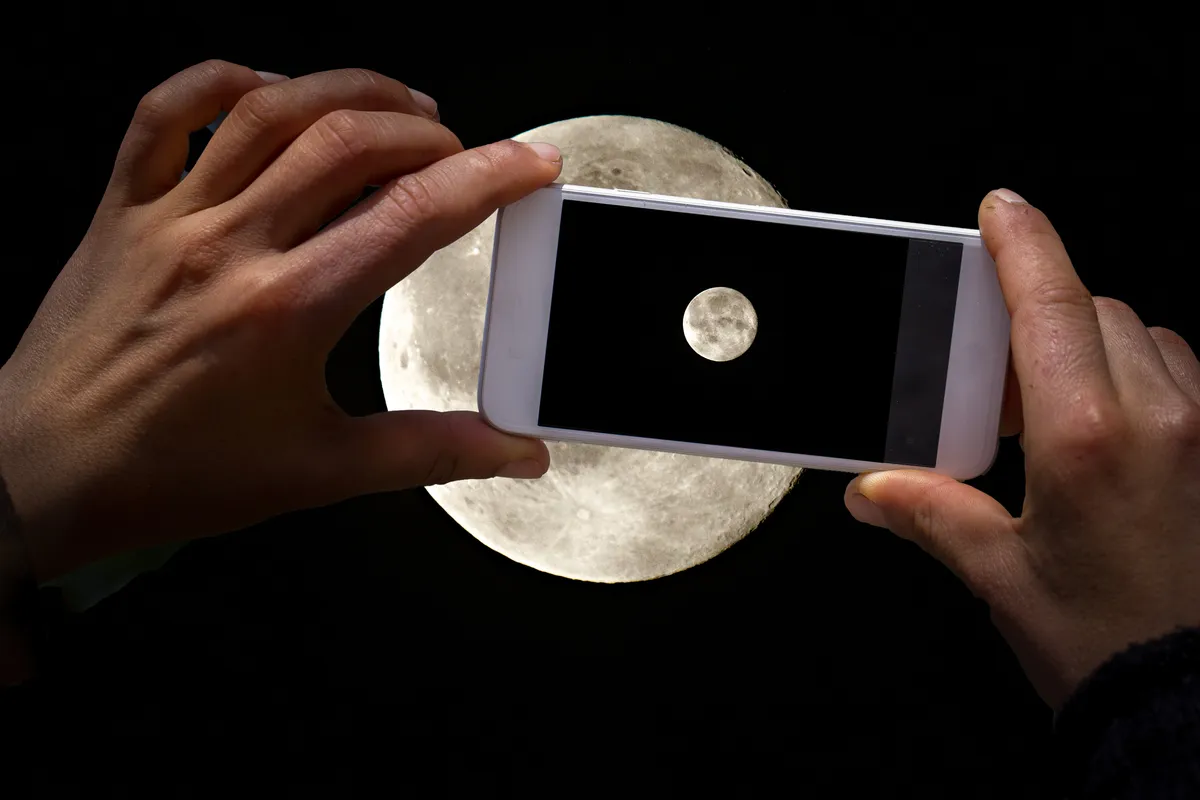
Yes, many will tell you that a full Moon isn't a great time to observe it, but you can still step outside and look up, and begin familiarising yourself with its features.
Even a modest pair of binoculars enables you to explore the lunar surface, including its craters and the lunar maria - or seas.
See if you can spot the moonlanding sites with our guide to locating the Apollo landing sites on the Moon.
And you can sketch the lunar surface, too, then compare your sketchings with family and friends. Find out more in our guide on how to sketch the Moon.
Or try and photograph the Moon. You don't need a fancy DSLR to do so.
If you have a smartphone tripod - or can balance your phone steadily while it's pointed at the Moon - and if your phone's camera has a 'pro' photography mode, tweak the ISO, white balance and exposure time and see what you can achieve.
Read our guide on how to photograph the Moon with a smartphone for more advice.
And if you do capture an image of the Pink Moon, don't forget to send us your images.

