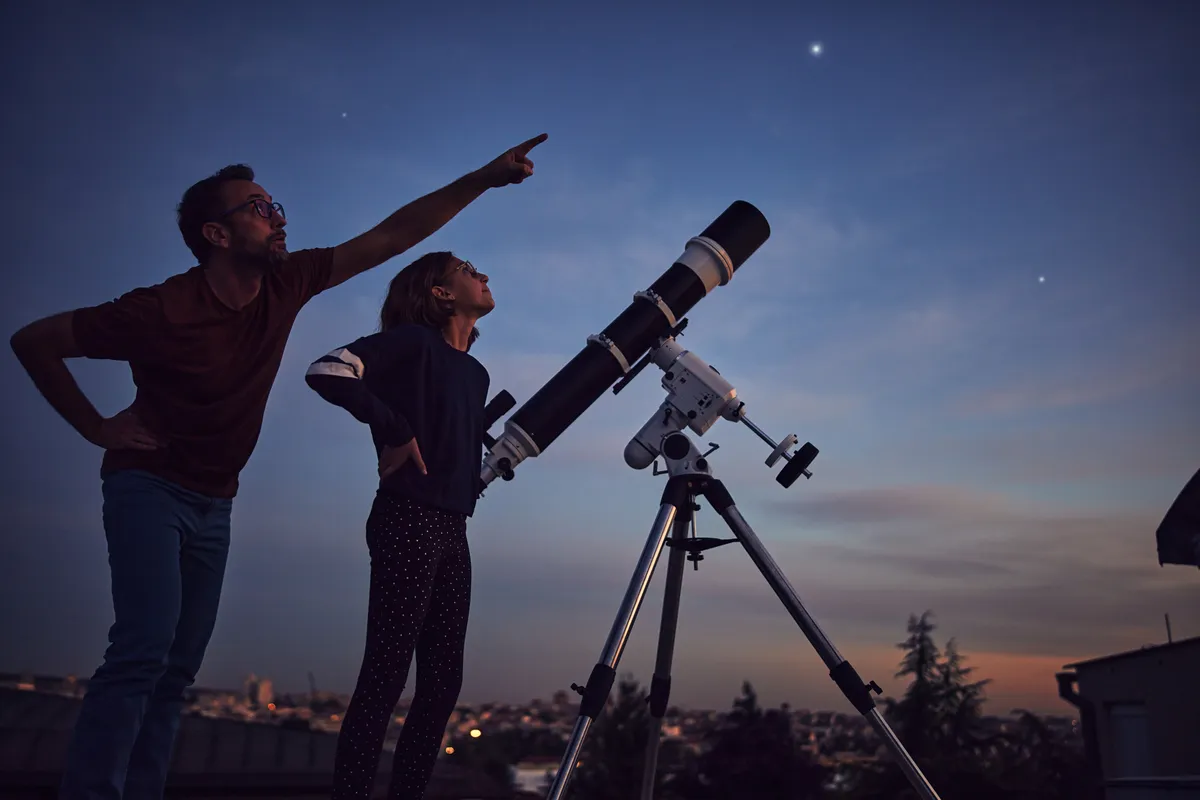
If you see one planet this month, make it Venus, as the Evening Star is now returning to the early evening sky.
In April 2026, Venus slowly enters the evening sky, with its sunset setting time extending from two hours to 2 hours and 45 minutes past the Sun by month's end.
Telescopically, it remains small and gibbous, shifting from 93% to 88% illumination and 10 to 11 arcseconds in size.
For regular stargazing advice delivered directly to your inbox, sign up to receive the BBC Sky at Night Magazine e-newsletter
Key Venus events include:
- 18–19 April: Venus (mag. –3.8) joins a thin crescent Moon near the Pleiades.
- 23 April: Venus sits 3.6° south of the Pleiades and 0.8° from Uranus.
- Late April: Venus passes north of the Hyades, visible low in twilight.
While the spring ecliptic offers high elevation for this small phase, the timing is poor.
By August, when Venus reaches its larger crescent phase, the ecliptic's shallow angle will keep the planet low on the horizon.
Below we'll take a look at what each of the planets is doing in April 2026.

Mercury
Mercury is currently a morning planet, but poor positioning means that it won’t be seen this month.
Venus
- Best time to see: 30 April, 1 hour after sunset
- Altitude: 13°
- Location: Taurus
- Direction: West-northwest
- Features: Phase, subtle atmospheric markings
- Recommended equipment: 100mm or larger
For more advice, read our guide to observing Venus in April 2026.
Mars
Mars is another morning planet with poor positioning and consequently is unlikely to be seen this month.
Jupiter
- Best time to see: 1 April, 21:45 BST (20:45 UT)
- Altitude: 52º
- Location: Gemini
- Direction: Southwest
After a magnificent observing appearance for the UK, Jupiter’s position begins to slip this month. On 1 April, it can be seen as true darkness falls at an altitude of 52° above the southwest horizon.
Coming up to midnight on 22 April, a 37%-lit waxing crescent Moon can be seen 2.7° to the north of mag. –1.9 Jupiter. This pairing, visible at an altitude around 20° above the western horizon, should be a lovely sight and a great target for photography.
Jupiter is currently located in Gemini and throughout April appears to move closer to Wasat (Delta (δ) Geminorum). By the end of the month, Jupiter will be little more than 0.5° from this mag. +3.5 star.
Through a telescope, there’s always something interesting going on in the Jovian system. The planet itself presents a decent-sized oblate disc.
That shape is the result of this enormous gas planet’s rapid spin – it rotates once on its axis in just under 10 hours. Jupiter’s disc is crossed by dark belts and it’s often possible to see intricate detail when the atmospheric conditions allow.
Viewing the famous Great Red Spot requires a bit of planning, as well as luck with the weather. Freeware apps such as WinJUPOS (www.jupos.org/gh/download.htm) allow you to predict when the feature will be visible.
Saturn
Saturn is a morning planet, part of the four-planet morning ‘club’ – along with Mercury, Mars and Neptune – that are badly placed for observing this month. Unfortunately, this means Saturn is unlikely to be seen in April. The planet moves from Pisces into Cetus on 9 April.
Uranus
- Best time to see: 1 April, 21:45 BST (20:45 UT)
- Altitude: 20º
- Location: Taurus
- Direction: West
The observing window for Uranus closes this month as it moves into the expanding spring twilight. You should still be able to observe it on 1 April, the planet sitting 20° above the western horizon at 21:45 BST (20:45 UT) that evening.
At this time, the sky will be fully dark. Three weeks later, on 23 April at around 22:30 BST (21:30 UT), mag. –3.8 Venus sits 46 arcseconds north of mag. +5.8 Uranus, but they can only be seen together when they are at low altitude. By the end of the month, it’s not possible to see Uranus under truly
dark conditions.
Neptune
Neptune is another morning planet. It’s currently close to Saturn, but its dimmer appearance means it’s more sensitive to background lighting. As a result, it’s unlikely to be seen this month.
Share your planet adventures and images with us by emailing contactus@skyatnightmagazine.com