In terms of observing the planets in March 2026, Jupiter is still king at the moment.
Jupiter is currently a dominant fixture in the early evening sky, positioned high within the constellation of Gemini.
On 1 March, the planet reaches a peak altitude of 60° when due south under the cover of true darkness.
Although it remains a brilliant target, 11 March marks the final day Jupiter achieves this high southern position before expanding spring twilight intervenes.
For weekly stargazing advice delivered straight to your email inbox, sign up to receive the BBC Sky at Night Magazine e-newsletter.

By the end of the month, the planet will sit at a still-impressive 52° altitude above the southwest horizon as darkness falls.
Shining brightly between magnitude –2.3 and –2.1, the planet is nearly impossible to miss with the naked eye in March.
Observers using telescopes can capitalize on this high altitude to view fine surface details through more stable, less turbulent air.
Keep an eye out on 26 March 2026, when a 61%-lit waxing gibbous Moon sits sit just 5.2 northeast of the gas giant.

Mercury
Mercury starts the month as a dim evening planet approaching the Sun. Inferior conjunction occurs on 7 March, but Mercury’s re-emergence into the morning sky doesn’t place it in a good position for viewing.
Venus
- Best time to see: 31 March, from 30 minutes after sunset
- Altitude: 12º
- Location: Aries
- Direction: West
Venus is an improving evening planet. On 1 March, it sets 70 minutes after sunset. On this date, it shines at mag. –3.8 and is located 5.4° southeast of mag. +2.4 Mercury. However, evening twilight will make Mercury hard to see.
Mag. +0.7 Saturn is just 7.7° east-northeast of Venus on 1 March, with Neptune nearby too. You may pick up Saturn, but, at mag. +8.0, Neptune will be invisible.
Venus moves in on Saturn and Neptune, passing close by on the evening of 7 March, located just 1.3° from Saturn on this date and 0.9° away on the evening of 8 March.
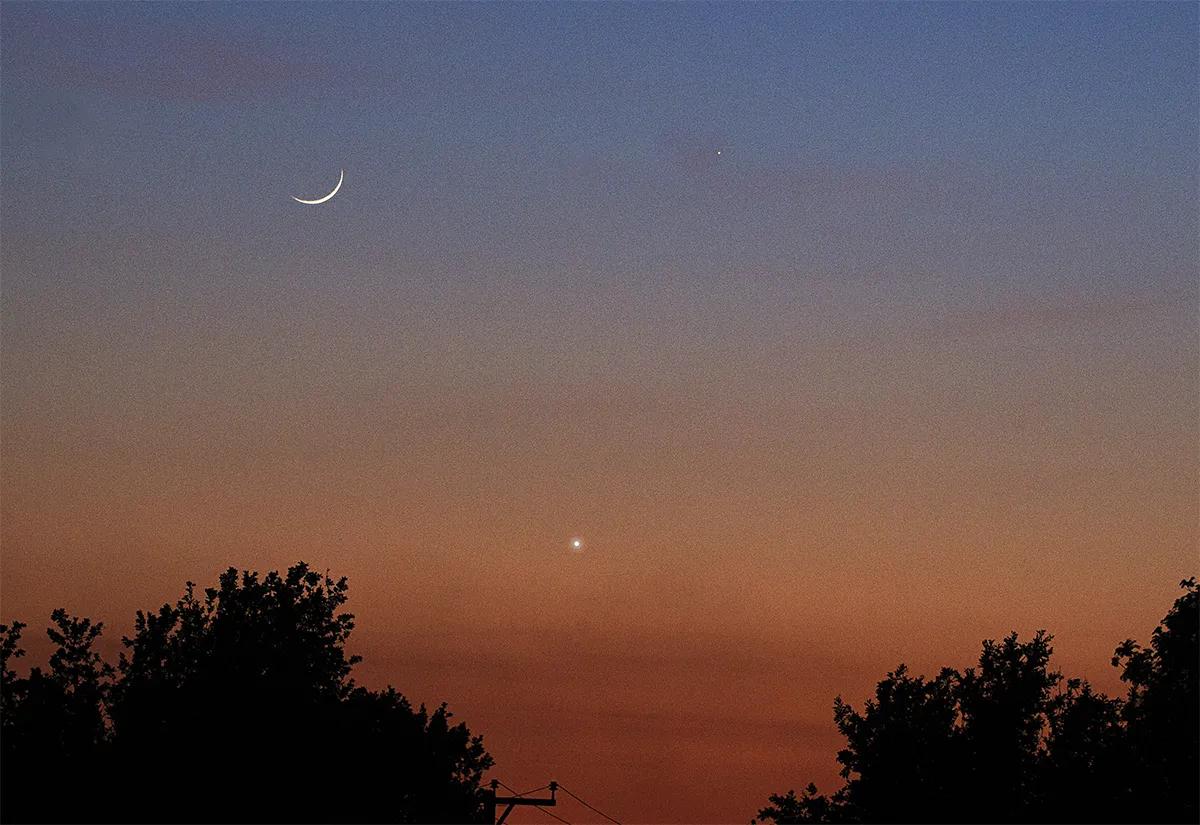
On 20 March at around 19:00 UT, Venus appears 6° south of a very thin 3%-lit waxing crescent Moon – a beautiful sight, if you can locate the pair. By the end of the month, Venus will have separated itself sufficiently from the Sun to set almost two hours after sunset.
Mars
Mars is currently a morning planet, but too close to the Sun to be seen.
Jupiter
- Best time to see: 1 March, 20:40 UT
- Altitude: 60°
- Location: Gemini
- Direction: South
- Features: Complex atmosphere, moons
- Recommended equipment: 100mm or larger
Saturn
- Best time to see: 7 and 8 March, from 30 minutes after sunset
- Altitude: 6º (low)
- Location: Pisces
- Direction: West
Mag. +0.7 Saturn’s observation window is closing fast as it moves ever closer to the Sun in the evening sky. Its salvation will be mag. –3.8 Venus, which points the way to Saturn on the evenings of 7 and 8 March, Venus being just 0.9° from Saturn on the evening of the 8th.
Saturn reaches solar conjunction on 25 March, when the planet is behind the Sun as seen from Earth, and remains too close to the Sun to be seen in the morning sky after that.
Uranus
- Best time to see: 1 March, 07:40 UT
- Altitude: 46º
- Location: Taurus
- Direction: Southwest
Uranus is in a decent position at the start of March, but this rapidly deteriorates as it moves closer to the position of the Sun throughout the month to meet the rapidly expanding evening twilight.
On 1 March, the mag. +5.7 planet can be seen 46° above the southwest horizon as true darkness falls. Currently, Uranus is located 5° south of the Pleiades open cluster.
On the evening of 20 March, Uranus makes a perfect, tiny triangle with the stars mag. +6.1 14 Tau and mag. +5.7 13 Tau. On 26 March, it sits 5 arcminutes south of 14 Tau.
Neptune
Planet Neptune is currently too close to the Sun to be seen. It reaches solar conjunction, when the planet is behind the Sun from Earth’s perspective, on 22 March.
Share your planet observations and images with us by emailing contactus@skyatnightmagazine.com