
Did you see the 'Blood Moon' total lunar eclipse of March 3, 2026?
The lunar eclipse was visible in North America, East Asia, Australia and New Zealand, and in those regions observers got to watch as Earth's shadow was cast on the Moon.
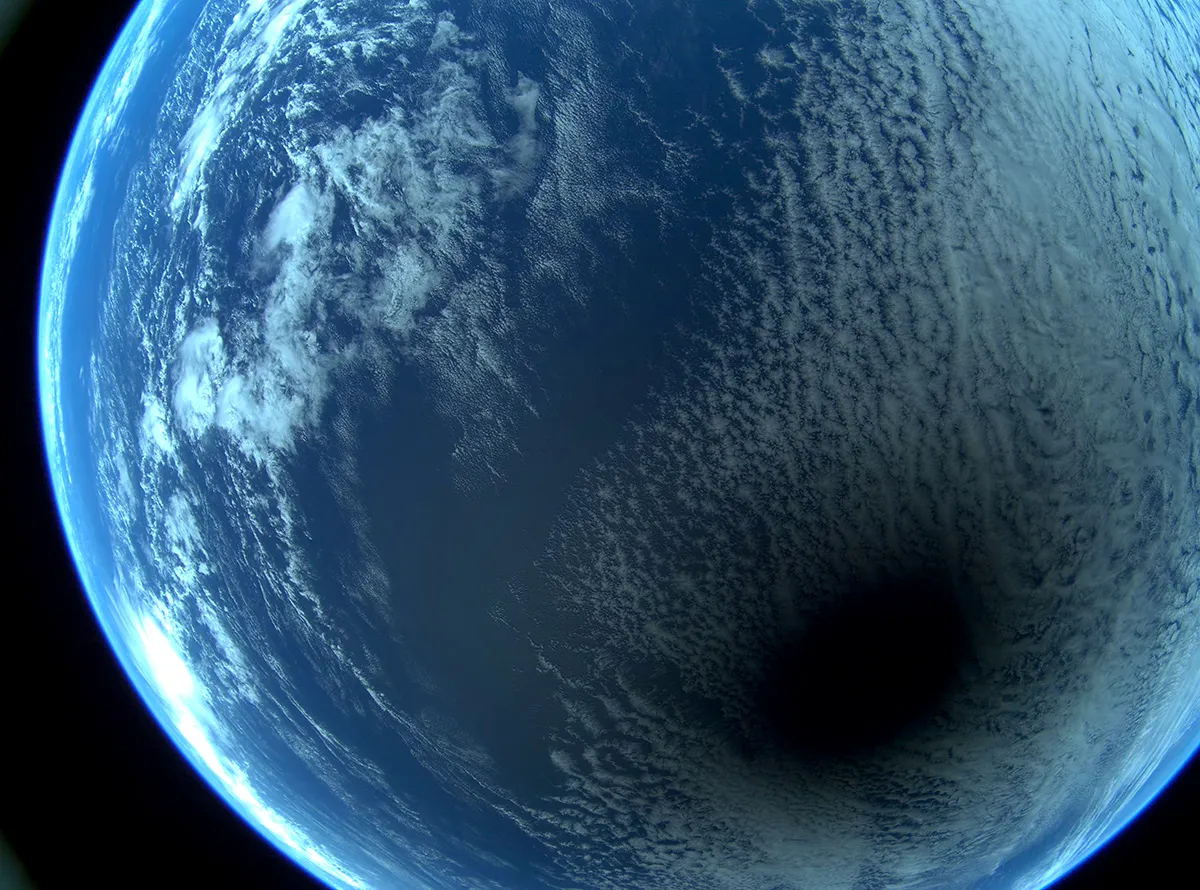
But what effect did the lunar eclipse have on Earth itself, and what would it have looked like see Earth from space during the Blood Moon?
New satellite imagery released by NASA reveals how the dimming of the Moon threw shadow on Earth itself.
More Earth from space
Why we get Blood Moons
A total lunar eclipse – a 'Blood Moon' – occurs when Earth passes between the Sun and the Moon.
This causes Earth's shadow to appear on the Moon, as our planet blocks out sunlight on its way to the lunar surface.
Not all of the sunlight is blocked, however. Some sunlight passes through Earth's thick atmosphere, is bent and refracted and throws a rusty red colour onto the Moon.
You can find out more about this in our primer on lunar eclipses.
The Blood Moon's effect on Earth

NASA has released images that show the effect of the lunar eclipse on Earth.
If you've ever been out in a rural location away from light pollution during a full Moon, you'll be aware of just how bright the glare from the Moon can be.
This lunar glare is sunlight reflecting off the surface of the Moon and hitting Earth.
During a lunar eclipse, as Earth passes between the Sun and Moon, that lunar glare is dimmed, thereby reducing the amount of reflected sunlight that makes it to Earth.
Changes in the amount of moonlight reflected to Earth during the March 3, 2026 lunar eclipse can be seen in this composite image.
It's made up of observations by the VIIRS (Visible Infrared Imaging Radiometer Suite) on the NOAA-21 satellite, which orbits Earth's poles and gathers information on climate change.
The satellite collected images of the Arctic every 100 minutes, showing how Earth's brightness dimmed over time during the lunar eclipse.
Totality – the peak moment when the whole of the Moon is basked in Earth's shadow – occurred at 11:33 UTC on March 3, 2026, and in the VIIRS image, we can see that this was indeed when Earth was at its darkest during the eclipse.

"The VIIRS day-night band detects nighttime light in a range of wavelengths from green to near-infrared and uses filtering techniques to observe signals such as city lights, reflected moonlight and auroras," NASA says.
The darkest moment was at 11:20 UTC, 15 minutes after the total phase had begun.
The bright 'W' shape formation in the image is the aurora borealis, while small dots of artificial light can be seen coming from settlements in the Yukon and eastern Alaska.
The brightest sections on the right and left were captured before and after the eclipse, respectively, revealing how light from the full Moon brightens Earth's surface.
If you missed the event, check out our top images of the March 2026 blood Moon.
And if you want to see the next total lunar eclipse, you'll have a bit of a wait. It occurs on December 31, 2028 and is visible over Europe, Africa, Asia, Australia and the Pacific.

