
There's a blood Moon total lunar eclipse visible next week on March 3, 2026, and viewers in North America will be among the best-placed to see it.
This lunar eclipse will be visible from North America, the Pacific, Australia and East Asia, but won't be visible in Europe or Africa.
Read on for our full guide to this total lunar eclipse, why the Moon will turn 'blood red' and how to get ready for it.
More on the Moon

Why lunar eclipses happen
A total lunar eclipse is one of the most startling sights in nature, and occurs because of the clockwork motions of Earth and the Moon as our planet orbits the Sun.
The Moon orbits Earth, and Earth in turn orbits the Sun, which means there's a range of Sun-Earth-Moon alignments that occur throughout the course of a month.
Lunar eclipses happen when the Moon is on the opposite side of the Sun to Earth. When you witness a lunar eclipse, you're seeing Earth's shadow cast onto the surface of the Moon.
If you know your lunar phases, you'll know that, when the Moon is on the opposite side of the Sun, this results in a full Moon.
That's because, during this alignment, sunlight shines directly onto the Earth-facing side of the Moon, illuminating the entire lunar disc from our perspective.
Full Moons happen about once every month, so why don't we get a lunar eclipse once a month?
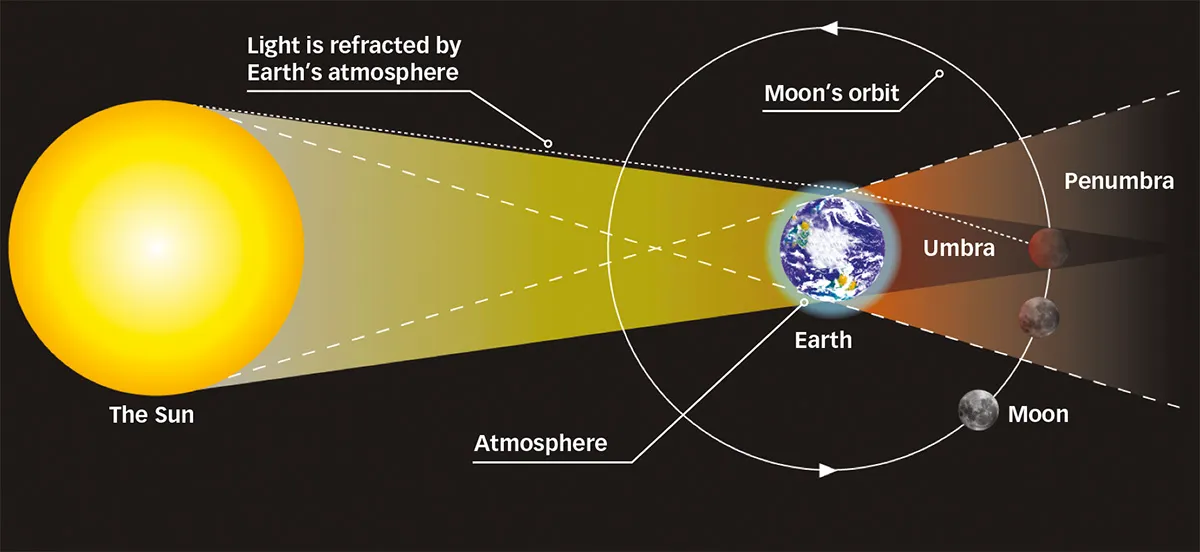
It's because the Sun, Earth and the Moon have to be lined up exactly for our planet's shadow to be cast on the Moon, and for a lunar eclipse to occur.
Sometimes Earth's shadow is above the Moon, sometimes it's below. But sometimes Earth's shadow is cast directly on to the Moon, and we see a lunar eclipse.
When Earth's shadow hits just a portion of the Moon, we see a partial lunar eclipse. When Earth's shadow covers the Moon entirely, it's a total lunar eclipse.
This total lunar eclipse occurs during the March 2026 full Moon, which is also known as the Worm Moon, so you'll likely hear it referred to as the 'Blood Worm Moon'.
You may remember that the 2025 Worm Moon was also a lunar eclipse, but while that eclipse was visible in Europe and Africa, this 2026 blood Moon won't be.

Blood Moon explained
A total lunar eclipse is often known as a 'blood Moon' because the Moon turns a dark, rusty red colour.
This is a result of sunlight passing through Earth's atmosphere and becoming refracted.
Our planet's atmosphere is filled with gases and particles that act like a filter, scattering blue light (which is why the sky is blue during the day).

Longer wavelengths of light, like reds and oranges, pass through our atmosphere more easily, so these are the wavelengths that hit the Moon, giving a total lunar eclipse a red or orange colour.
The good thing about a lunar eclipse compared to a solar eclipse is that, for a lunar eclipse, no eclipse glasses are required. You can safely observe it with the naked eye.
This also makes it a good event for children, and there are no dangers in observing the Moon during a total lunar eclipse.
March 3, 2026 lunar eclipse timings
On March 3, 2026, the total lunar eclipse will be visible in the evening over eastern Asia and Australia, and throughout the night in the Pacific Ocean, according to NASA.
In North and Central America, observers will see the lunar eclipse in the early morning.
In central Asia and the far west of South America, observers will see a partial lunar eclipse.
The March 3, 2026 lunar eclipse is not visible in Europe or Africa.
Earth's shadow will begin to creep across the Moon, left to right, starting at 09:50 UTC on March 3. That's 04:50 EST
Totality – when the Moon begins to turn 'blood red' – begins at 11:04 UTC (06:04 EST), with 11:33 UTC (06:33 EST) being the best time to see the blood Moon.
From 12:02 UTC (07:02 EST), Earth's shadow begins to leave the surface of the Moon, and the lunar eclipse is coming to an end.
Generally speaking, for observers in the Northern Hemisphere, the lunar eclipse will be visible in the west in the morning, and in the Southern Hemisphere it will be in the east in the evening.
But a good stargazing app will enable you to pinpoint the Moon from your location ahead of time, so you can work out the best spot to view it from.

Watch the March 3, 2026 lunar eclipse online
Given how visible this lunar eclipse will be from North America, many institutions and websites are offering live-stream views of the event.
If you're based in Europe or Africa, this is a great way of making sure you don't miss out on the March 2026 lunar eclipse.
Here are some of the best live-streams we found.
If you observe or photograph the March 3, 2026 total lunar eclipse, share your experiences and images with us by emailing contactus@skyatnightmagazine.com

