
The world's largest digital camera has captured the fastest-spinning large asteroid ever discovered.
The camera in question is that of the Vera C. Rubin Observatory, a brand new ground-based telescope located on the Cerro Pachón mountain in northern Chile.
And the asteroid is over half a kilometre wide, giving astronomers valuable insight into the science of space rocks and the formation of our Solar System.

Rubin's asteroid bonanza
The Vera C. Rubin Observatory's first images were released in June 2025 and provide a tantalising glimpse of what the facility could discover over the coming decade.
During its initial 'first look' event, scientists announced that Rubin had discovered thousands of asteroids in our Solar System, nearly 2,000 of which had never been seen before.
Among them were 19 asteroids zooming through our Solar System and spinning at breakneck speeds.
One of them is the fastest-spinning asteroid larger than 500 metres ever found.
A key to our Solar System's formation
The asteroids we find in our Solar System are the leftover ingredients out of which the Solar System formed.
These primordial space rocks provide scientists with a means to explore what the Solar System is made up of, and what its early conditions must have been like.
Asteroids orbit our Sun, and they do so while spinning at a range of speeds.
The speed of their spin can tell scientists both about what they're made of and what they've been doing over the 4.5 billion years since the Solar System formed.
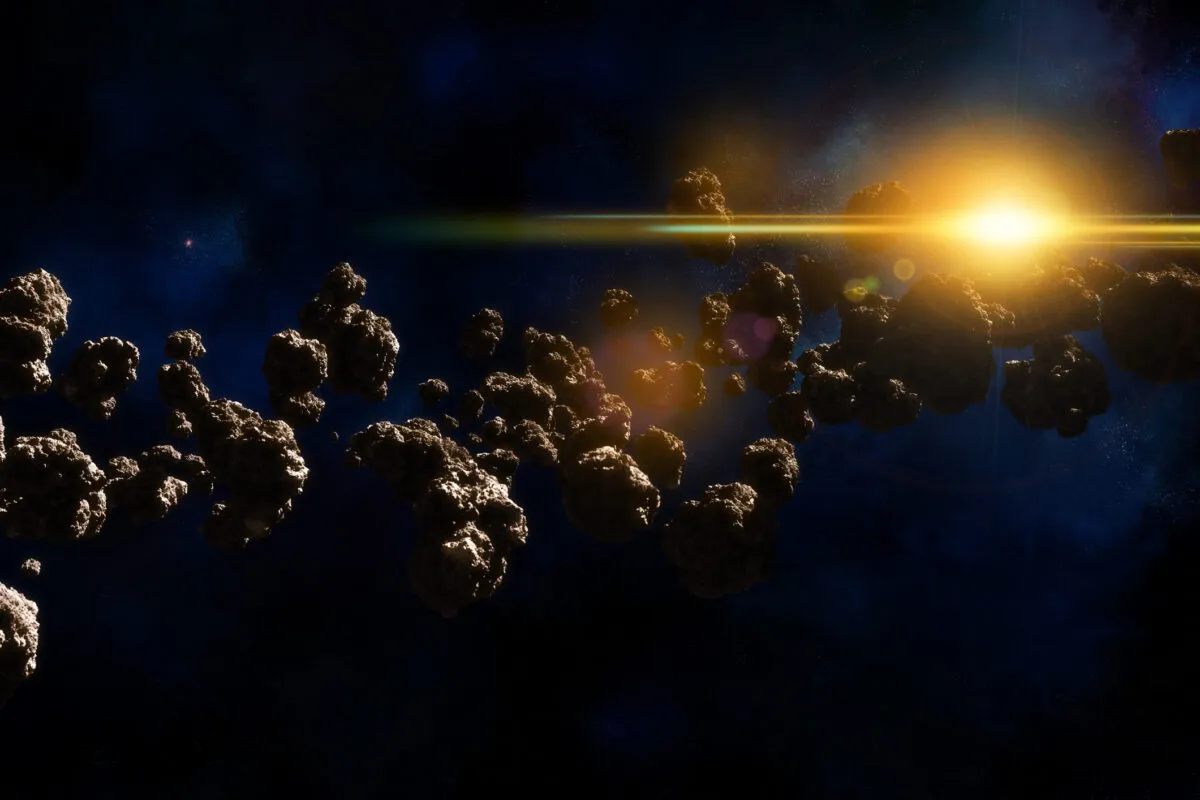
For example, a particularly fast-spinning asteroid may be the result of a past collision with another asteroid, and may therefore be just a fragment of a larger piece.
As well as this, a fast-spinning asteroid must be made of strong stuff, in order to keep itself together while the strong centrifugal force generated by its spin threatens to tear it apart.
Scientists say that for objects in the main asteroid belt, the limit to how fast an asteroid can spin before being ripped apart is once every 2.2 hours.
Any faster, they say, and the asteroid must be very strong to remain intact. As a result, spin rate can reveal a lot about the asteroid's internal structure.

Discovering the fastest asteroid
The study that found this fast-spinning asteroid was led by Sarah Greenstreet, lead of Rubin Observatory’s Solar System Science Collaboration’s Near-Earth Objects and Interstellar Objects working group.
It used data from Rubin's LSST Camera, which is the largest digital camera on Earth.
LSST is the Legacy Survey of Space and Time, Rubin's project to scan the Southern Hemisphere night sky for 10 years to create a time-lapse record of the Universe.
This asteroid study used data gathered over about 10 hours over seven nights in April and May 2025.

It presents 76 asteroids and their rotation periods, including 16 asteroids that spin so fast, they complete one rotation during periods between roughly 13 minutes and 2.2 hours.
Three of them complete a full spin in less than five minutes.
All 19 are longer than the length of an American football field. The fastest-spinning main-belt asteroid, named 2025 MN45, is 710 meters (0.4 miles) wide and completes a rotation every 1.88 minutes.
It's the fastest-spinning asteroid with a diameter over 500 meters that astronomers have found.
"Clearly, this asteroid must be made of material that has very high strength in order to keep it in one piece as it spins so rapidly," says Greenstreet.
"We calculate that it would need a cohesive strength similar to that of solid rock.
"This is somewhat surprising since most asteroids are believed to be what we call ‘rubble pile’ asteroids, which means they are made of many, many small pieces of rock and debris that coalesced under gravity during Solar System formation or subsequent collisions."

A new era for asteroid hunting?
Most of the known fast-rotating asteroids orbit the Sun just beyond Earth, and these are called near-Earth objects (NEOs).
There are fewer known fast-rotating asteroids in the main asteroid belt, because they're further away and harder to see.
However, within this group of newly-discovered fast-rotating asteroids, all but one are in the main asteroid, and some are even just beyond the belt's outer edge.
That could mean Rubin is about to give scientists an insight into asteroids in our Solar System like never before.
"As this study demonstrates, even in early commissioning, Rubin is successfully allowing us to study a population of relatively small, very-rapidly-rotating main-belt asteroids that hadn’t been reachable before," says Greenstreet.

