- A 74%-lit waning gibbous Moon crosses the Beehive Cluster on 28 November, occulting its southern stars.
- Best time to see: 28 November from 21:40 UT
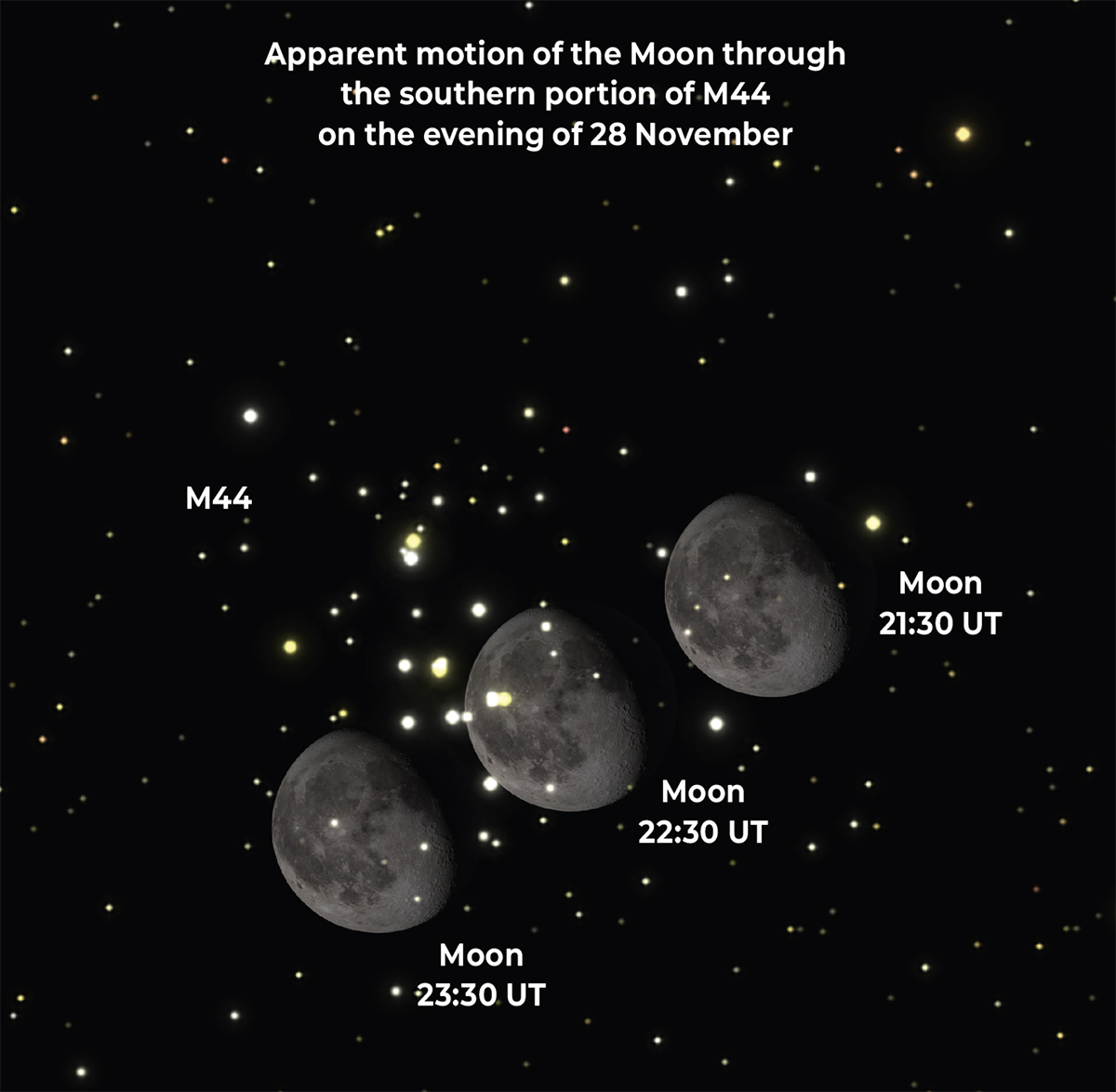
The Moon’s run of close encounters with the Beehive Cluster, M44, continues in November 2026, when it occults several of the cluster’s southern stars.
The event can be seen on the night of 28 November from around 21:40 UT. This time around, the Moon will be showing a 74%-lit waning gibbous phase.
This is certainly bright enough to challenge the cluster stars, although binoculars should still reveal them near the Moon’s bright limb at this time.
How to see it
Once you’ve found the Moon around 21:40 UT, its apparent motion against the cluster is impressive, reaching the brightest stars at the centre of the cluster just after 22:00 UT.
It takes about 80 minutes to make the passage past the brighter stars.
This event will give rise to a number of occultations of stars, where cluster stars disappear behind the Moon’s bright limb, reappearing some time later.
A couple of the brighter members may well show grazing occultations, where the star appears to scrape along the rough edge of the Moon, hiding as it passes behind raised features and reappearing when low relief features pass in front of it.
Whether you get to see such events depends on your location within the UK.
If you observe or photograph the lunar occultation, let us know by emailing contactus@skyatnightmagazine.com