
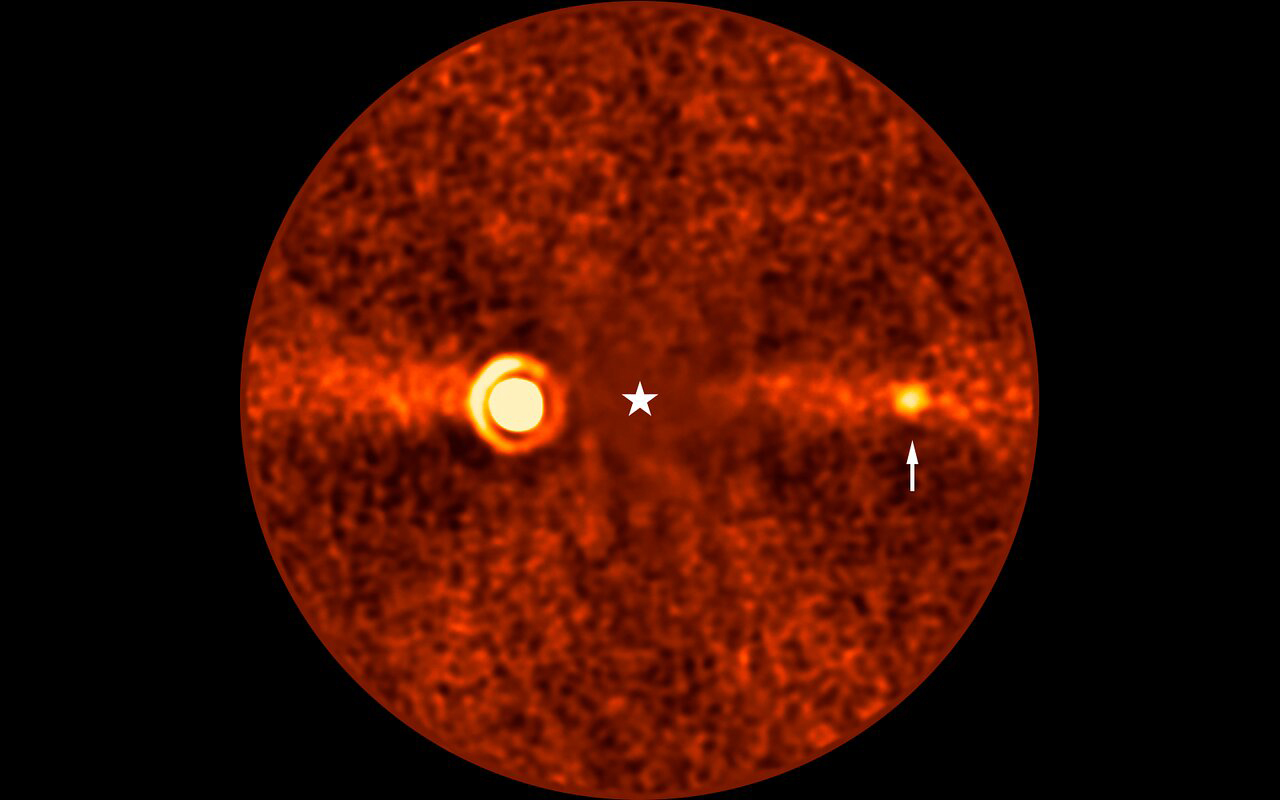
The image you can see here is of Beta Pictoris d, a newly-discovered planet orbiting the distant star Beta Pictoris.
It's the faintest planet beyond our Solar System – an 'exoplanet' – ever imaged from Earth.
Beta Pictoris d is even 100 times fainter than Beta Pictoris b, which was the first planet found orbiting the star and also one of the lighest exoplanets to ever be photographed from the ground.
What's more, after spotting the planet using the European Southern Observatory’s Very Large Telescope in Chile, the science team realised Beta Pictoris d had been hiding in archive observations spanning over a decade.
More exoplanet science
'Did you see it?'
"This was a serendipitous discovery," says Ben Sutlieff, co-lead of the study and astronomer at the University of Edinburgh in the UK.
"We initially wanted to look more at a known planet in the system, Beta Pictoris b, to see how it changed over time."
But when the team began to look closer at their image, they found another object, distinct from Beta Pictoris b.
"'There’s something else there, did you see it?'", recalls Markus Bonse, ESO astronomer in Germany and co-lead of the study.
The team then looked through the archive of past observations made with ESO telescopes and found the new planet, Beta Pictoris d, appeared in multiple images dating back as far as 11 years ago.
That includes one image in which Beta Pictoris d was very faint, but still just visible against the glare of its larger neighbour.
"Planet d, it seems, has been playing a game of hide-and-seek with us for over a decade and only now can we say 'found you!'" says Jayne Birkby, co-author of the study and astronomer at the University of Oxford in the UK.
Beta Pictoris d revealed
Beta Pictoris d is a gas giant like Jupiter or Saturn in our own Solar System and similar to the two other known planets in the Beta Pictoris system.
But Beta Pictoris d orbits the star much further away than planets b and c.
And while the planets b and c are about 10 times the mass of Jupiter, Beta Pictoris d is about 2.4 times the mass of Jupiter.
That makes it one of the lightest exoplanets ever photographed from the ground.
The planet is also relatively cold and therefore extremely faint, relative to the brightness of the host star.
How they found it
Directly photographing an exoplanet is hard because of how small and faint they are compared to their host star.
“The new planet is 100 times fainter than Beta Pictoris b, the famous planet in the same system, making it the faintest exoplanet ever imaged directly from Earth,” says Bonse.
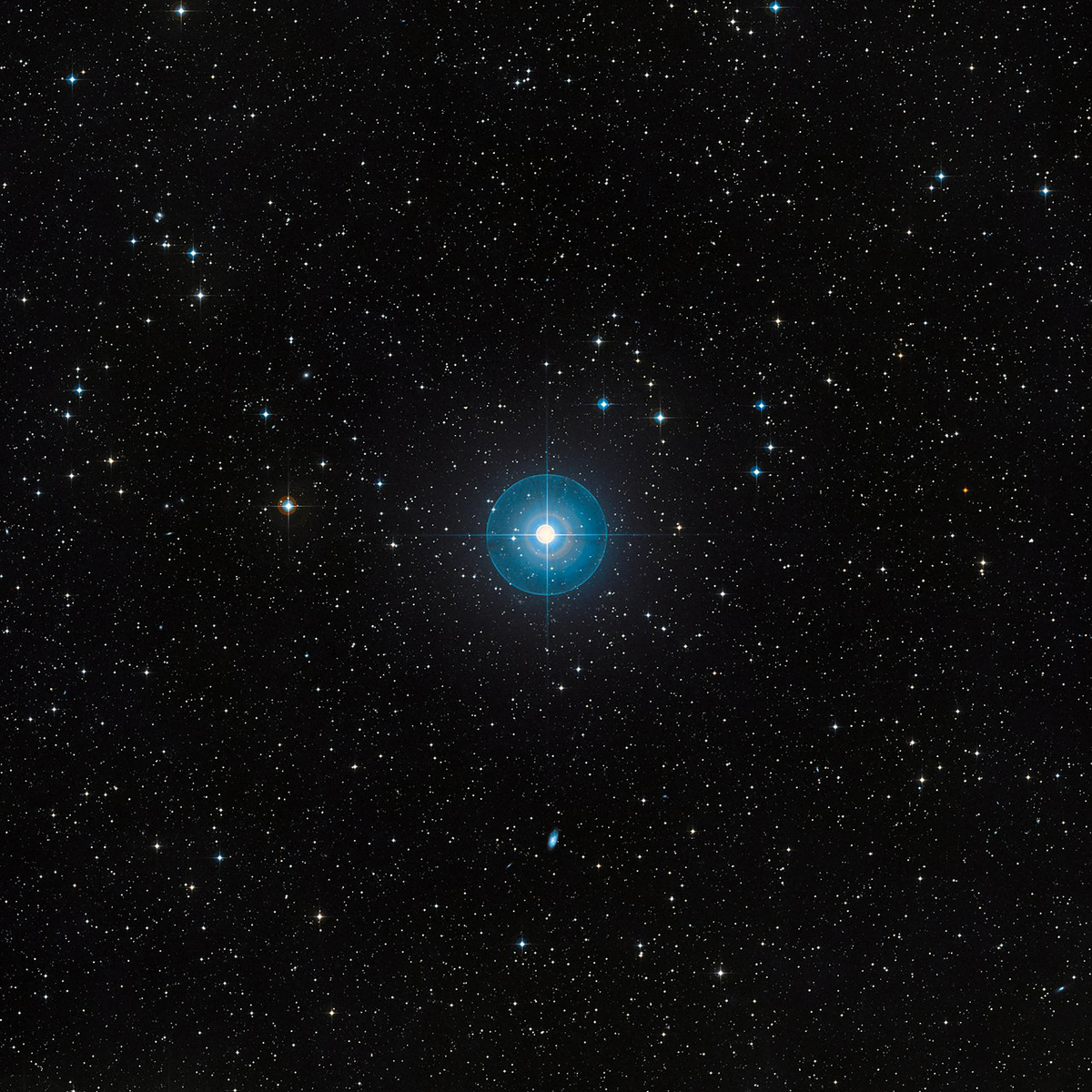
This is the first clear detection of Beta Pictoris d, 63 lightyears away from Earth, and was made with the ERIS instrument on the Very Large Telescope.
An independent team led by Aidan Gibbs at the University of California, US, also discovered the same planet using the James Webb Space Telescope.
Archive data from ESO and Webb was able to confirm the observations.
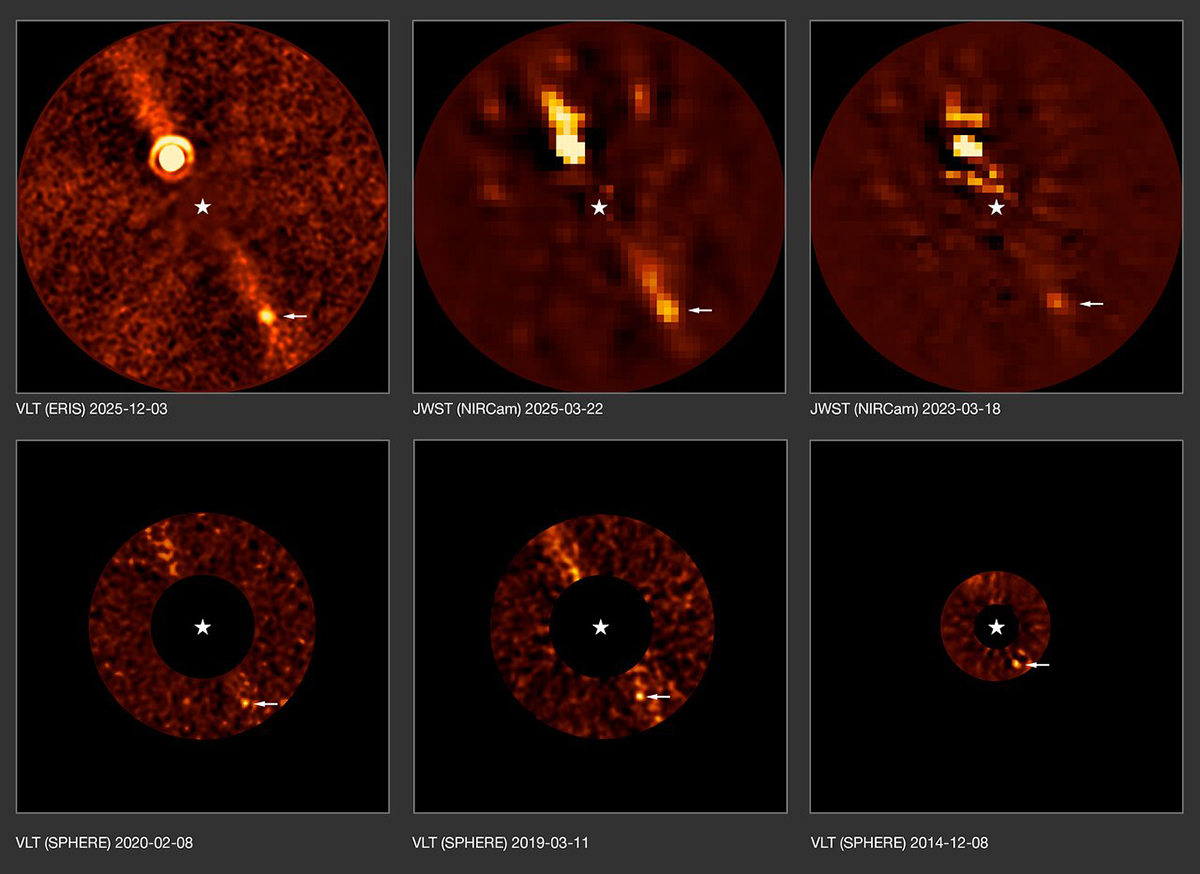
"To our joy, out it popped in previous SPHERE observations," says Birkby, in reference to another VLT instrument that was previously used to observe the Beta Pictoris system.
The planet also shows up in archive observations by the NIRCam instrument on the James Webb Space Telescope.
"It turns out it was hiding in the data all along!" says Birkby.
"The detections in the archival SPHERE data are not only very exciting on their own, but also because they suggest a number of treasures are still hidden in the archives of VLT instruments," says co-author Valentin Christiaens, researcher at CEA Paris-Saclay, France.
"Systems with multiple directly imaged exoplanets are the ‘holy grails’ of discoveries, because they can teach us a lot about what different exoplanets are like in the same formation environment," says Sutlieff.
A mystery solved, with more to learn
The team say the presence of Beta Pictoris d also helps clear up a mystery surrounding the star system.
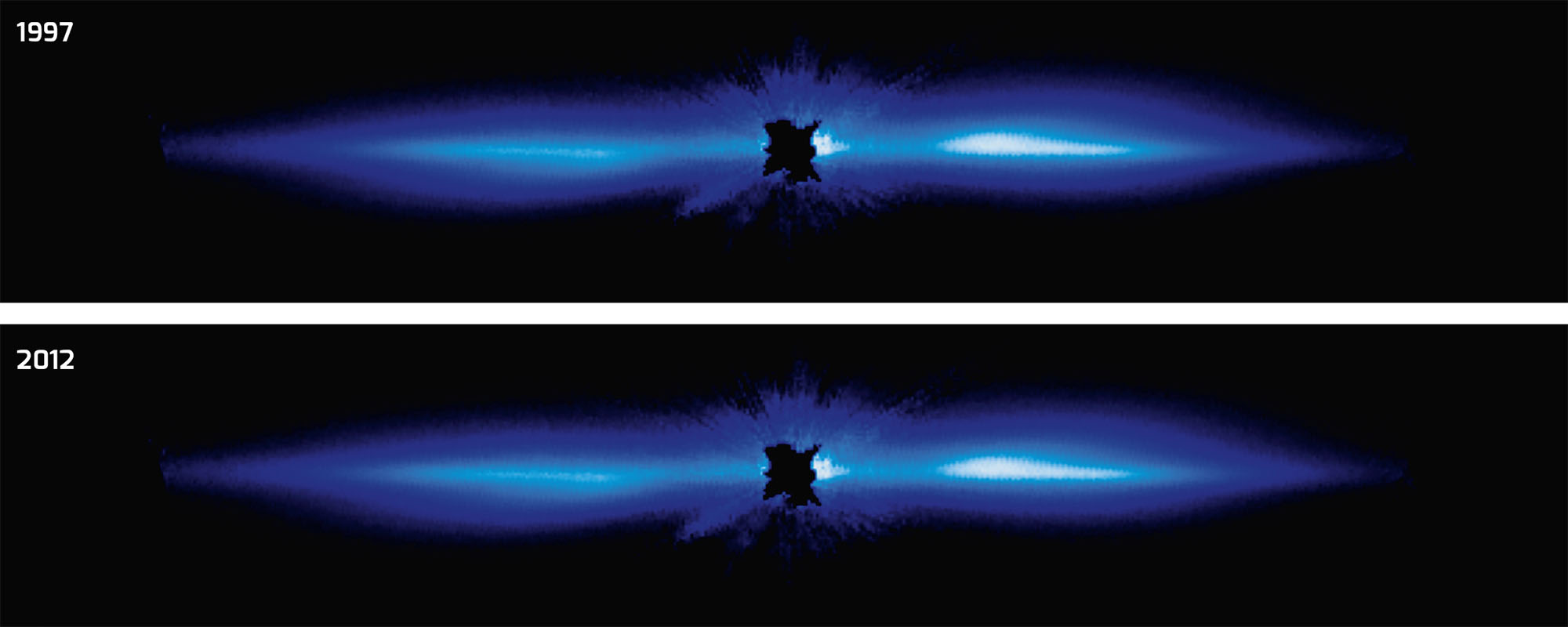
A dusty disc of material surrounding the star and left-over from the star's formation has a strange shape – but this can now be explained by the mass and location of Beta Pictoris d.
The team say the discovery of Beta Pictoris d is a case for further direct imaging of planetary systems where faint planets may have been hiding in plain sight, such as with the Extremely Large Telescope, which is currently being constructed in Chile.
“Planets seem to have friends,” says Beth Biller, co-author of the paper and astronomer at the University of Edinburgh.
"Many of the famous directly imaged exoplanet systems seem to have multiple giant planets in the same system, and likely there are even more lower mass planets hiding in these systems that might be revealed with instruments on the ELT."

