
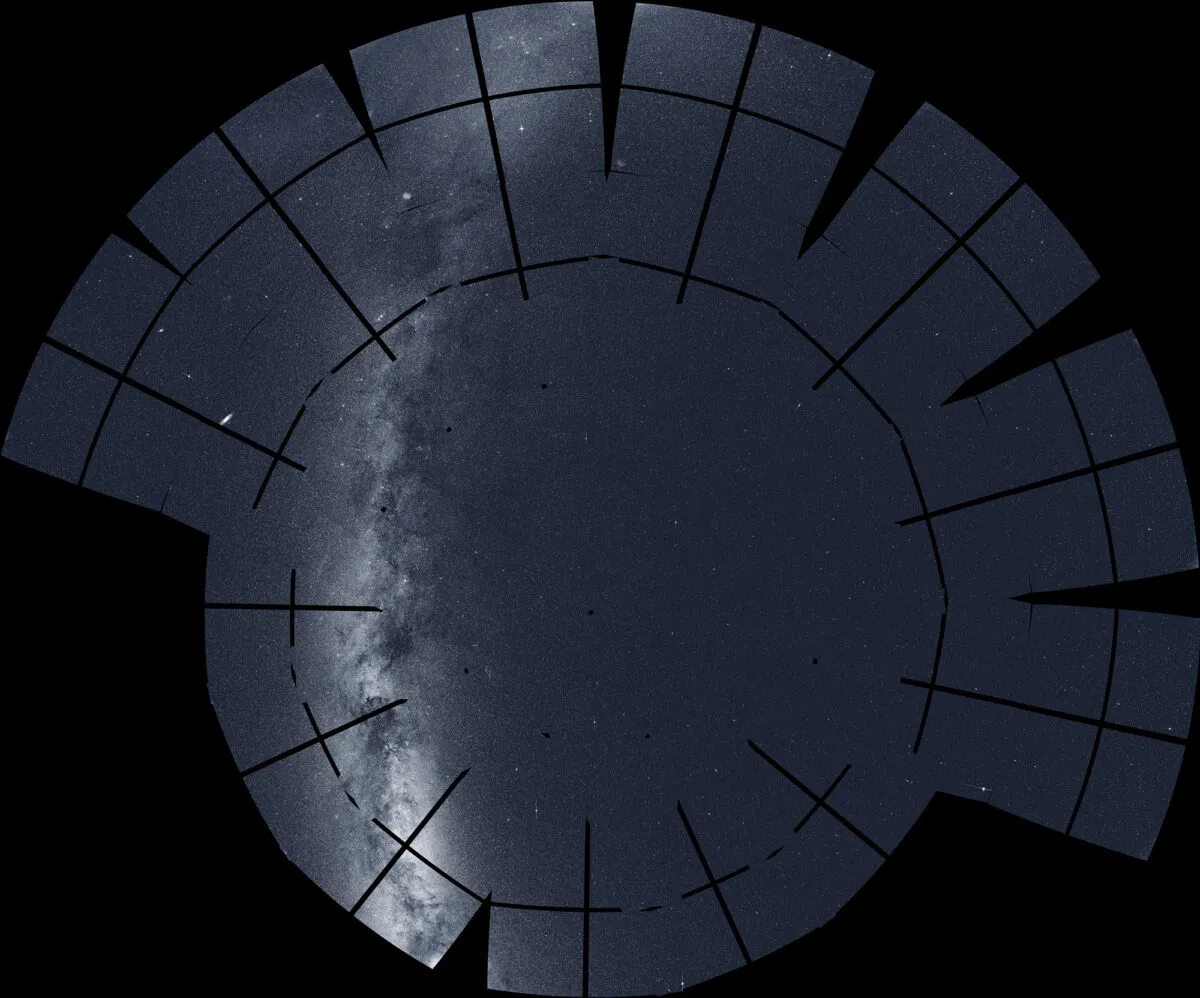
This image shows 6,000 planets beyond our Solar System as scattered dots stretching across the plane of the Milky Way galaxy.
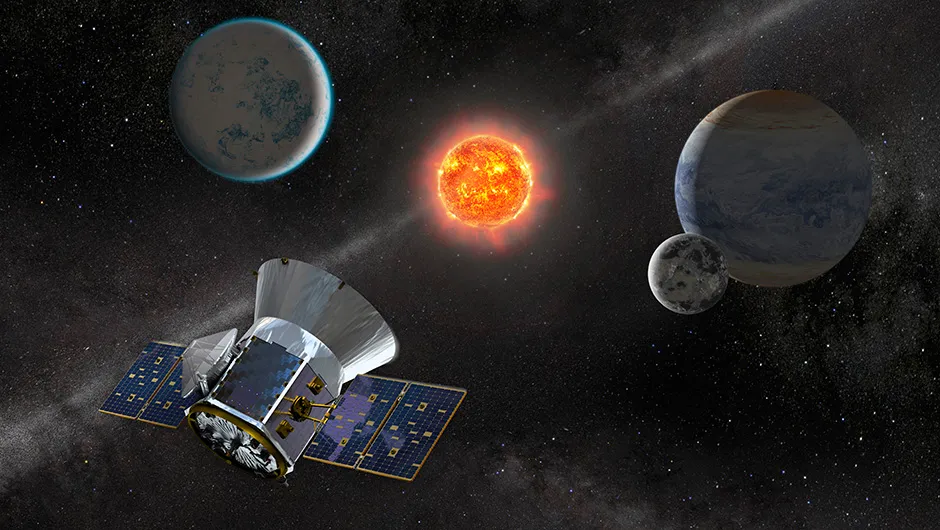
It comes courtesy of NASA’s TESS (Transiting Exoplanet Survey Satellite) spacecraft, which launched in 2018 and has since been scanning the sky looking for distant worlds, known as exoplanets.
Nearly 6,000 coloured dots are seen in the image, revealing the locations of both confirmed exoplanets and 'candidate' exoplanets, i.e. planets still awaiting official confirmation.
More on the TESS mission


TESS and the hunt for alien worlds
While scientists had long expected there must be planets orbiting stars beyond our Sun, the first exoplanets weren't confirmed until the mid 1990s.
Recently, NASA announced that missions like TESS had confirmed over 6,000 exoplanets, and astronomers say that for every star we can see in the sky, there's at least one planet in orbit around it.
"TESS has become a fire hose of exoplanet science," says Rebekah Hounsell, a TESS associate project scientist at the University of Maryland Baltimore County and NASA’s Goddard Space Flight Center.
"It’s helped us find planets of all different sizes, from tiny Mercury-like ones to those larger than Jupiter.
"Some of them are even in the habitable zone, where liquid water might be possible on the surface, an important factor in our search for life beyond Earth."
TESS scans a wide region of the sky for a month at a time using its four cameras.
It looks at stars and measures changes in their brightness that could indicate a planet passing in front of the star, causing a temporary dimming of starlight.

A mosaic of thousands of exoplanets
The image was produced by the TESS team. It's an all-sky mosaic made of 96 regions of the sky – or 'sectors' – observed by TESS between April 2018 and September 2025.
Blue dots in the image show the locations of nearly 700 confirmed exoplanets, and scientists say some of these worlds could be covered in volcanoes, destroyed by their stars or even orbit two stars and therefore have two suns in their skies.
Orange dots represent more than 5,000 candidate exoplanets that are awaiting verification.
The glowing arc in the centre of the image is the plane of our Milky Way galaxy.
Running along the lower edge of the image, just left of centre, is the Large Magellanic Cloud, a satellite galaxy that orbits our own, larger Milky Way galaxy.
"The more we dig into the large TESS dataset, especially using automated algorithms, the more surprises we find," says Allison Youngblood, TESS project scientist at NASA Goddard.
"In addition to planets, TESS has helped us study rivers of young stars, observe dynamic galactic behaviour and monitor asteroids near Earth.
"As TESS fills in more of the night sky, there’s no knowing what it might see next."

