
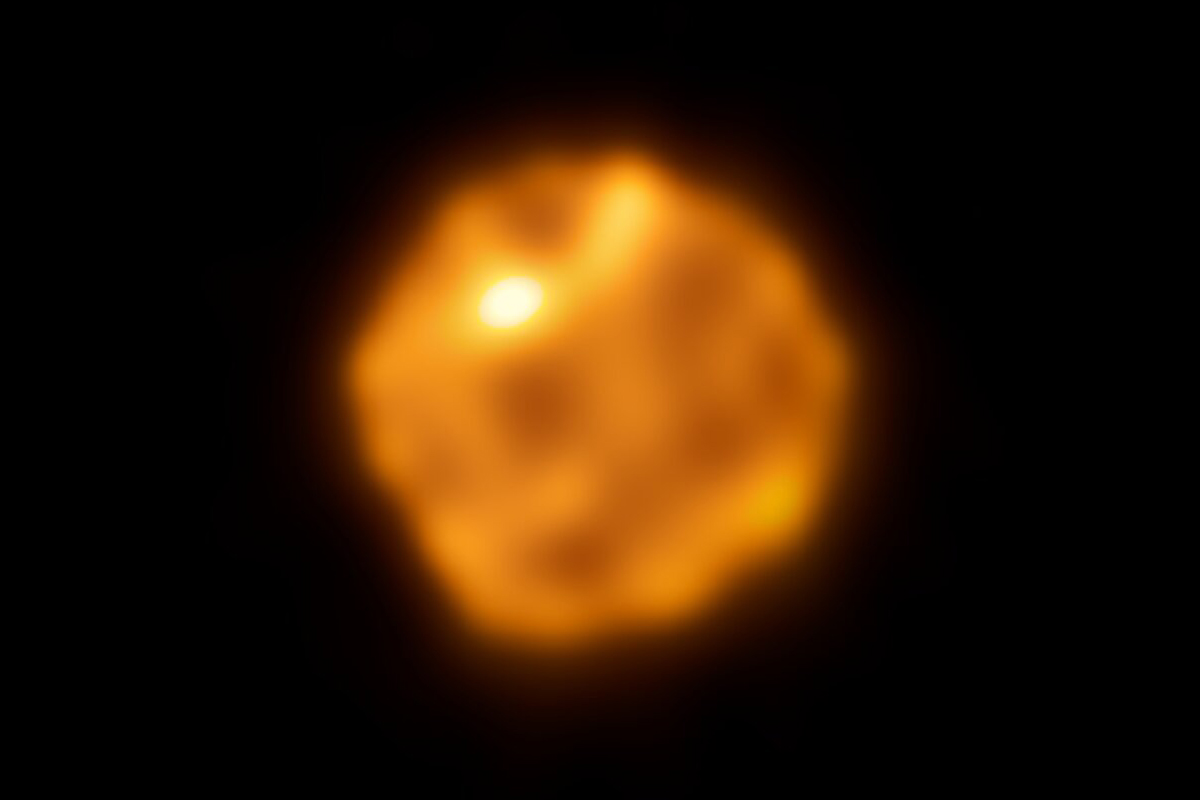
This is a spectacular close-up view of the red giant star Betelgeuse, as seen by one of the most powerful telescopes on Earth.
Betelgeuse is an ageing star that forms one of the shoulders of the constellation Orion the Hunter, and is one of the most famous stars in the night sky.
This image was captured under the dark skies of Chile's Atacama Desert by the Atacama Large Millimeter/submillimeter Array.
More on Betelgeuse

It shows Betelgeuse's uneven surface, bright hotspots and an irregular outline caused by chaotic motions taking place within the star.
But when astronomers looked back on older images of Betelgeuse and compared it with this one, they found something interesting.
A new look at a dying star
Betelgeuse is an ageing star approaching the final stages of its evolution. That means it will eventually explode as a supernova.
"Its eventual fate as a supernova makes it fascinating to know what it actually looks like now," says lead author of the study Bill Dent, an astronomer at ESO.
Betelgeuse is about 600 lightyears from Earth, making it one of the closest red supergiants.
It's 800 times as wide as the Sun. and its colossal size and close distance mean astronomers are able to use observatories like ALMA to get a close-up view and see structures across its atmosphere that would remain hidden in most other stars.
Why Betelgeuse is bumpy
The observations seen here were made in 2023 and highlight the texture of Betelgeuse's atmosphere, which has an average temperature of about 2,020°C (3,670°C).
Two hotter regions can be seen on Betelgeuse in this image, with the brightest hotspot being about 526°C (980°F) hotter than the surrounding regions.
Scientists say these structures could be connected to convective motions inside Betelgeuse.
This is when hot gas rising from within the depths of the star generates shocks as it reaches the outer atmosphere.
That's what produces the bright, uneven features on Betelgeuse seen here.
A surprise find
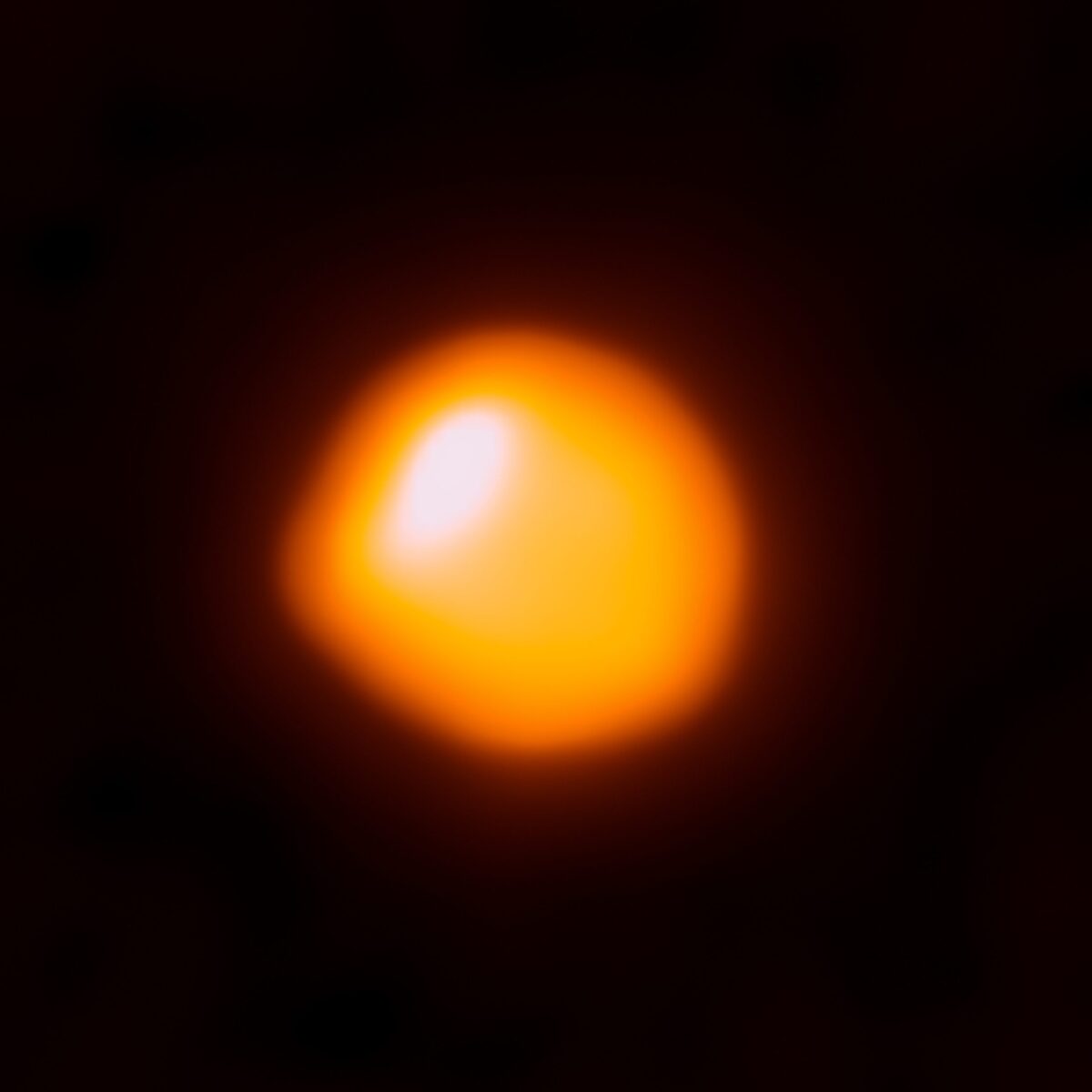
When astronomers compared these 2023 observations with similar ALMA data from 2015, the prominent hotspot in the top left of the star appeared in almost the same location and with a similar intensity.
That means the feature has likely been there for at least seven years which, say astronomers, is much longer than the lifetimes of large convective structures predicted by theoretical models.
ALMA also measured variations of up to about 6% in Betelgeuse's apparent radius, showing it's anything but spherical.
Fainter emission from the star extends several stellar radii into Betelgeuse’s atmosphere.

